
Not All Real Estate Time Is Created Equal
Most people approaching the 750-hour test for Real Estate Professional status fixate on the number. The harder and more consequential question is rarely the total; it is the composition. Which of the things you actually do all year are hours the IRS will accept, and which are time you spent that simply does not move the needle? Two investors can each feel busy with their rentals, log similar amounts of time, and end up in completely different places, because one filled the log with operational work and the other filled it with activities that look like real estate but do not qualify.
This article is the activity catalog. It is not about the 750 figure itself or the fine-print thresholds behind it; it is about sorting the day-to-day tasks of owning and running rentals into two buckets: the work that counts toward your hours, and the work that, however valuable to your wallet, counts for nothing toward REP. Getting this sorting right is what separates a defensible record from a padded one.
The governing idea is simple to state and easy to misapply: an hour counts only if it is a service you personally performed in a real property trade or business in which you materially participate. Strip out any one of those elements and the hour falls out of your count.
Below we walk through the activities that reliably count, the ones that reliably do not, and the genuinely gray areas where the answer depends on the facts. Treat the lists as a working reference rather than a verdict on your specific situation; your tax advisor should confirm how the categories map onto your portfolio.
The Three-Part Test Every Hour Must Pass
Before cataloging individual tasks, it helps to internalize the filter every entry has to clear. An hour qualifies toward your 750 only when all three of the following are true at once. If you keep these in mind, most of the catalog that follows becomes obvious.
- It is a real property trade or business activity. The work must fall within a recognized real property trade or business: development, redevelopment, construction, reconstruction, acquisition, conversion, rental, operation, management, leasing, or brokerage. Time spent outside these categories does not count, no matter how related it feels.
- You personally performed it. The 750-hour test is applied to you as an individual. Hours your property manager, your contractors, or even your unrelated assistant worked are their hours, not yours. On a joint return your spouse's hours support the spouse's own determination, not yours.
- It reflects material participation, not passive ownership. The hours must come from genuine involvement in running the activity, not from clipping coupons on a property someone else operates for you.
A useful gut check: if you stopped doing the task tomorrow, would the property notice? Operational, hands-on work that the business depends on tends to count. Optional study, monitoring an investment from a distance, or signing off on work a manager already handled tends not to.
Activities That Reliably Count
These are the bread-and-butter tasks of actively operating rental real estate. When you perform them yourself and can tie them to a date and a property, they form the backbone of a strong 750-hour record.
- Tenant screening: reviewing applications, running background and credit checks, calling references, and interviewing prospective tenants.
- Marketing and leasing: listing vacancies, fielding inquiries, showing units, negotiating terms, and signing or renewing leases.
- Supervising repairs and maintenance: walking the property, diagnosing issues, scoping the work, getting bids, and overseeing the job on site.
- Contractor and vendor coordination: hiring, scheduling, directing, and reviewing the work of plumbers, electricians, landscapers, and cleaners.
- Rent collection and tenant relations: invoicing, following up on late payments, handling complaints, and managing renewals and move-outs.
- Rental bookkeeping and operations: recording income and expenses, reconciling accounts, paying property bills, and preparing for tax filing.
- Property acquisition and disposition work you actively perform: walkthroughs, due diligence, negotiating purchases or sales, and working closings for properties in your trade or business.
- Travel directly between your rental properties for a documented operational purpose, such as driving from one unit to inspect a repair at another.
Notice the common thread: each item is operational work that the business genuinely requires and that you, personally, carry out. This is also why these hours are so much easier to defend than vaguer claims; each one attaches naturally to a specific property, a specific date, and a specific outcome.
Even within this list, the same task can flip from countable to uncountable depending on who does it. You walking the property to scope a repair counts; your property manager walking it and emailing you a summary does not become your hour just because you read the email.
Activities That Do Not Count
These activities feel like real estate work, and several of them are legitimately useful, but they fall outside the count for one of three reasons: they are investor-level rather than operational, they are someone else's hours, or they are not in a real property trade or business at all.
Investor-level and study time
- Investor-level financial review: reading statements, tracking portfolio returns, and monitoring your investment from a distance
- Pure education and self-improvement: courses, books, podcasts, and webinars not tied to an existing activity
- General market research and deal-hunting that never becomes part of an actual trade or business you operate
- Personal financial planning, estate planning, and meetings about your overall wealth strategy
Other people's hours and non-real-estate time
- Work physically performed by your contractors, cleaners, or property manager
- Tasks done by employees or an assistant whose time is not your personal service
- Your ordinary commute from home to a W-2 job, and any non-real-estate work hours
- Time on unrelated businesses or hobbies that share no real property trade or business connection
The investor-versus-operator distinction is the one that catches the most people. Courts have drawn a firm line between activities a typical investor performs in a non-management capacity, such as reviewing financial statements and monitoring operations, and the hands-on management and operation of the property. The former is treated as investor activity that does not count toward material participation, while the latter is the operational work that does. If your log is heavy on review-and-monitor entries and light on hands-on operations, the count is weaker than it looks.
Education is the most common padding mistake. A real estate course you take to learn the business is not a service performed in a real property trade or business; it is preparation. Generic study time, no matter how voluminous, does not advance your 750-hour total.
The Travel Question: Between Properties Versus Commuting
Travel is the single most misunderstood category in the catalog, partly because the answer is genuinely split: some travel counts and some does not, and the difference turns on purpose and endpoints rather than on the fact of driving.
Travel that generally counts
- Driving from one rental property to another to inspect, manage, or repair
- Trips to a property to show a unit, meet a contractor, or handle a tenant issue
- Travel to a closing or walkthrough for a property in your trade or business
- Runs to pick up materials for a job you are personally supervising
Travel that does not count
- Your ordinary commute from home to your W-2 job
- Personal errands bundled loosely with a property stop
- Driving with no documented real estate purpose for the trip
- Travel to general education events or networking unrelated to your activities
The practical lesson is that travel time is only as good as its documentation. An entry that reads "drove 90 minutes" proves nothing. An entry that reads "drove from the Maple St. duplex to the Oak Ave. fourplex to meet the roofer and inspect the completed flashing repair" ties the time to a specific operational purpose and two specific properties. The first is an invitation to scrutiny; the second is a defensible hour.
Be especially careful with commuting. The drive to your day job is never a real estate hour, and trying to recharacterize it as such is exactly the kind of aggressive entry that undermines the credibility of an otherwise honest log.
The Gray Areas Where Facts Decide
Some activities resist a clean yes or no, and the honest answer is that it depends on the surrounding facts. The mature approach is to recognize these as gray, document them carefully, and lean conservative when you are unsure.
- Education tied to a live deal. Generic self-improvement does not count, but time learning a specific system you are actively implementing for your properties can sit closer to operations. The closer it is to executing real work, the stronger the case.
- Searching for new properties. Active acquisition work for a business you operate can count, while open-ended browsing with no resulting activity looks like investor research. The presence of a genuine trade or business is what tips the balance.
- Time overseeing a property manager. Truly directing and supervising the manager is different from passively receiving reports. Hands-on direction can count; rubber-stamping a manager's work generally does not, and heavy reliance on a manager can undermine material participation entirely.
- Bookkeeping that drifts into investing. Recording rental income and expenses is operational; analyzing whether to refinance or reallocate your broader portfolio drifts toward investor-level review.
- Work bundled with personal travel. A property inspection during a family vacation may include some countable time, but only the genuinely operational portion qualifies, and the personal hours must be excluded.
When an activity is genuinely ambiguous, the safest move is to write a richer description of what you actually did and why it served the business. A specific, purpose-driven note gives your tax advisor the context to decide, and gives an examiner far less room to second-guess.
Tagging Who Did the Work
Because the test counts only the hours you personally performed, the most important piece of metadata on any entry is who did the work. This is where many otherwise diligent records quietly fall apart: the owner logs the project, not the labor, and inadvertently claims hours the contractor or manager actually performed.
Consider a kitchen renovation. The contractor's forty hours of demolition and installation are the contractor's hours, not yours. Your countable time is the scoping, the bid review, the on-site supervision, the inspections, and the coordination calls. Those might total eight or ten hours across the project, and that is the honest number. Logging the full forty because it was "your" renovation is precisely the kind of overstatement that collapses under examination.
The same who-did-it discipline protects the separate material participation analysis. If contractors and managers perform substantially all the work on a property, your own participation may be too thin to clear material participation even if you cleared 750 hours in aggregate. Knowing the split is not optional.
This is exactly the friction REP Helper is built to remove. Each entry is tagged by who performed it, so owner hours, spouse hours, and contractor hours stay cleanly separated, and only your countable time rolls into your 750-hour total. That same tagging feeds the per-property and grouped material-participation tracking, so you can see at a glance whether your hands-on involvement is substantial enough on each activity rather than discovering a thin spot at audit.
Logging So the Catalog Actually Works for You
Knowing what counts is only half the battle. The catalog only protects you if every entry captures enough detail to place itself in the right bucket, and if it is recorded as the work happens rather than reconstructed from memory months later. A vague, after-the-fact log forfeits the very distinctions this article is about.
- Record the date, the property or business, the specific activity, and the duration for every entry.
- Describe the activity concretely enough that anyone could tell which bucket it belongs in, especially for travel and gray-area work.
- Tag who performed the work so only your personal hours count toward your total.
- Exclude commuting, generic education, investor-level review, and any time a contractor or manager actually performed.
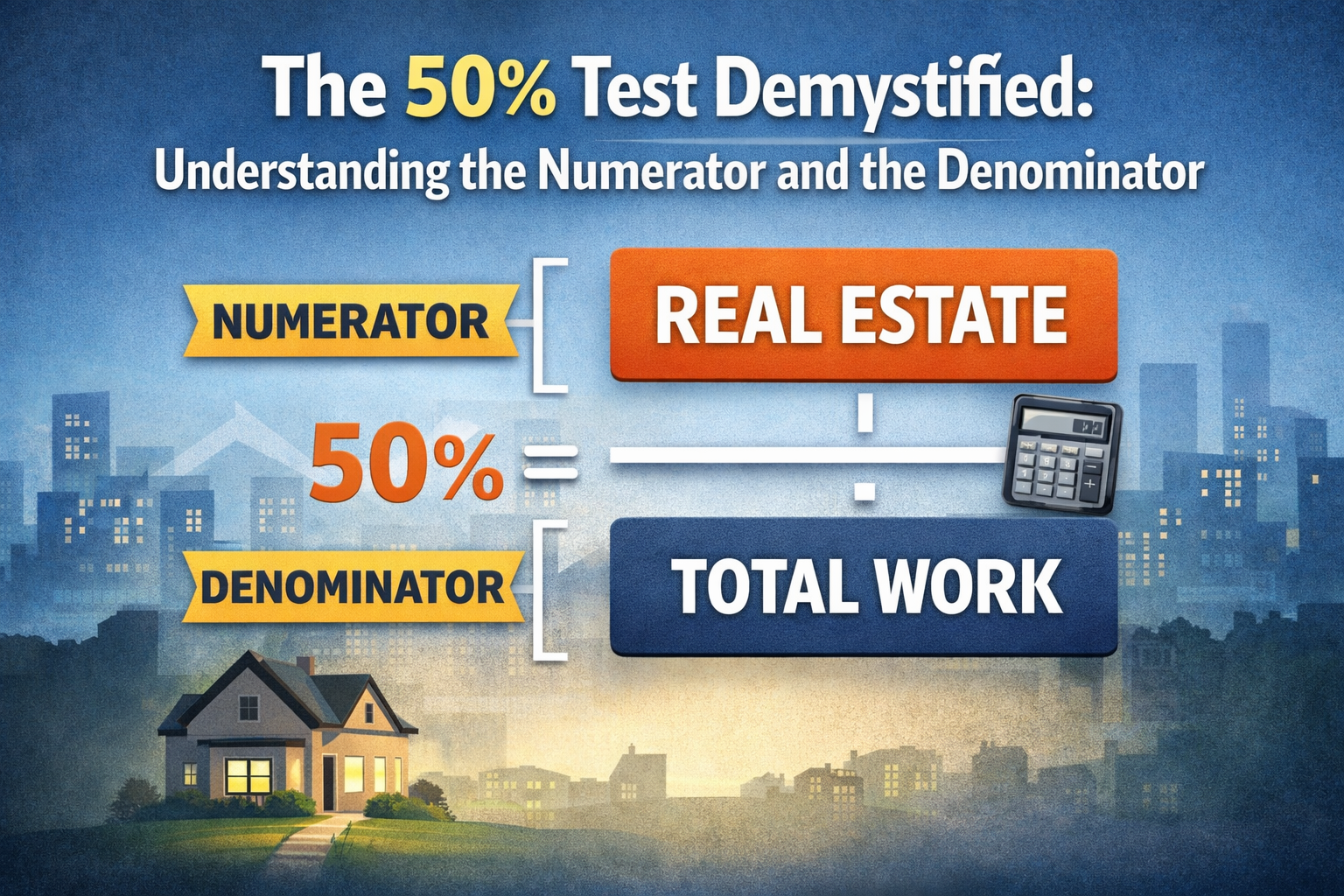
- Capture your non-real-estate working hours too, so the count supports the separate more-than-50-percent test as well as the 750.
- Log contemporaneously, in the moment, rather than rebuilding the year at filing time.
The last item is the one with teeth. Reconstructed logs assembled at tax time are the records that have repeatedly failed in Tax Court, while contemporaneous records built as the work happened are the ones that hold up. The activity catalog is only useful if your log faithfully reflects which bucket each hour belongs in, and that fidelity comes from capturing the entry while the details are fresh.
REP Helper handles this side directly: you log by phone, voice, or web in seconds the moment a task ends, each entry is categorized by activity and by who performed it, and the running 750-hour total and the live 50 percent ratio update as you go. When the year closes, the CPA-ready export hands your advisor a record that already sorts countable hours from the rest, built as the work happened rather than under deadline pressure.
Frequently Asked Questions
Q: Does time spent looking for new rental properties count toward my 750 hours?
A: It depends on the facts. Active acquisition work for a real property trade or business you actually operate, such as performing due diligence, walking properties, and negotiating a purchase, can count. Open-ended browsing of listings that never results in an activity looks more like investor research and is harder to defend. The presence of a genuine, ongoing trade or business is what tips the balance, so describe the purpose of the search in your log and confirm the treatment with your tax advisor.
Q: I manage a renovation but the contractors do the physical work. How many hours can I count?
A: Only the hours you personally performed. The contractors' labor is their time, not yours. Your countable hours are the scoping, bid review, on-site supervision, inspections, and coordination, which is usually a fraction of the total project hours. Logging the full project as your own time overstates the count and is exactly the kind of entry that fails under examination. Tagging each entry by who performed the work keeps this honest.
Q: Can I count the time I spend driving to my rentals?
A: Travel between your rental properties for a documented operational purpose, such as inspecting a repair or meeting a contractor, generally counts. Your ordinary commute to a W-2 job does not, and neither does driving with no documented real estate purpose. The key is a specific note tying the trip to a property and a business reason; a bare "drove 90 minutes" entry proves nothing and invites scrutiny.
Q: Do the real estate courses and books I study count toward my hours?
A: Generally no. Pure education and self-improvement are treated as preparation, not as services performed in a real property trade or business, so generic courses, books, podcasts, and webinars do not advance your 750-hour total. Time spent learning a specific system you are actively implementing for your own properties can sit closer to operations, but the further it is from executing real work, the weaker the case. When in doubt, treat study time as not counting.
Q: Does reviewing my rental financial statements count?
A: There is an important line here. Operational bookkeeping, such as recording rental income and expenses, reconciling accounts, and paying property bills, is hands-on work that counts. Investor-level financial review, such as monitoring your investment from a distance and analyzing portfolio returns, is the kind of activity courts have treated as investor time that does not count toward material participation. If your log is heavy on review-and-monitor entries and light on hands-on operations, the count is weaker than the raw total suggests.
About the author

Real Estate Investor · Founder, REP Helper
Carlos Lourenço is a real estate investor and the founder of REP Helper. Over 10+ years he's built a portfolio of long- and short-term rentals across several states, personally qualifying for Real Estate Professional Status (REPS) and running the short-term-rental strategy on his own properties. A product manager by trade, he built REP Helper after years of tracking his own hours and IRS tests by hand.
Connect on LinkedInDisclaimer: Carlos Lourenço is a real estate investor, not a CPA, enrolled agent, or tax attorney. This article is for educational purposes only and is not tax, legal, or financial advice. Tax outcomes depend on your specific facts and on current law, which changes. Always consult a qualified CPA or tax attorney before implementing any tax strategy.