
Introduction
Most articles about Real Estate Professional status focus on whether you qualify: the 750-hour test, the more-than-50 percent test, and the material participation rules that sit on top of them. This one assumes you already believe you qualify and asks a harder question — if the IRS opened your return tomorrow, could you prove it?
REP status is not won on the day you file. It is won on the day an examiner asks you to back it up.
The investors who lose in audit and in Tax Court rarely lose because they did too little real estate work. They lose because they cannot demonstrate what they did with credible, contemporaneous, corroborated records. A spreadsheet typed up the week before the audit is a liability, not a defense.
This guide walks through the complete defensive file — the full package that makes your claim hard to unwind. It is not just a logging method. It is the log plus the evidence behind the log, the reconciliation that proves the percentage test, the grouping election that makes material participation reachable, and the summary that lets your CPA hand the examiner a clean story instead of a shoebox.
What an Examiner Actually Wants to See
It helps to understand the burden you are carrying. REP status is a taxpayer-favorable position, which means the burden of proof is on you. The examiner does not have to disprove your hours; you have to substantiate them.
The regulations under Treas. Reg. §1.469-5T(f)(4) say the extent of participation may be established by any reasonable means. That sounds generous, but the same provision makes clear that vague, after-the-fact estimates and ballpark recollections are not enough. Tax Court opinions have repeatedly thrown out logs that were obviously reconstructed, internally inconsistent, or unsupported by anything outside the taxpayer's own memory.
In practice, an examiner is testing three separate things, and your file needs an answer for each:
- Did you spend more than 750 hours on real property trades or businesses in which you materially participated?
- Were those hours more than 50 percent of all the personal-service hours you worked that year, across every job and business?
- Did you materially participate in the rental activity (or in your elected group) under one of the seven tests of Treas. Reg. §1.469-5T?
Notice that REP and material participation are two separate gates. Passing the 750-hour and 50 percent tests makes you a Real Estate Professional; it does not by itself make your rental losses non-passive. You still have to materially participate. Your file has to defend both gates.
Layer One: The Contemporaneous Log
The foundation of the file is a contemporaneous log — a record built as the work happens, or close to it, rather than reconstructed at year-end. The word contemporaneous is doing real work here. A log dated and updated throughout the year carries enormous credibility; a tidy spreadsheet created in March of the following year invites suspicion.
A defensible entry is specific. "Real estate — 3 hours" is nearly worthless. Each entry should answer who, what, when, where, how long, and which property.
- The date the work was performed (not the date you logged it).
- The specific property or the group the work relates to.
- A concrete description of the task — "screened two tenant applications and ran background checks," not "management."
- The actual time spent, in realistic increments rather than round numbers every single day.
- Who performed the work — you, your spouse, an employee, or a contractor (only your own personal services count toward your hours).
Logs that show 2.0 hours every weekday and nothing on weekends, or suspiciously round totals that land exactly above a threshold, are a classic red flag. Real work is lumpy. Your log should look like it.
This is exactly the friction REP Helper is built to remove. Instead of trying to remember a year of work each April, you log activity by phone, voice, or web the moment it happens, so the record is genuinely contemporaneous and time-stamped rather than reconstructed under pressure.
Layer Two: The Evidence Behind the Log
Here is the part most investors miss. A log is your story of what happened. Corroborating evidence is the proof that it happened. The strongest files pair every meaningful category of hours with independent documents an examiner can verify without taking your word for it.
Think of the evidence as the receipts that anchor the log to reality. For each type of activity, ask: what would naturally exist as a byproduct of doing this work?
Activity in your log
- Tenant screening and leasing
- Repairs and renovations you oversaw
- Vendor and contractor coordination
- Rent collection and bookkeeping
- Property showings and travel
- Acquisition and financing work
Evidence that backs it up
- Signed leases, application emails, screening reports
- Invoices, before/after photos, permit records, text threads with the contractor
- Emails and call logs scheduling and approving work
- Bank deposits, accounting entries, late-notice correspondence
- Calendar entries, mileage logs, listing-platform messages
- Purchase contracts, inspection reports, loan documents
Photos with embedded timestamps, dated emails, and invoices that name a date and a property are especially powerful because they are hard to fabricate after the fact. They turn "I spent four hours on the kitchen repair" into a claim that is independently anchored in time.
You do not need a separate document for every single entry. You need enough corroboration across the year, and across each property, that the pattern is undeniable. A log densely cross-referenced to real evidence is the difference between a position the examiner concedes and one they pull apart.
Layer Three: Reconciling Hours for the 50% Test
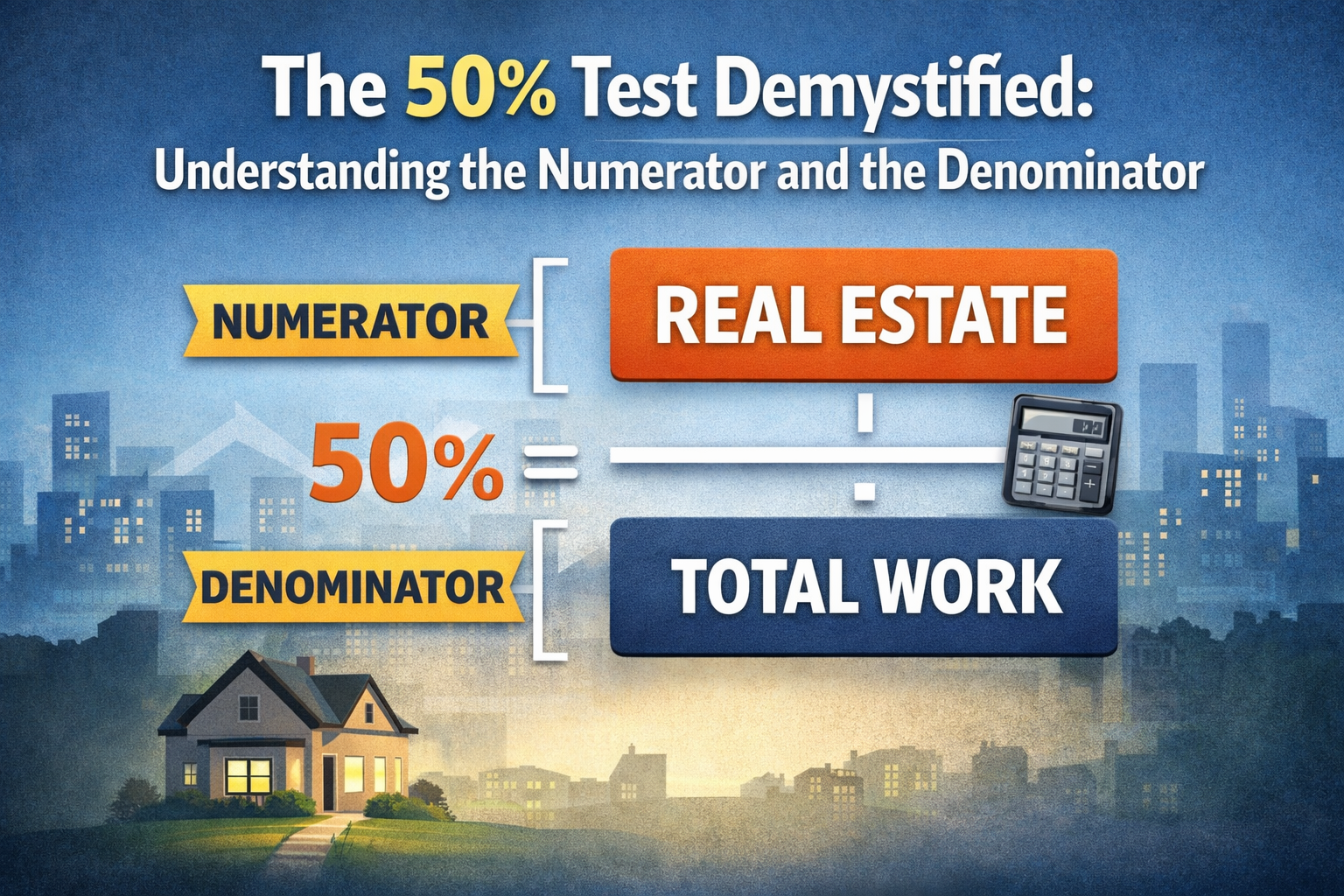
The 750-hour test gets all the attention, but the more-than-50 percent test is what quietly sinks high earners with demanding day jobs. To be a Real Estate Professional, more than half of all the personal-service hours you worked that year — every job and business combined — must be in real property trades or businesses.
That means your file cannot only document your real estate hours. It has to account for the denominator too: your W-2 work, your other businesses, and any side work. If you work a full-time job at, say, roughly 2,000 hours a year, you would need to log more real estate hours than that just to clear 50 percent — and you need records that make that comparison believable.
An examiner who suspects REP will often start with your W-2 and ask a simple, devastating question: how could more than half of your working hours have been real estate if you also held this job? Your reconciliation has to answer that on paper.
A clean reconciliation in the file should include:
- Your estimated total non-real-estate working hours for the year, with the basis for the estimate (employment records, pay stubs, a work calendar).
- Your total qualifying real estate hours from the contemporaneous log.
- The resulting ratio, shown clearly to be above 50 percent.
- A note on the 5 percent owner rule — W-2 hours for an employer count toward real property trades or businesses only if you own at least 5 percent of that employer.
Because this ratio depends on two moving numbers, it is easy to misjudge until it is too late. REP Helper tracks both sides at once — your real estate hours and your outside or W-2 hours — so the 750-hour progress and the live 50 percent ratio update together throughout the year, rather than surprising you at filing.
Layer Four: The Grouping Election
Even once you are a Real Estate Professional, each rental activity must clear material participation — most commonly the 500-hour test under Treas. Reg. §1.469-5T — before its losses become non-passive. If you own several properties and treat each as its own activity, you would have to hit the material participation bar on every one separately. For most investors that is impossible.
This is what the grouping election solves. Under IRC §469(c)(7)(A) and Treas. Reg. §1.469-9(g), you can elect to treat all of your rental real estate interests as a single activity, so material participation is measured across the whole portfolio at once.
The election is not automatic and it is not casual. It is made by attaching a written statement to your original return declaring that you are a qualifying taxpayer and electing to treat all interests in rental real estate as one activity. It is generally irrevocable, so it belongs in your permanent file, not just the year you first made it.
A surprising number of audits go sideways here. The taxpayer materially participated across the portfolio in total but never filed the election, so the examiner tests each property on its own — and the losses fall back into passive treatment. A copy of the filed election statement, with the year it was attached, is a small page that protects everything else.
Because the election shifts the measurement to the portfolio level, your tracking has to match. REP Helper lets you track material participation both per property and as a grouped portfolio, so the way you document hours lines up with the election you actually filed.
A Note on Short-Term Rentals
Short-term rentals deserve their own line in the file because they can change the analysis entirely. If the average guest stay is 7 days or less, the activity is not a "rental activity" under Treas. Reg. §1.469-1T(e)(3). It falls outside the per-se passive rule for rentals, which means you may not need REP status at all — but you do still have to materially participate.
The catch is that the average-stay calculation is itself an audit point. If you are relying on the 7-day rule, your file needs to prove the average, not just assert it.
- A reservation-level record showing each stay's check-in and check-out dates.
- The math that derives the average stay across all reservations for the year.
- Booking-platform or PMS exports that corroborate those dates independently.
- The same contemporaneous log of your own hours, since material participation still has to be met.
REP Helper calculates the average stay for short-term rentals directly from your booking data, so the number you would put in front of an examiner is documented rather than estimated.
Layer Five: The CPA-Ready Summary
All the records in the world do not help if no one can navigate them. The final layer is a summary that turns the raw file into a defense your CPA, and ultimately an examiner, can follow in minutes. This is what separates a position that gets conceded from one that drags through months of back-and-forth.
A strong summary package generally includes:
- A one-page overview of total qualifying hours, the 50 percent ratio, and the material participation test you are relying on.
- A per-property and grouped hour breakdown that ties to the contemporaneous log.
- An index mapping each major category of hours to the supporting evidence that corroborates it.
- The W-2/other-work reconciliation establishing the more-than-50 percent test.
- A copy of the filed grouping election statement and, for STRs, the average-stay calculation.
The goal is that your CPA can hand an examiner a clean narrative — here are the hours, here is how they beat both tests, here is the proof, here is the election — instead of a year of scattered records to be reassembled under deadline.
Producing this by hand at filing time is painful, which is why so many files are incomplete. REP Helper exports CPA-ready summaries that tag each activity by who performed it and which test it counts toward, and that aggregate across your portfolio, so the package is ready before anyone asks for it.
Putting the Whole File Together
A truly audit-proof position is not one document; it is five layers that reinforce each other. The log says what you did, the evidence proves it, the reconciliation wins the percentage test, the election makes material participation reachable, and the summary makes all of it legible. Pull any one layer out and the others get noticeably weaker.
- Contemporaneous log: dated, specific entries showing date, property, task, time, and who performed the work.
- Corroborating evidence: leases, invoices, dated photos, emails, contracts, calendars, and mileage records cross-referenced to the log.
- Hour reconciliation: real estate hours versus all other working hours, clearly above 50 percent, with the 5 percent owner rule addressed.
- Grouping election: a copy of the filed Treas. Reg. §1.469-9(g) statement in the permanent file.
- STR support (if applicable): reservation records and a documented average-stay calculation.
- CPA-ready summary: a one-page overview plus an index tying every claim to its proof.
Build this as you go and an audit becomes an inconvenience instead of a crisis. Build it the week before the examiner calls and you are already losing. None of this is a guarantee of any particular outcome, and your own facts and your tax advisor's judgment always come first — but a complete, contemporaneous, corroborated file is the single best thing within your control.
Frequently Asked Questions
Q: Is a contemporaneous log enough on its own to defend my hours?
A: Rarely. The regulations allow you to prove participation by any reasonable means, but examiners and the Tax Court give the most weight to logs that are corroborated by independent evidence. A log paired with leases, invoices, dated photos, and emails is far stronger than a log standing alone, because the outside documents confirm the work actually happened on the dates you claim.
Q: Can I reconstruct my log at the end of the year if I forgot to keep one?
A: You can, but it is the weakest version of the record. Reconstructed logs are routinely discounted when they are obviously after-the-fact, internally inconsistent, or unsupported by anything else. If you must reconstruct, anchor every entry you can to contemporaneous evidence like dated emails, invoices, and calendar entries — the more outside proof, the more credible the reconstruction.
Q: Why does the file need my W-2 hours if the issue is real estate?
A: Because the more-than-50 percent test compares your real estate hours to all of your personal-service hours, including your W-2 and other businesses. To prove you cleared that test, your file has to document the denominator, not just the numerator. Without a credible accounting of your other working hours, an examiner can argue the ratio is impossible — especially if you held a full-time job.
Q: Do I really need the grouping election if I already materially participate?
A: If you own more than one rental, almost certainly yes. Without the election under Treas. Reg. §1.469-9(g), each property is tested for material participation separately, and few investors can hit the threshold on every property individually. The election lets you measure participation across the whole portfolio. It is generally irrevocable, so keep a copy of the filed statement in your permanent file.
Q: How does REP Helper fit into building this file?
A: It addresses the specific places files fall apart. You log activity by phone, voice, or web as the work happens so the record is genuinely contemporaneous; it tracks both your real estate hours and your outside hours so the 750-hour and 50 percent progress update live; it handles per-property and grouped material participation, average-stay for STRs, and CPA-ready exports. It is a tool to help you assemble the package — your facts and your tax advisor still drive the conclusion.
About the author

Real Estate Investor · Founder, REP Helper
Carlos Lourenço is a real estate investor and the founder of REP Helper. Over 10+ years he's built a portfolio of long- and short-term rentals across several states, personally qualifying for Real Estate Professional Status (REPS) and running the short-term-rental strategy on his own properties. A product manager by trade, he built REP Helper after years of tracking his own hours and IRS tests by hand.
Connect on LinkedInDisclaimer: Carlos Lourenço is a real estate investor, not a CPA, enrolled agent, or tax attorney. This article is for educational purposes only and is not tax, legal, or financial advice. Tax outcomes depend on your specific facts and on current law, which changes. Always consult a qualified CPA or tax attorney before implementing any tax strategy.