
Why 2026 Is a Different Conversation
For a few years, the most important number in the cost segregation conversation was a moving target. Bonus depreciation, the rule that lets you deduct the full cost of certain assets in the year you place them in service rather than spreading it across their useful life, was on a scheduled glide path toward zero. It was 100% through 2022, then stepped down to 80% in 2023, 60% in 2024, and was set to keep falling. Investors planning a short-term rental purchase had to factor in exactly which calendar year their property would be ready, because the difference between an 80% and a 60% first-year write-off on a six-figure pile of reclassified assets is real money.
That uncertainty is gone. The 2025 One Big Beautiful Bill Act (OBBBA) permanently restored 100% bonus depreciation for qualified property acquired and placed in service after January 19, 2025. For short-term rental (STR) owners pairing a purchase with a cost segregation study, this is the single biggest tax-timing change in years, and it removes the pressure to race a falling percentage.
This article stays in one lane: what bonus depreciation is in 2026, what qualifies, how it stacks with cost segregation, and how placed-in-service timing decides which year you get the deduction. It is general education, not advice on your specific return. Run the actual numbers with a qualified tax advisor and an engineering-based cost-seg firm before you act.
One thing to keep front of mind throughout: a giant first-year deduction is only worth chasing if you can actually use the loss against your active income. For an STR, that depends entirely on clearing the average-stay rule and materially participating. We will return to that at the end, because the depreciation and the qualification are two halves of the same strategy.
What Bonus Depreciation Actually Is
Ordinary depreciation spreads the cost of an asset over its assigned recovery period. A residential rental building is depreciated over 27.5 years; a commercial building over 39. Bonus depreciation is a separate, additional first-year allowance that lets you deduct a large percentage of an eligible asset's cost immediately, in the year it is placed in service, rather than waiting for the normal schedule to dole it out a slice at a time.
The catch is in the word 'eligible.' Bonus depreciation does not apply to the building itself. It applies to qualified property, and the central qualifier is the recovery period: the asset must have a Modified Accelerated Cost Recovery System (MACRS) recovery period of 20 years or less. A 27.5-year building does not qualify. The 5-, 7-, and 15-year components hidden inside that building do.
That is why bonus depreciation and cost segregation are talked about together. On their own, almost none of a long-life building qualifies for bonus. But once an engineering study carves the building into its true components, a meaningful slice of the cost basis lands in those short-life classes, and that slice becomes bonus-eligible.
- Eligible: tangible personal property and land improvements with a recovery period of 20 years or less (the 5-, 7-, and 15-year MACRS classes).
- Generally not eligible: the building structure itself, which is depreciated over 27.5 years (residential) or 39 years (commercial).
- Other rules apply, such as used property being eligible if it is new to you and not acquired from a related party. Confirm the specifics with your advisor.
The 2026 Rule: 100%, Permanently
Here is the current state of the law as it applies to a property you place in service today. Under the 2025 OBBBA, qualified property acquired and placed in service after January 19, 2025 is eligible for 100% bonus depreciation, and that 100% rate was made permanent rather than scheduled to phase down. In plain terms: a qualifying asset can be fully expensed in its first year again.
To understand why this matters, it helps to see where the rule had been heading. Before the OBBBA change, bonus depreciation was phasing down on a fixed schedule.
The old phase-down path
- 2022: 100% bonus on qualified property
- 2023: stepped down to 80%
- 2024: stepped down to 60%
- Early 2025 (before Jan 20): 40% for property placed in service before the OBBBA cutoff
- Trajectory: continued decline toward 0%
After the 2025 OBBBA
- Acquired and placed in service after January 19, 2025
- 100% bonus restored
- Made permanent, not scheduled to phase down
- Applies to qualified property with a 20-year-or-less life
- No more racing a falling percentage by year-end
A note on dates: the January 19, 2025 line is the dividing point. Property placed in service in early 2025 before that cutoff generally fell under the older 40% rate, while property placed in service after it qualifies for the restored 100%. If your acquisition straddles that window, this is a detail to confirm carefully with your tax advisor.
Because the restored 100% rate is described as permanent rather than temporary, the year-by-year urgency that defined cost-seg planning in 2023 and 2024 has eased. That said, tax law can change, and 'permanent' in tax language means 'until Congress changes it,' not 'forever guaranteed.' Plan around the rule as it stands today and stay in touch with your advisor about any future legislative shifts.
How It Stacks With Cost Segregation
Cost segregation and bonus depreciation are a two-stage machine. Stage one is the engineering study, performed by a specialist firm, which examines your property and reclassifies its components from the long 27.5-year bucket into their correct shorter MACRS lives. Carpeting, cabinetry, appliances, and decorative fixtures often fall into the 5-year class. Certain equipment lands in 7-year. Land improvements like driveways, fencing, and landscaping commonly sit in the 15-year class.
Stage two is bonus depreciation doing its job on what stage one surfaced. Every asset the study moved into the 5-, 7-, or 15-year classes has a recovery period of 20 years or less, which is exactly the eligibility threshold. With 100% bonus restored, you can deduct the entire reclassified amount in year one rather than depreciating it slowly over those shorter lives.
Consider the difference in illustrative terms only. Suppose a study reclassifies a portion of a property's cost basis into short-life assets. Without bonus depreciation, that amount would deduct over 5 to 15 years. With 100% bonus, that same amount deducts in the first year. The total lifetime depreciation is the same either way, what changes is the timing, and timing is the whole point: a dollar of deduction now is worth more than the same dollar spread over a decade, and a large front-loaded loss is what makes the STR strategy financially powerful.
Bonus depreciation does not create extra deductions out of thin air. It accelerates deductions you would eventually take anyway. The flip side shows up on sale, when depreciation recapture taxes the gain attributable to the depreciation you claimed (up to 25% on the real-property portion and ordinary rates on personal property). Faster deductions now mean recapture later, so model the full hold-and-sell picture, not just year one.
What Qualifies and What Does Not
The cleanest way to think about eligibility is the 20-year line. If a cost-seg study assigns an asset a recovery period of 20 years or less, it is in the running for bonus depreciation. If the asset stays in the 27.5-year structural bucket, it is not. Here is how the typical STR components sort out.
- 5-year assets: appliances, carpeting, removable flooring, window treatments, decorative lighting, furniture used in furnished rentals, and similar personal property.
- 7-year assets: certain equipment and furnishings depending on classification.
- 15-year assets: land improvements such as driveways, walkways, patios, fencing, landscaping, and exterior lighting.
- All of the above (20-year life or less): eligible for 100% bonus depreciation under the current rule.
- The building shell (27.5-year residential life): NOT eligible for bonus, depreciated on the normal schedule.
- Raw land: never depreciable at all, bonus or otherwise.
For a furnished short-term rental specifically, the share of cost that lands in the short-life classes can be meaningful, because STRs are full of the kind of personal property and finishes that fall into the 5-year bucket. That is part of why the STR-plus-cost-seg combination gets so much attention. The exact percentages depend entirely on the property and the study, so resist any rule of thumb that promises a fixed figure, and let the engineering report speak for itself.
A reminder on used property: buying a property someone else owned does not disqualify the components from bonus depreciation, because the property simply needs to be new to you and not bought from a related party. This is why cost segregation works on properties you purchase, not only ones you build. As always, the related-party and acquisition rules have nuances worth confirming with your advisor.
Placed-in-Service Timing and Year-End
Bonus depreciation is a first-year deduction, which means it is governed by one date above all others: when the property is placed in service. Placed in service does not mean the day you closed, and it does not mean the day you finished renovating for its own sake. It means the asset is ready and available for its intended use. For a short-term rental, that generally means the property is listed and genuinely available to accept bookings.
This distinction decides your tax year. To claim the deduction for a given year, the property must be placed in service by December 31 of that year. A property you buy in November but do not list until the following January is placed in service in the new year, and the first-year bonus deduction belongs to that later year, not the one you closed in.
- Placed in service = ready and available to rent (typically: listed and bookable), not merely purchased.
- Depreciation, including bonus, starts at the placed-in-service date.
- Miss December 31 by even a day and the first-year deduction shifts to the next tax year.
- Document the date your listing went live and the property was available, because that is the date that supports your claim.
The placed-in-service date is one of the most contestable facts in an STR depreciation claim, and it is easy to be sloppy about. Keep a clear record of when the unit became available to rent, the listing went live, and the property was truly ready. REP Helper keeps your placed-in-service date and the supporting evidence alongside the rest of your activity log, so the date you rely on at filing time is documented rather than reconstructed from memory months later.
The Deduction Is Useless If the Loss Stays Passive
Here is the part that gets skipped in the excitement over a six-figure first-year deduction. A large depreciation loss only helps your tax bill if it is non-passive, meaning it can offset your wages, business income, and other active income. If the loss is passive, it gets suspended and carried forward, doing nothing for you until you have passive income or sell. For a short-term rental, whether that loss is passive or non-passive is decided by two separate tests that have nothing to do with bonus depreciation itself.
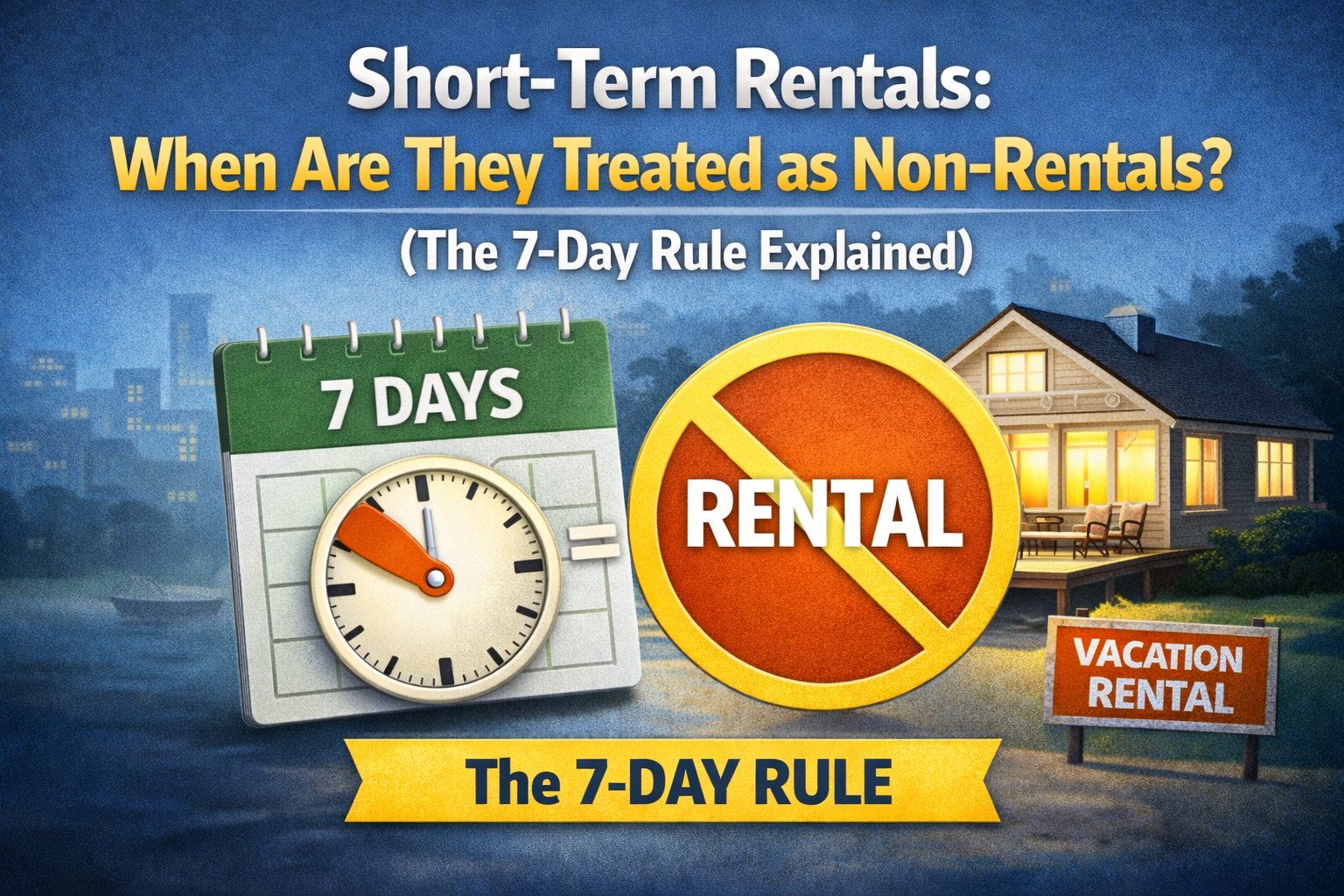
Step 1: Beat the 7-day rule
- Your average guest stay must be 7 days or fewer (per property, for the year).
- Average stay = total rental nights divided by number of separate reservations.
- Clearing this takes the property out of 'rental activity' status, so it is not automatically passive.
- You do NOT need Real Estate Professional (REP) status to use this path.
Step 2: Materially participate
- Meet one of the seven material participation tests (Treas. Reg. 1.469-5T).
- Common ones: more than 500 hours; or more than 100 hours and more than anyone else; or substantially all the work.
- Cleaner, co-host, and property-manager hours do NOT count as yours and can defeat the 100-hour test.
- Without material participation, the loss stays passive even if you cleared the 7-day rule.
So the sequence is: cost segregation creates the short-life assets, bonus depreciation lets you deduct them now, the 7-day average-stay rule keeps the activity out of the per-se passive bucket, and material participation makes the resulting loss non-passive so it can actually offset your active income. Break any link in that chain and the big deduction sits idle.
This is where the day-to-day record-keeping earns its keep. REP Helper calculates your average stay per property from your bookings so you know whether you are under seven days, logs your material-participation hours contemporaneously, and tags each task by who did it (you, your spouse, your cleaner, your co-host, your property manager) so you can prove you out-participated everyone else for the 100-hour test. Cost segregation itself is the specialist firm's job; the point of the tracking is to prove the qualification that lets you actually use the depreciation they unlock.
A Year-End Bonus Depreciation Checklist
If you are aiming to claim a first-year bonus depreciation deduction on an STR for the current tax year, walk this list before December 31. None of it is a substitute for professional advice, but it keeps the moving parts in view.
- Confirm the property is acquired and placed in service after January 19, 2025, so the restored 100% rate applies.
- Verify the property is genuinely placed in service (listed and available to rent) by December 31 of the year you want the deduction.
- Engage an engineering-based cost segregation firm; an itemized, defensible study is what surfaces the bonus-eligible short-life assets.
- Confirm the reclassified assets carry a recovery period of 20 years or less (the 5-, 7-, and 15-year classes).
- Track your average guest stay so you can show it is 7 days or fewer per property for the year.
- Log material-participation hours contemporaneously and tag them by who performed each task.
- Save the placed-in-service date evidence: listing-live screenshots, first availability, readiness records.
- Model depreciation recapture on an eventual sale, not just the year-one benefit.
- Review the whole plan with a qualified tax advisor before filing.
Frequently Asked Questions
Q: Is bonus depreciation really back at 100% for 2026?
A: Yes. The 2025 OBBBA permanently restored 100% bonus depreciation for qualified property acquired and placed in service after January 19, 2025, reversing the earlier phase-down (80% in 2023, 60% in 2024, and 40% for property placed in service in early 2025 before the cutoff). 'Permanent' here means it is not on a scheduled sunset, though tax law can always change, so confirm the current rule with your advisor for your specific year.
Q: Can I take bonus depreciation on the rental building itself?
A: No. The building structure is depreciated over 27.5 years for a residential rental, which is well above the 20-year-or-less eligibility line, so it does not qualify for bonus depreciation. What qualifies are the components a cost segregation study reclassifies into the 5-, 7-, and 15-year MACRS classes. That is precisely why bonus depreciation and cost segregation are used together rather than separately.
Q: I bought in December but had not listed the property yet. Can I still claim the deduction this year?
A: Generally no, because the deduction follows the placed-in-service date, not the purchase date. An asset is placed in service when it is ready and available for its intended use, which for an STR usually means listed and available to rent. If you did not reach that point by December 31, the first-year bonus deduction shifts to the following tax year. Keep records of exactly when the property became available to support whichever year you claim.
Q: Does a big bonus depreciation deduction guarantee a tax refund?
A: Not by itself. The deduction creates a loss, but that loss only offsets your active income if it is non-passive. For an STR, that requires clearing the 7-day average-stay rule and materially participating. If either test fails, the loss is passive and gets suspended until you have passive income or sell. The depreciation and the qualification are two separate steps, and you need both.
Q: Will I have to pay any of this back when I sell?
A: Partly, through depreciation recapture. When you sell, gain attributable to the depreciation you claimed is taxed, up to 25% on the real-property portion and at ordinary rates on personal-property components. Bonus depreciation accelerates deductions rather than adding to them, so it brings the recapture timing forward as well. This is a trade-off to model with your advisor, weighing the time value of deducting now against the recapture later.
About the author

Real Estate Investor · Founder, REP Helper
Carlos Lourenço is a real estate investor and the founder of REP Helper. Over 10+ years he's built a portfolio of long- and short-term rentals across several states, personally qualifying for Real Estate Professional Status (REPS) and running the short-term-rental strategy on his own properties. A product manager by trade, he built REP Helper after years of tracking his own hours and IRS tests by hand.
Connect on LinkedInDisclaimer: Carlos Lourenço is a real estate investor, not a CPA, enrolled agent, or tax attorney. This article is for educational purposes only and is not tax, legal, or financial advice. Tax outcomes depend on your specific facts and on current law, which changes. Always consult a qualified CPA or tax attorney before implementing any tax strategy.