
The Question Everyone Asks (and the Answer Gurus Won't Give You)
Scroll through any real estate investing forum and you will find the same promise repeated like a mantra: "Become a Real Estate Professional and write off your rental losses against your W-2 income, even while you keep your day job." It is a seductive pitch, and it is usually sold with a confident wink that suggests anyone willing to "hustle" can pull it off. This article is the reality check that pitch never includes.
So can you have a job and qualify for Real Estate Professional status (REP, sometimes written REPS)? The honest answer is: usually no, sometimes yes, and the difference comes down to math, not motivation. For a person working a standard 40-hour-a-week job that has nothing to do with real estate, REP status is not merely hard. For most, it is structurally out of reach because of a test the gurus tend to gloss over. But there are real, legitimate exceptions, and this piece lays them out without sugarcoating or fearmongering.
The goal here is not to crush your dreams. It is to make sure that if you claim REP status, you can actually defend it, because the IRS has been winning these cases in Tax Court for years against taxpayers who believed the hype.
What 'REP' Actually Requires (Two Gates, Not One)
Before we debunk anything, you need the rules cold, because nearly every myth in this space comes from people who only learned half of them. Qualifying as a Real Estate Professional under IRC Section 469(c)(7) requires you to clear BOTH of these in the SAME tax year, measured per individual:
- The 750-hour test: You spend more than 750 hours during the year in real property trades or businesses in which you materially participate.
- The 50% test: More than half of ALL the personal-service hours you perform in ANY trade or business that year are in real property trades or businesses.
Read the 50% test again, because it is the one that quietly ends most W-2 employees' ambitions. It is not 50% of your real estate hours. It is 50% of every working hour you log anywhere, your job included. Your salaried position is a trade or business, and those hours land squarely in the denominator.
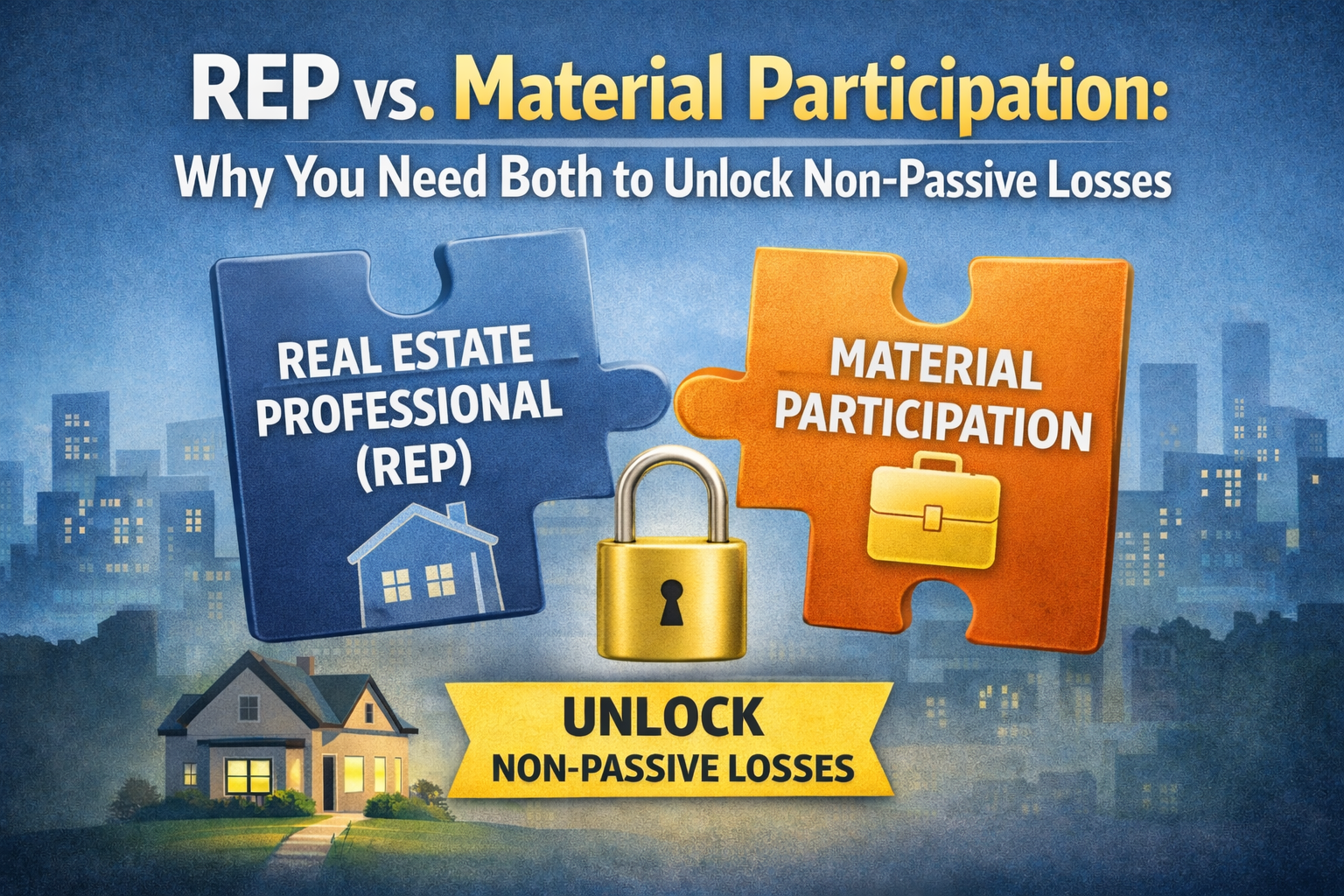
And here is the part the gurus almost never mention: clearing both tests does NOT, by itself, let you deduct rental losses against your salary. REP status only removes the rule that treats rentals as automatically passive. You then have a SECOND, separate hurdle. You must materially participate in the rental activity (per property, or across your whole portfolio if you make the grouping election) for those losses to become non-passive. REP and material participation are two different gates, and you have to walk through both.
Mental model: REP status unlocks the door. Material participation actually opens it. Skip either and your losses stay suspended, carried forward, doing nothing for this year's tax bill.
The Brutal Math the 50% Test Forces On You
Let's do the arithmetic the sales pitches avoid. A typical full-time job runs about 40 hours a week for roughly 50 weeks, which is about 2,000 working hours a year. To pass the 50% test, your real property hours must EXCEED your total working hours' midpoint, meaning your real estate hours have to beat your job hours.
The W-2 hours (denominator)
- Full-time job: about 2,000 hours/year
- These count whether or not the work is glamorous
- Commuting generally does not count, but the working time does
- You cannot simply ignore or under-report them
What you'd need in real estate
- More than 2,000 real property hours to win the 50% test
- That's over 38 hours every single week, on top of the day job
- All of it in activities that genuinely qualify
- All of it documented well enough to survive scrutiny
Sit with those numbers. To pass the 50% test alongside a real full-time job, you would need to perform MORE hours in real estate than at your job, which for many people means a second full-time job's worth of real estate work, every week, all year. The 750-hour test is the easy one by comparison; people fixate on it because 750 sounds achievable. The 50% test is the wall, and it is built specifically so that someone whose primary livelihood is a non-real-estate job cannot also be a "professional" in real estate.
This is not an accident or a loophole the IRS forgot to close. Congress designed the 50% test precisely to stop high earners from labeling a side hobby as a profession. When a guru waves it away, that is the moment to be skeptical.
Five Myths That Get Taxpayers Audited
Most failed REP claims trace back to one of a handful of confidently repeated falsehoods. Here are the ones that show up over and over in Tax Court losses.
- Myth: "750 hours is all you need." Reality: It is necessary but not sufficient. You also must beat the 50% test and separately prove material participation. Hitting 750 while working full time often still fails the 50% test.
- Myth: "Just log your hours and you're fine." Reality: Logs created after the fact, or vague estimates like '10 hours/week, every week,' are routinely thrown out. Courts want contemporaneous, specific, credible records.
- Myth: "Investor and management time all counts." Reality: Time spent purely as an investor (reviewing financials, monitoring in a non-managerial way) generally does NOT count toward material participation, and certain investor activities are explicitly excluded.
- Myth: "My property manager does the work but the hours are mine." Reality: Hiring a manager often undermines your material participation, because someone else is doing the substantial work. It can be the very thing that sinks the claim.
- Myth: "REP status means I can deduct everything." Reality: REP only removes the automatic-passive label. Without material participation per property or per the grouped activity, the losses remain passive and suspended.
The pattern in the Tax Court losses is consistent: confident taxpayer, full-time job, reconstructed time log, no contemporaneous proof, and a 50% test that never had a realistic chance. Do not become the next data point.
When the Answer Is Honestly 'No'
Candor requires naming the situations where, barring a major life change, REP status simply is not in reach this year. If you are in one of these and someone is telling you otherwise, they are selling something.
- You work a standard full-time, non-real-estate job (about 2,000 hours) and have one or two rentals you manage on weekends. The 50% test fails, period.
- You have a demanding salaried career and you outsource most rental work to a property manager. You likely fail BOTH the hour tests and material participation.
- You're a high-income professional (physician, engineer, attorney) who wants the write-off but cannot meaningfully reduce your day-job hours. The denominator is too large.
- You're trying to retroactively 'find' the hours for a past year you didn't track. Reconstructed logs rarely hold up, and the 50% test still has to be true on the facts.
None of this means you cannot benefit from real estate. It means the specific label 'Real Estate Professional' is the wrong tool, and forcing it is how people end up owing back taxes, interest, and penalties. There are other, legitimate strategies, and the next section covers the paths that genuinely work.
When It Genuinely IS Possible (The Real Exceptions)
Now the contrarian flip side: REP status absolutely can coexist with employment in specific, defensible situations. These are not loopholes; they are the cases where the math and the rules actually line up.
Paths that can work
- Your day job IS a real property trade or business (e.g., a full-time real estate broker, agent, or developer). Those hours count in BOTH the numerator and denominator, so the 50% test becomes winnable.
- You work part-time or seasonally, so your non-real-estate hours are low enough that real estate can genuinely exceed them.
- A spouse route: on a joint return, if one spouse qualifies as a REP, the rental losses can be treated favorably, even if the other spouse works full time. The qualifying spouse must individually meet both tests.
The STR alternative (different rules entirely)
- If your rental's average guest stay is 7 days or fewer, it is not a 'rental activity' under the regulations, so it is not automatically passive and REP is NOT required.
- You still must materially participate (e.g., the 500-hour test, or 100 hours and more than anyone else).
- This is why busy professionals often pursue short-term rentals instead of forcing the REP label.
- Average stay must be calculated correctly and documented.
Notice what the genuine yes-cases have in common: either your working-hours denominator is small (part-time, seasonal), your real estate work IS your job (broker/agent/developer), the qualifying person is a spouse who is not consumed by a non-real-estate career, or you have sidestepped the REP requirement entirely via the short-term rental rules. If none of those describe you, be honest with yourself.
The spouse route and the short-term rental route are the two most common ways genuinely busy people get the tax outcome they wanted, often without ever needing one person to thread the full-time-job-plus-REP needle.
The Two Doors Busy People Actually Use
Because the spouse and short-term rental paths come up so often, they deserve a closer, honest look, including their catches.
The spouse route: REP status is determined per individual, and one spouse's hours generally cannot be added to the other's for the hour tests. So the qualifying spouse must personally clear more than 750 hours AND more than 50% of THEIR OWN working hours in real property businesses. That works beautifully when one spouse is not working a big outside job, or works only part time. It does NOT work if both spouses have demanding full-time non-real-estate careers, no matter how the household divides the chores. The good news: if one spouse qualifies and the couple materially participates, the rental losses can offset the household's income on a joint return.
The short-term rental route: this one sidesteps REP entirely. When the average period of customer use is 7 days or fewer, the activity is excluded from the definition of a 'rental activity,' so the automatic-passive rule never applies and you do not need to be a Real Estate Professional at all. The catch is that you still must materially participate. For a single STR, that often means hitting the 500-hour test, or the 100-hours-and-more-than-anyone-else test, which gets harder the moment you hand off most of the work to a co-host or management company.
- Confirm which path actually fits your real working-hours math before you commit to a strategy.
- If using the spouse route, make sure the qualifying spouse can personally beat both the 750-hour and 50% tests.
- If using STRs, verify your average guest stay is truly 7 days or fewer and keep the booking data to prove it.
- Either way, plan to prove material participation, not just total hours.
- Decide early whether to make the grouping election to treat all long-term rentals as one activity for material participation.
Why Documentation Decides Everything
Here is the uncomfortable truth that ties this whole article together: even taxpayers who legitimately qualify often LOSE in audit because they cannot prove it. The hours may have happened, but a credible, contemporaneous record did not. Courts have repeatedly rejected after-the-fact logs, round-number estimates, and calendars reconstructed from memory the night before an audit.
Defensible documentation means records built as the work happens, with dates, the property, the activity, who performed it, and the time spent. It also means tracking your NON-real-estate working hours, because the 50% test is a ratio, and you cannot prove a ratio if you only counted one side of it. This is the single most common gap: people log their real estate hours diligently and never document the denominator, leaving the most important test unsupported.
This is exactly the pain REP Helper is built to remove. You log activities contemporaneously by phone, voice, or web as the work happens, so the record exists when you need it. It tracks your 750-hour progress AND your 50% ratio live, including your outside or W-2 hours, so you can see in real time whether the 50% test is even winnable for you this year, before you bank on a deduction you can't support.
If you cannot answer 'what does my 50% ratio look like right now?' on demand, you do not yet have a REP strategy. You have a hope. The whole point of contemporaneous tracking is to replace hope with evidence.
Making the Honest Decision
Strip away the marketing and the decision becomes refreshingly clear. Run your real numbers, not the optimistic ones, and let the math tell you the truth.
- Count your realistic non-real-estate working hours for the year. If it's near 2,000, REP via your own hours is almost certainly off the table.
- Ask whether your real estate hours can HONESTLY exceed that number. If not, stop forcing the REP label.
- Consider whether a part-time/seasonal schedule, a non-working spouse, or short-term rentals change the picture.
- Remember you'll still need material participation per property or across the grouped activity, not just the hour totals.
- Track BOTH sides of the ratio contemporaneously, or your claim is undefendable regardless of how the math looks.
- Confirm your specific facts with a qualified tax advisor before filing on a REP position.
REP Helper supports this honest assessment by tagging each activity by who performed it (you, your spouse, or a contractor) and by which material-participation test it counts toward, tracking per-property and grouped participation separately, calculating average stay for short-term rentals, and producing CPA-ready exports. The aim is not to manufacture a qualification you don't have; it is to let you see clearly whether you qualify and to prove it cleanly if you do.
The brutal truth is liberating: once you accept that the 50% test, not effort, is the real gatekeeper, you can stop chasing a label you can't earn and pick the strategy, spouse route, short-term rentals, or simply carrying losses forward, that actually fits your life.
Frequently Asked Questions
Q: Can a full-time W-2 employee ever qualify for REP status on their own?
A: Rarely, and only if their real property hours exceed their total working hours. With a standard 2,000-hour-a-year job that isn't itself a real property business, the 50% test is the wall, because your real estate hours would have to beat your job hours. It becomes realistic when the day job IS real estate (broker, agent, developer) or when the schedule is part-time or seasonal. For most full-time professionals in unrelated fields, the answer is no.
Q: My friend says he qualified while working full time. Is he wrong?
A: Maybe, maybe not. Ask three questions: Is his job actually a real property trade or business? Does he work part-time or seasonally? Or did his spouse qualify rather than him? If none of those apply and he has a full 40-hour unrelated job, his claim may be vulnerable in an audit even if it survived without one. People often confuse 'I claimed it' with 'it would hold up.'
Q: If I can't be a REP, is there another way to deduct rental losses against my salary?
A: Yes, a couple. Short-term rentals with an average guest stay of 7 days or fewer escape the rental-activity rules, so REP isn't required, though you still must materially participate. A qualifying spouse can carry the REP designation on a joint return. And if neither fits this year, your passive losses aren't lost; they're suspended and carried forward to offset future passive income or the eventual sale. A modest special allowance of up to $25,000 may also apply but phases out between $100k and $150k of MAGI.
Q: Does hitting 750 hours mean I'm a Real Estate Professional?
A: No. The 750-hour test is only one of two gates. You must ALSO have more than 50% of all your working hours in real property businesses, and then separately prove material participation for the losses to become non-passive. People who fixate on 750 and ignore the 50% test are the ones most likely to lose in audit.
Q: How important is it that I track my non-real-estate hours too?
A: Critical. The 50% test is a ratio, and you cannot prove a ratio while documenting only one side of it. Many otherwise-legitimate claims fail because the taxpayer logged real estate hours diligently but never recorded the W-2 or outside hours in the denominator. Tracking both sides contemporaneously, which is exactly what REP Helper does, is what makes the test provable rather than merely arguable.
About the author

Real Estate Investor · Founder, REP Helper
Carlos Lourenço is a real estate investor and the founder of REP Helper. Over 10+ years he's built a portfolio of long- and short-term rentals across several states, personally qualifying for Real Estate Professional Status (REPS) and running the short-term-rental strategy on his own properties. A product manager by trade, he built REP Helper after years of tracking his own hours and IRS tests by hand.
Connect on LinkedInDisclaimer: Carlos Lourenço is a real estate investor, not a CPA, enrolled agent, or tax attorney. This article is for educational purposes only and is not tax, legal, or financial advice. Tax outcomes depend on your specific facts and on current law, which changes. Always consult a qualified CPA or tax attorney before implementing any tax strategy.