
What Is Really at Stake
Most articles about Real Estate Professional status focus on how to qualify. This one is about what happens when the IRS decides you did not. Understanding the downside is not pessimism - it is risk management. If you are going to deduct large rental losses against your wages or business income, you should know the size of the bet you are placing.
Here is the uncomfortable truth: when an examiner disallows your REP status, you do not simply lose a single line item. You lose the entire mechanism that made your rental losses deductible against active income. Every dollar of loss you claimed gets reclassified as passive, and passive losses cannot offset wages, a spouse's W-2, or your business profit. The tax you avoided comes back - and it rarely comes back alone.
REP status only strips the automatic-passive label off your rentals. You still have to materially participate for the losses to be non-passive. An audit can attack either gate - and losing either one produces the same painful result.
This article walks through each component of the bill: disallowed losses, back taxes, the accuracy penalty, interest, suspended-loss lockup, multi-year exposure, and professional fees. We will close with an illustrative dollar scenario so you can see how the pieces compound. All figures are illustrative ranges, not guarantees - your facts and your advisor will determine the real numbers.
The First Domino: Disallowed Losses
The core adjustment in a lost REP audit is the recharacterization of your rental losses from non-passive to passive. Under IRC Section 469, rental real estate is passive by default. Qualifying as a Real Estate Professional and materially participating is what lifts that default and lets the losses flow against active income. Remove the qualification, and the default snaps back into place.
Say you reported $80,000 of rental losses and used them to wipe out $80,000 of W-2 and business income. After disallowance, that $80,000 deduction is gone for the year. Your taxable income jumps by $80,000, and you owe tax on it at your marginal rate. For a household in the 32% bracket, that single adjustment is roughly $25,600 in additional federal tax - before any penalty or interest, and before your state piles on.
The disallowed loss is not deleted from existence. It is reclassified as a suspended passive loss and carried forward. You will likely get the benefit eventually - but on the IRS's timeline, not yours. We cover that lockup later, because it is the part most people underestimate.
Back Taxes and Multi-Year Exposure
Audits rarely stay inside one tax year. The IRS generally has three years from the filing date to assess additional tax, and examiners commonly open the year under exam plus the two surrounding years once they find a pattern. If you claimed REP status the same way in 2022, 2023, and 2024, a finding that you did not qualify in one year invites the same finding in the others.
This is why a REP position is structurally a multi-year exposure, not a one-year gamble. The same documentation weakness - thin time logs, vague activity descriptions, hours that overlap with a full-time job - tends to repeat across returns. When it does, the adjustments multiply. Three years of $80,000 disallowed losses is $240,000 of additional taxable income, examined together.
Single-Year Thinking
- I deducted losses this year
- Worst case, I lose this year's deduction
- It is one return, one risk
How Audits Actually Work
- Examiner sees the same pattern every year
- Open years get adjusted together
- One weak record set sinks multiple returns
There is one more wrinkle. In cases involving a substantial understatement or other defined issues, the assessment window can extend beyond three years. And if the examiner alleges fraud - rare in ordinary REP disputes, but not impossible where time logs appear fabricated after the fact - there is no statute of limitations at all. The cleaner and more contemporaneous your records, the further you stay from that conversation.
The 20% Accuracy Penalty
On top of the back tax, the IRS can assert an accuracy-related penalty under IRC Section 6662. The most common version is 20% of the underpayment attributable to negligence or a substantial understatement of income tax. A substantial understatement is generally triggered when the understatement exceeds the greater of 10% of the tax required to be shown, or $5,000 - a threshold that large rental losses clear easily.
Twenty percent does not sound catastrophic until you apply it to a real number. On $25,600 of additional tax from a single year, the penalty is about $5,120. Across three years of similar adjustments, you are looking at roughly $15,000 in penalties alone - a cost that exists only because the position failed, separate from the tax you would have owed had you never claimed it.
The accuracy penalty is not automatic, and it is defensible. A reasonable-cause and good-faith defense under Section 6664 - or reliance on a competent advisor given complete information - can abate it. But the practical reality is that this defense lives or dies on your records. Strong contemporaneous documentation is both your shield against disallowance and your best argument against the penalty.
This is the part worth internalizing: the same time logs that prove you met the 750-hour and 50% tests also demonstrate good faith. They do double duty. A taxpayer with a credible, real-time record of their hours is in a fundamentally different negotiating position than one reconstructing a calendar from memory the week before the exam.
Interest: The Quiet Multiplier
Interest is the cost most people forget to model, and it is the one that grows while you are busy fighting everything else. The IRS charges interest on underpayments from the original due date of the return - not from the date the audit closes. By the time a multi-year exam works through examination and appeals, the oldest year may have been accruing interest for three or four years.
The underpayment interest rate is set quarterly and has recently sat in the high-single-digit range, compounded daily. On a combined tax-plus-penalty balance in the tens of thousands, that adds up to thousands of dollars more, and it keeps running until you pay. Interest also accrues on the accuracy penalty itself, not just the tax.
- Interest starts at each return's original due date, so older years cost more.
- It compounds daily at a rate that resets every quarter.
- It applies to the additional tax and to the accuracy penalty.
- It keeps accruing throughout examination, appeals, and any litigation.
- Unlike the penalty, interest is very difficult to abate - it is the price of using the government's money.
Suspended Losses: The Cash Lockup
Here is the subtlety that makes a lost REP audit feel worse than the math first suggests. When your losses are reclassified as passive, they are not destroyed - they become suspended passive losses carried forward under Section 469. In theory you keep them. In practice, you may not be able to use them for years.
Passive losses can only offset passive income, or be freed up when you dispose of the activity in a fully taxable transaction. If your rentals run at a loss and you have little other passive income, those suspended losses just sit there. The $25,000 special allowance that lets some landlords deduct losses against active income phases out between $100,000 and $150,000 of modified adjusted gross income - and the high earners who pursue REP status are usually well above that ceiling, so it offers them nothing.
Think of it as a frozen tax asset. You spent real cash on mortgage interest, depreciation, repairs, and operating costs. The deduction is still yours on paper - but the cash benefit is deferred indefinitely until you generate passive income or sell. Meanwhile you have already paid the back tax, penalty, and interest in real dollars today.
This timing mismatch is the hidden cost. A disallowance does not just raise your tax bill - it converts an immediate, usable deduction into a locked, future, maybe-someday deduction. The time value of that swing, especially over a decade-long hold, can dwarf the headline adjustment.
The Professional Fees Nobody Budgets For
Defending a REP examination is not a DIY project, and the professional fees are a real line item regardless of outcome. A REP audit is fact-intensive: the examiner wants to see your hours, your activities, who performed the work, and whether your rentals were grouped. Responding properly takes a CPA or tax attorney, and their time is not free.
Where Fees Come From
- Initial exam response and document assembly
- Reconstructing or organizing time records
- Drafting position memos and legal authority
- IRS Appeals representation
- Tax Court petition and litigation if it escalates
Illustrative Ranges
- Straightforward exam: a few thousand dollars
- Contested exam with Appeals: five figures
- Tax Court litigation: tens of thousands
- Costs are owed win or lose
- Reconstruction work is the avoidable part
Notice the avoidable part: a large share of professional fees in REP cases goes to reconstructing records that should have existed all along. When your advisor has to rebuild a year of hours from emails, bank statements, and memory, the bill climbs and the position weakens at the same time. Clean, contemporaneous logs cut both the fee and the risk.
This is one of the clearest places where a logging habit pays for itself. REP Helper builds your time records as the work happens - by phone, voice, or web - so that if an exam ever comes, your advisor is organizing an existing file instead of reconstructing one. That difference is measured in both fees and outcomes.
An Illustrative Dollar Scenario
Let us put it together with round, illustrative numbers. These are not a real taxpayer's figures and not a prediction - they exist to show how the components stack. Assume a married couple in the 32% federal bracket claimed $80,000 of rental losses against active income in each of three open years, the IRS disallowed REP status across all three, and the accuracy penalty was asserted.
- Additional federal tax: $80,000 x 32% = ~$25,600 per year, ~$76,800 across three years.
- Accuracy penalty at 20%: ~$5,120 per year, ~$15,360 total.
- Interest (illustrative, compounding from each year's due date): commonly several thousand dollars and rising - call it ~$10,000+ across the three years by the time it resolves.
- Professional defense fees: ~$10,000 to $30,000+ depending on whether it settles at exam, Appeals, or Tax Court.
- State tax and state penalties: additional, and not included here.
Federal exposure in this illustration lands somewhere in the neighborhood of $110,000 to $130,000+ in cash out the door - and that is before state tax, before the time value of the now-suspended $240,000 in losses, and before the hours you personally spend on the exam. The deduction you were trying to keep was worth far less than what losing it costs.
Run your own numbers with your advisor, because brackets, rates, and facts vary. The point of the exercise is proportion: the asymmetry between the tax saved and the total cost of losing is why documentation discipline is not optional for anyone deducting meaningful rental losses.
What Actually Protects You
If the cost of losing is this lopsided, the rational response is to make your position genuinely defensible before you ever file. Audit prevention has its own dedicated discussion - here the focus is narrower: the records and structure that determine whether a loss is sustained or surrendered when the examiner is already at the table.
- A contemporaneous time log capturing date, hours, activity, and property - built as the work happens, not reconstructed later.
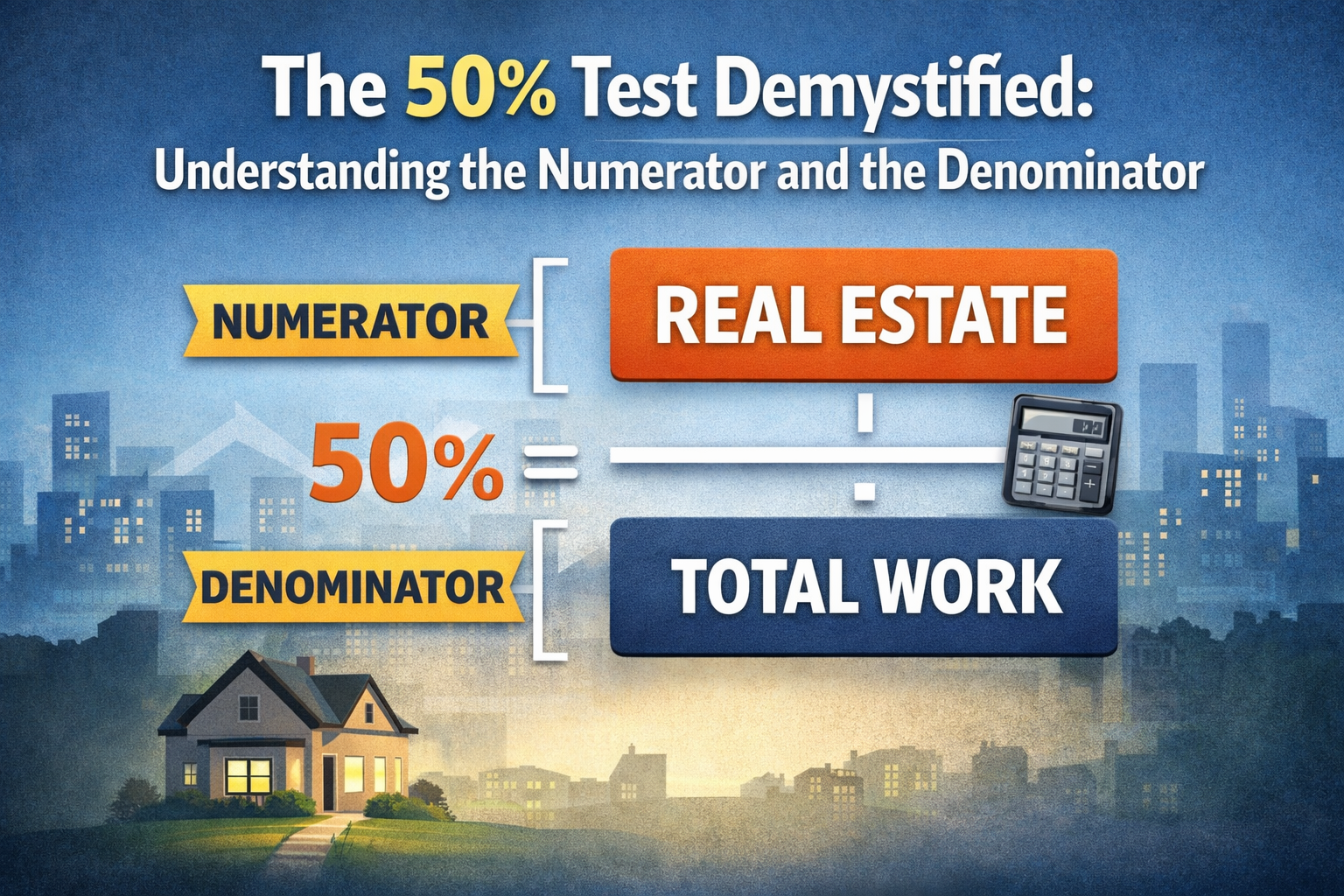
- Evidence you exceeded 750 hours AND more than 50% of your total working hours in real property trades or businesses, in the same year.
- Separate proof of material participation per property, or a documented grouping election under Reg. Section 1.469-9(g) treating all rentals as one activity.
- Tags showing who performed each activity - owner, spouse, or contractor - since only owner and spouse hours count toward your tests.
- For short-term rentals, an average-stay calculation supporting the 7-day analysis, plus your material-participation proof.
- A CPA-ready export your advisor can hand to the examiner without rebuilding anything.
Every item on that list is something the IRS will probe and something a credible record answers in advance. The recurring theme across decided cases is not that taxpayers worked too few hours - it is that they could not prove the hours they worked. REP Helper exists to close exactly that gap: it tracks your 750-hour and 50% progress live (including your outside and W-2 hours so the ratio stays honest), keeps per-property and grouped material-participation records separate, and tags each activity by who did it and which test it counts toward.
Prevention and consequence are two sides of one coin. The same evidence that keeps an examiner from disallowing your status is the evidence that, if a penalty is asserted, demonstrates the good faith needed to abate it. You are never building records for just one purpose.
Frequently Asked Questions
Q: If I lose a REP audit, do I lose my rental losses forever?
A: No. The losses are recharacterized as passive and suspended under Section 469, then carried forward. You can use them against future passive income or when you dispose of the activity in a fully taxable sale. The practical problem is timing - the benefit can be locked up for years while you pay the back tax, penalty, and interest in cash today.
Q: How many years can the IRS go back in a REP audit?
A: The IRS generally has three years from the filing date to assess additional tax, and examiners often open multiple years once they spot a recurring pattern. That window can extend in cases of substantial understatement, and there is no time limit at all where fraud is established. This is why REP positions are best understood as multi-year exposure rather than a single-year risk.
Q: Is the 20% accuracy penalty automatic if I lose?
A: No, but it is commonly asserted when the understatement is substantial. It can be abated with a reasonable-cause and good-faith showing under Section 6664, including reasonable reliance on a competent advisor who had complete information. The strength of that defense depends heavily on whether you kept credible, contemporaneous records - the same records that defend the underlying position.
Q: Can I just reconstruct my hours after I get the audit notice?
A: You can try, and an organized reconstruction is better than nothing, but after-the-fact logs are the weakest form of proof and examiners know it. Reconstruction also drives up professional fees because your advisor has to rebuild the record from scratch. Contemporaneous logging - capturing each activity as it happens - is what courts and examiners find credible, which is the entire premise behind tools like REP Helper.
Q: Roughly how much can losing a REP audit cost?
A: It depends entirely on your losses, bracket, number of open years, and state, so any figure is illustrative. But the components stack: back tax on the disallowed losses, a 20% accuracy penalty, daily-compounding interest from each return's due date, professional defense fees from a few thousand to tens of thousands, plus the deferred value of suspended losses and any state exposure. A multi-year case can easily reach six figures of total cost. Run your specific numbers with a qualified tax advisor.
About the author

Real Estate Investor · Founder, REP Helper
Carlos Lourenço is a real estate investor and the founder of REP Helper. Over 10+ years he's built a portfolio of long- and short-term rentals across several states, personally qualifying for Real Estate Professional Status (REPS) and running the short-term-rental strategy on his own properties. A product manager by trade, he built REP Helper after years of tracking his own hours and IRS tests by hand.
Connect on LinkedInDisclaimer: Carlos Lourenço is a real estate investor, not a CPA, enrolled agent, or tax attorney. This article is for educational purposes only and is not tax, legal, or financial advice. Tax outcomes depend on your specific facts and on current law, which changes. Always consult a qualified CPA or tax attorney before implementing any tax strategy.