
The Engine Behind the Loophole
The short-term rental (STR) loophole gets all the headlines, but on its own it is just a classification rule. It says that if the average guest stay at your property is 7 days or fewer, the activity is not a 'rental activity' under Reg. 1.469-1T(e)(3), so the losses are not automatically passive and you do not need Real Estate Professional (REP) status to use them. That is the door. But a door is not a deduction. What actually produces the large loss that offsets your W-2 or business income is depreciation, and specifically the accelerated depreciation that a cost segregation study unlocks.
Think of it as a two-part machine. The STR loophole changes the character of the loss from passive to non-passive. Cost segregation changes the size of the loss from a trickle into a flood. You need both. A perfectly qualifying 7-day-average STR with ordinary straight-line depreciation might throw off a modest loss over decades. The same property, after an engineering-based cost segregation study and bonus depreciation, can generate a first-year paper loss large enough to erase a six-figure chunk of active income. This article explains exactly how that synergy works, where it breaks, and what you have to prove to keep it.
The loophole decides whether the loss is usable. Cost segregation decides how big the loss is. This article is about why the two are far more powerful together than either is alone.
Default Depreciation: Slow and Lumped Together
When you buy a building, the IRS does not let you deduct the whole price the year you write the check. You recover the cost of the building over its 'recovery period' through depreciation. Land is never depreciable. The default recovery period for residential rental property is 27.5 years, and for nonresidential (commercial) property it is 39 years. Many short-term rentals, depending on how they are used and classified, end up on the 39-year clock.
By default, your tax preparer lumps the entire depreciable building into that one long-life bucket. A 1.5 million dollar building (excluding land) on a 39-year straight-line schedule produces roughly 38,000 dollars of depreciation per year. That is a real deduction, but it is thin and it is slow. It dribbles out over four decades. For a busy professional trying to offset a large salary today, a 38,000 dollar annual deduction is not the kind of number that changes a tax bill.
The key insight cost segregation exploits is that a building is not actually one homogeneous 39-year asset. It is a bundle of very different components, many of which the tax code would let you depreciate much faster if you bothered to identify and separate them.
How a Cost Segregation Study Reclassifies the Building
A cost segregation study is an engineering-based analysis that breaks your building down into its parts and assigns each part to the shortest defensible MACRS recovery period the tax law allows. Instead of one 39-year (or 27.5-year) bucket, you end up with several buckets, including 5-year, 7-year, and 15-year property. The portions that move into those shorter lives depreciate dramatically faster, and as you will see in the next section, they also become eligible for bonus depreciation.
Here is the rough logic of what gets reclassified, and why it matters so much for a short-term rental, which tends to be heavy on exactly the kinds of components that move to shorter lives.
Stays on the long clock (27.5 / 39 yr)
- Structural shell, foundation, and framing
- Roof, exterior walls, and load-bearing elements
- Standard building plumbing and HVAC that serves the structure
- Anything integral to the operation and maintenance of the building itself
Moves to shorter lives (5 / 7 / 15 yr)
- 5/7-yr: appliances, furniture, decorative fixtures, carpeting, window treatments, dedicated equipment
- 15-yr land improvements: driveways, patios, landscaping, fencing, pools, outdoor lighting
- Specialty electrical and plumbing tied to specific equipment rather than the building
- Removable and decorative finishes that are not part of the permanent structure
A furnished short-term rental is unusually rich in short-life property. The whole point of an STR is that it is turnkey: furniture, appliances, electronics, a hot tub, a deck, landscaping, outdoor lighting, the kitchen package. Those are precisely the components that a study pulls out of the 39-year bucket. It is common for a study to reclassify 20 to 35 percent of a building's depreciable basis into 5-, 7-, and 15-year property, though the exact split depends entirely on the property and must be determined by the engineering analysis, not a rule of thumb.
Cost segregation does not invent new deductions. It accelerates depreciation you were already entitled to, pulling decades of write-offs forward into the early years when they do the most good.
The Multiplier: Bonus Depreciation on Short-Life Assets
Reclassifying assets into shorter lives is powerful by itself, but the real explosion comes from how those short-life assets interact with bonus depreciation. Bonus depreciation lets you deduct a large percentage of the cost of qualifying property in the very first year it is placed in service, instead of spreading it across even the shorter 5-, 7-, or 15-year schedule. The eligibility test is simple: property with a recovery period of 20 years or less generally qualifies. That is exactly the property a cost segregation study just created.
So the chain of events is: the study moves, say, 30 percent of your building's basis into 5-, 7-, and 15-year buckets, and because every one of those buckets is 20 years or less, that entire reclassified amount becomes eligible for bonus depreciation and can be deducted in year one. The 39-year shell stays on its long schedule, but the chunk you carved off comes flooding into the current year.
On the current rules: the 2025 One Big Beautiful Bill Act (OBBBA) permanently restored 100% bonus depreciation for qualified property acquired and placed in service after January 19, 2025. Before that, bonus had been phasing down, 80% for property placed in service in 2023, 60% in 2024, and 40% for property placed in service in early 2025 before the law changed. For property placed in service after January 19, 2025, the current rule is a full 100% first-year deduction on qualifying short-life assets. As with any tax provision, rules can change, so confirm the figure that applies to your specific placed-in-service date with a professional.
Cost segregation creates the 20-year-or-less assets. Bonus depreciation lets you deduct nearly all of them at once. That combination is what turns a thin annual deduction into a single enormous first-year paper loss.
Where the Magic Happens: Synergy with the Loophole
Now connect the two halves. A large first-year depreciation deduction creates a 'paper loss', a loss on the tax return that does not reflect any cash leaving your pocket. The property can be cash-flow positive while showing a tax loss, because depreciation is a non-cash deduction. The question that decides everything is: can you use that loss against your other income?
For an ordinary long-term rental, the answer is usually no. Long-term rentals are passive activities by default, so a big paper loss is trapped, it can only offset other passive income and otherwise carries forward, doing nothing for your salary this year. This is exactly the wall that drives people toward REP status. The STR loophole offers a different door entirely. Because a 7-day-average STR is not a 'rental activity', the per-se passive rule does not apply. If you materially participate, the loss is non-passive and can offset active and W-2 income directly.
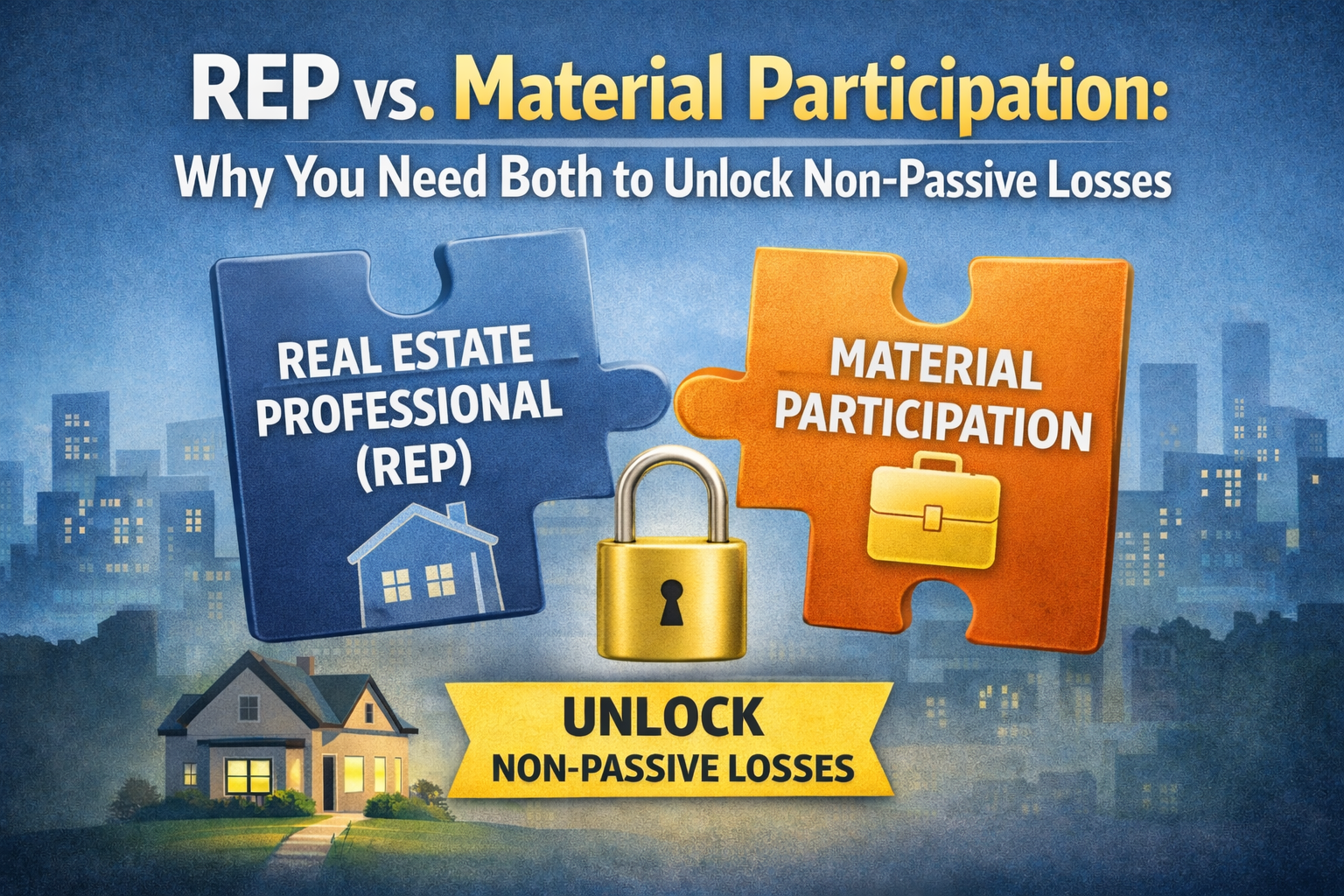
That is the synergy. Cost segregation manufactures a large loss. The STR loophole makes that loss non-passive. Material participation is the key that turns the loophole on. Strip out any one piece and the strategy collapses: no cost seg means only a small loss; no loophole (a normal long-term rental) means the loss is passive and stuck; no material participation means the loophole does not actually free the loss.
Long-term rental + cost seg
- Big first-year paper loss is created
- But the activity is passive by default
- Loss is suspended unless you have REP status or passive income
- Salary is untouched this year
7-day-average STR + cost seg + material participation
- Same big first-year paper loss is created
- Activity is NOT a rental activity, so not per-se passive
- Material participation makes the loss non-passive
- Loss can offset active and W-2 income now
An Illustration of the Combined Effect
The figures below are illustrative and rounded for teaching, not a promise or a real client outcome. Your numbers depend on your purchase price, the engineering study, your placed-in-service date, and your tax situation.
Imagine you buy a furnished STR with a depreciable building basis (after removing land) of about 800,000 dollars. On the default 39-year straight-line schedule, your first-year depreciation is roughly 20,000 dollars, a thin deduction. Now run a cost segregation study, and suppose it reclassifies 30 percent of the basis, 240,000 dollars, into 5-, 7-, and 15-year property. Because all of that is 20-year-or-less property, it is eligible for 100% bonus depreciation in the year placed in service. That 240,000 dollars can come off in year one, on top of the normal depreciation on the remaining shell.
If your average guest stay is 7 days or fewer and you materially participate, that roughly 240,000-plus dollar paper loss is non-passive. It flows against your W-2 salary or business income. The difference between a 20,000 dollar deduction and a 240,000-plus dollar deduction, applied to active income, is the entire reason this strategy exists. Note the order of operations: the cost seg supplies the size, the loophole and material participation supply the usability.
Remember the trade-off: accelerated depreciation lowers your basis, so depreciation recapture applies when you sell. Gain attributable to depreciation is taxed, partly at up to 25% for real property and at ordinary rates for personal property. Pulling deductions forward is a timing and rate-arbitrage play, not free money.
The Gate You Cannot Skip: Material Participation
Here is where most people who chase this strategy quietly fail. They buy the property, order the cost segregation study, claim the huge loss, and never seriously prove material participation. The depreciation is real, the loophole is real, but without material participation the loss is still passive and the whole plan unravels under examination.
Material participation is defined by the seven tests in Treas. Reg. 1.469-5T. For STR owners, three are the workhorses:
- The 500-hour test: you participate in the activity for more than 500 hours during the year.
- The 100-hour-and-most test: you participate more than 100 hours AND no other individual participates more than you, including cleaners, co-hosts, and property managers.
- The substantially-all test: your participation is substantially all of the participation in the activity by everyone (which can be powerful for an owner who does nearly everything).
The trap is in that second test. Hours performed by a cleaner, a co-host, an employee, or a property management company are NOT your hours, and they count toward the 'no one else participates more' comparison. If you handle bookings and guest messaging for 90 hours, but your cleaning crew logs 150 hours turning over the unit, you have failed the 100-hour test even though you were genuinely involved. The people you hired to make the STR passive in spirit are the same people who can defeat your material participation on paper.
A flawless cost segregation study attached to an activity you cannot prove you materially participated in is a disallowed loss waiting to happen. The depreciation is only as good as your hour log.
Proving the Two Things That Unlock the Depreciation
Cost segregation itself is performed by a specialist engineering firm, and you should engage a qualified provider for the study and a tax advisor to apply it. But the two facts that let you actually USE that depreciation, your average stay and your material participation, are yours to prove, and they are exactly where claims fall apart. You need contemporaneous evidence, not a reconstruction built the week before an audit.
- Confirm the property's average guest stay is 7 days or fewer, computed per property as total rental nights divided by the number of separate reservations for the year.
- Establish and document the placed-in-service date, the day the property was ready and available to rent (listed and bookable), because depreciation starts there and it must be by Dec 31 to deduct that year.
- Log your material-participation hours contemporaneously, with dates, durations, and a description of each task.
- Tag every logged activity by who performed it, you, your spouse, your cleaner, your co-host, your property manager, so you can show you out-participated everyone else for the 100-hour test.
- Choose your target material-participation test in advance (500-hour, 100-hour-and-most, or substantially-all) and track progress toward it.
- Keep the cost segregation report, depreciation schedules, and supporting records together as a CPA-ready package.
- Confirm you are not tripping a separate limit, such as personal use that turns the property into a Section 280A residence, which restricts loss deductions.
This is the part of the strategy that lives in the day-to-day, and it is the part people are worst at. REP Helper is built for exactly these two pain points. It calculates your average stay per property straight from your bookings, so you know whether you are under 7 days before you ever rely on it, and it logs your material-participation hours contemporaneously by phone, voice, or web. Crucially, it tags each activity by who performed it, owner versus spouse versus cleaner versus co-host versus property manager, which is the precise evidence the 100-hour-and-most test demands.
REP Helper also tracks your progress toward whichever material-participation test you have chosen, stores your placed-in-service date and supporting evidence, and produces CPA-ready documentation. The cost segregation firm gives you the deduction. REP Helper helps you prove the average-stay and material participation that let you actually keep it.
Pitfalls That Quietly Kill the Synergy
The strategy is sound, but the failure modes are predictable. Each of these can take a perfectly good cost segregation deduction and render it useless.
- Average stay creeps over 7 days. Add a few longer reservations and the activity can slide back into being a 'rental activity', which makes it per-se passive again and re-traps the loss.
- A property manager or cleaner out-participates you. This is the single most common defeat of the 100-hour-and-most test for hands-off owners.
- No contemporaneous log. Hours you cannot substantiate with dates and descriptions are hours an examiner can disregard.
- Placed-in-service date is wrong or unsupported. If the property was not actually ready and available to rent by Dec 31, the first-year deduction can be pushed to the next year.
- Excess personal use. Use the property yourself more than the greater of 14 days or 10% of rental days and Section 280A can limit your loss deductions.
- Assuming self-rental fixes a problem. Renting your STR to your own LLC or company does not create a tax-free arrangement; under Section 469, net rental income from property rented to an activity you materially participate in is recharacterized as non-passive, while losses generally stay passive, so it usually does not help the loophole.
- Forgetting recapture exists. The accelerated deductions reduce basis and come back as depreciation recapture on sale; plan for it rather than being surprised by it.
Notice the pattern: almost none of these are about the cost segregation study being wrong. The study is usually fine. The deduction dies on the loophole side, average stay and material participation, which is exactly the side you control day to day and the side worth instrumenting carefully.
Frequently Asked Questions
Q: Do I need Real Estate Professional status to use cost segregation losses on my short-term rental?
A: No, and that is the whole appeal. If your average guest stay is 7 days or fewer, the activity is not a 'rental activity' under Reg. 1.469-1T(e)(3), so the special rule that makes rentals automatically passive does not apply, and REP status is not required. You still must materially participate under Treas. Reg. 1.469-5T for the loss to be non-passive and offset W-2 income. So the loophole replaces the REP requirement, but never the material-participation requirement.
Q: Is cost segregation worth it without the STR loophole?
A: It can still be valuable, but it is far more powerful with the loophole. On a normal long-term rental, the activity is passive by default, so even a large cost-seg loss is usually suspended and only offsets other passive income unless you have REP status. On a 7-day-average STR where you materially participate, that same loss becomes non-passive and can offset active and W-2 income immediately. Cost segregation supplies the size of the loss; the loophole and material participation supply its usability.
Q: How much of my building can a cost segregation study move into shorter recovery periods?
A: It depends entirely on the property and must be determined by the engineering study, not a rule of thumb. Furnished short-term rentals tend to be rich in short-life property, furniture, appliances, decorative finishes, landscaping, patios, outdoor lighting, so it is common to see a meaningful share of basis reclassified into 5-, 7-, and 15-year buckets. Because all of those are 20-year-or-less property, the reclassified portion is generally eligible for bonus depreciation. A qualified cost-seg firm will give you a defensible, property-specific number.
Q: What happens to all this depreciation when I sell the property?
A: Accelerated depreciation lowers your basis, so depreciation recapture applies on sale. Gain attributable to depreciation is taxed, partly at a rate of up to 25% for real property and at ordinary rates for personal property. This means the strategy is largely a timing and rate-arbitrage play: you pull big deductions forward against high-rate active income today and pay some of it back later, ideally at a lower effective cost. A tax advisor can model the after-sale picture for your situation.
Q: I use a property manager and a cleaning crew. Can I still claim the loss?
A: Possibly, but be careful, because their hours are not your hours and they count against you on the 100-hour-and-most test. If your manager or cleaner participates more than you do, you fail that test. You would need to either clear the 500-hour test, show that your participation is substantially all of the total, or restructure how much you personally do. This is exactly why tagging each logged activity by who performed it matters; REP Helper is designed to capture that owner-versus-helper breakdown contemporaneously so you can prove you out-participated everyone else.
About the author

Real Estate Investor · Founder, REP Helper
Carlos Lourenço is a real estate investor and the founder of REP Helper. Over 10+ years he's built a portfolio of long- and short-term rentals across several states, personally qualifying for Real Estate Professional Status (REPS) and running the short-term-rental strategy on his own properties. A product manager by trade, he built REP Helper after years of tracking his own hours and IRS tests by hand.
Connect on LinkedInDisclaimer: Carlos Lourenço is a real estate investor, not a CPA, enrolled agent, or tax attorney. This article is for educational purposes only and is not tax, legal, or financial advice. Tax outcomes depend on your specific facts and on current law, which changes. Always consult a qualified CPA or tax attorney before implementing any tax strategy.