
The Question Behind the Question
Owners of short-term rentals ask a deceptively simple question: do the hours I spend on my Airbnb or VRBO count toward Real Estate Professional status? They have read that Real Estate Professional status (REP, sometimes written REPS) requires more than 750 hours and more than half of all working time in real property trades or businesses, and they are pouring real hours into cleaning, messaging guests, restocking, and pricing. It feels obvious that those hours should count.
The honest answer is: sometimes, and the reason it is only sometimes reveals a technical wrinkle that trips up even experienced investors. The same seven-day rule that makes short-term rentals attractive in the first place can also push an STR out of the "rental activity" bucket entirely. Once that happens, the way its hours interact with the 750-hour and 50% tests changes, and in many cases you no longer need Real Estate Professional status at all.
This article stays in one lane: the technical interaction between STR hours and the two REP tests. It does not re-explain how to materially participate, and it is not a head-to-head STR-versus-REP decision guide. It answers one question precisely: when do STR hours help you qualify as a Real Estate Professional, and when are they doing something else entirely?
What the Two REP Tests Actually Measure
Real Estate Professional status is earned by an individual, in a single tax year, by passing two tests at the same time. The first is the 750-hour test: you must perform more than 750 hours of services in real property trades or businesses in which you materially participate. The second is the 50% test: more than half of all the personal-service hours you perform in any trade or business during the year must be in real property trades or businesses.
The 750-Hour Test
- Counts hours in real property trades or businesses
- Threshold is more than 750 hours
- Hours must be in activities you materially participate in
- An absolute floor that does not move with your other work
The 50% Test
- Compares real property hours to ALL working hours
- Real property hours must exceed every other category combined
- A W-2 job, consulting, or side business sits in the denominator
- A ratio that gets harder the more you work elsewhere
Notice the load-bearing phrase in both tests: real property trade or business. That phrase is the hinge this entire article turns on. Hours only count toward REP if they are hours in a real property trade or business. So the real question is not "are STR hours real estate hours" in a common-sense way. It is "is your short-term rental a real property trade or business whose hours feed these two tests, or is it something else?"
Why the Seven-Day Rule Reclassifies Your STR
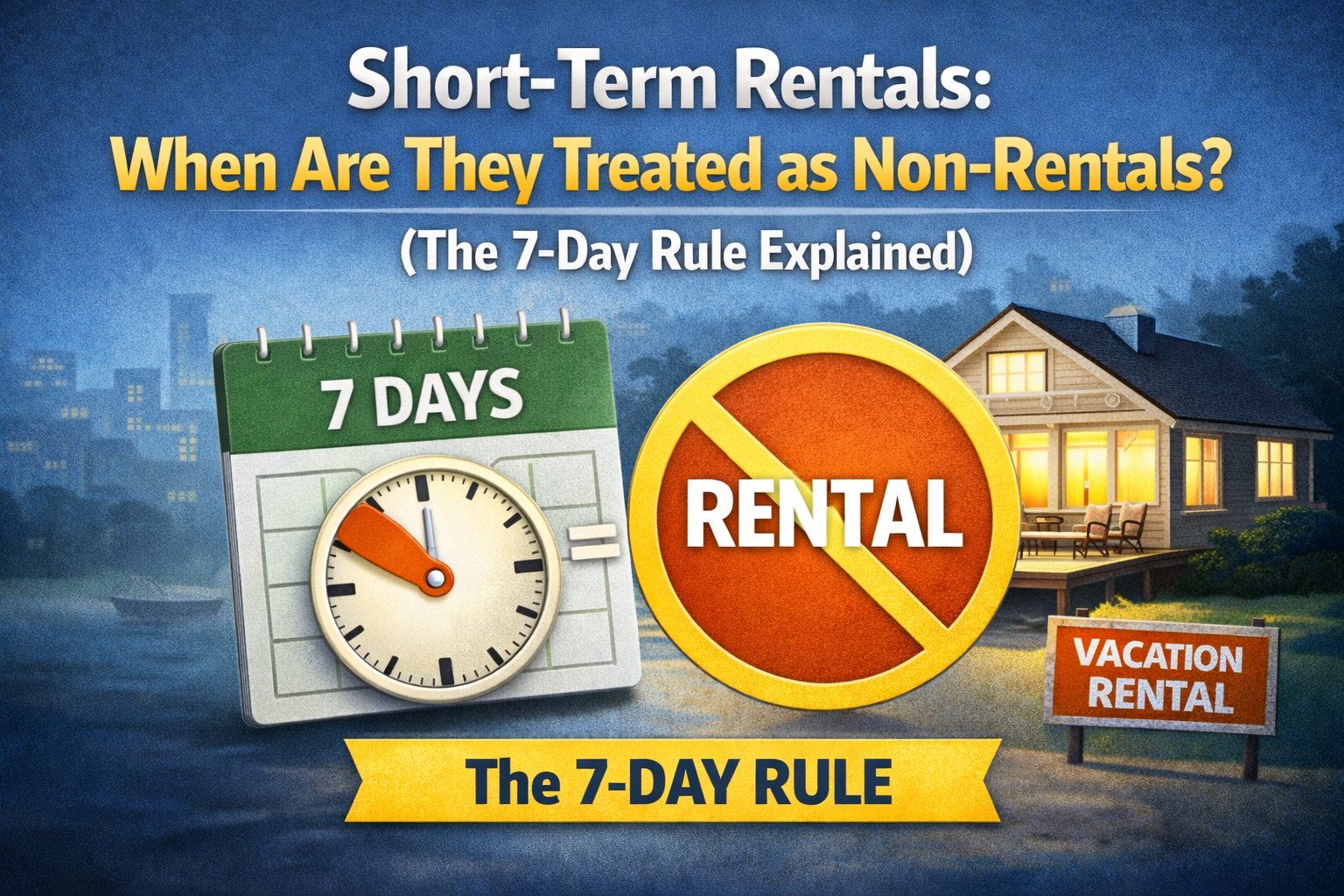
Here is the wrinkle. Under Treas. Reg. section 1.469-1T(e)(3), an activity is generally a "rental activity" only if the average period of customer use is more than seven days. If the average guest stay across your bookings is seven days or fewer, your activity is, by definition, not a rental activity for passive-loss purposes. It is treated like an operating business that happens to involve real estate, more akin to a hotel than to a long-term apartment lease.
This single classification cascades in two directions. First, because the activity is not a rental activity, it is not subject to the rule that automatically presumes all rental activities to be passive. That is the well-known "STR loophole": a non-rental activity is tested for passivity under the ordinary material-participation rules, so a host who materially participates can have non-passive income or loss without being a Real Estate Professional at all.
The same fact that creates the STR loophole, an average stay of seven days or fewer, is the fact that determines whether your STR hours feed the REP tests. You cannot reason about one without the other. They are two consequences of the same reclassification.
Second, and this is the subtle part for REP, the reclassification raises a genuine question about whether the sub-seven-day STR is a "real property trade or business" for purposes of the 750-hour and 50% tests. The definition of a real property trade or business in IRC section 469(c)(7)(C) lists categories like real property development, construction, acquisition, conversion, rental, operation, management, leasing, and brokerage. A short-term rental operation often fits comfortably within "real property operation" or "management," but the heavier the hospitality-services overlay you add, the more an examiner may view the enterprise as a services business rather than a real property business.
When STR Hours DO Count Toward REP
STR hours count toward both the 750-hour test and the numerator of the 50% test when the short-term rental is treated as a real property trade or business in which you materially participate. In practice, the typical owner-operated short-term rental, where you handle operations, management, guest coordination, maintenance, and the property itself is the core of what customers pay for, sits squarely within real property operation and management. Those hours are real property hours.
- Time spent managing the property, coordinating turnovers, and overseeing maintenance and repairs is real property operation and management.
- Time spent acquiring, improving, or preparing the property for rent fits the development, construction, and acquisition categories.
- Time spent setting rates, handling bookings, and marketing the unit as a place to stay generally supports the operation of the real property.
- When this STR is one of several real property activities, its qualifying hours stack with your other real property hours toward the 750-hour floor.
There is an important consistency point. If you want your sub-seven-day STR hours to count toward Real Estate Professional status, you are implicitly asserting it is a real property trade or business. That same position cuts both ways: the activity that helps you clear 750 hours is also part of the universe REP status applies to. Be deliberate about the characterization and keep it consistent across the return.
A common point of confusion: people assume that because a sub-seven-day STR is not a "rental activity," its hours cannot help with REP. That does not follow. "Not a rental activity" and "not a real property trade or business" are different statements. An STR can fail to be a rental activity yet still be a real property operation whose hours count toward the 750-hour and 50% tests.
When STR Is a Separate, Non-Real-Property Business
There is a category of short-term rental that drifts away from being a real property business and toward being a pure services or hospitality business. As you layer on substantial personal services, daily housekeeping, meals, concierge offerings, organized tours, transportation, the enterprise starts to resemble a bed-and-breakfast or boutique hotel operation where guests are paying for service as much as for the use of the property.
Why does this matter for the REP tests? Because hours spent in a business that is not a real property trade or business do not count toward the 750-hour test and do not count in the numerator of the 50% test. Worse, those hours land in the denominator of the 50% test, right alongside your W-2 job, making the ratio harder to satisfy. A heavily service-oriented STR can quietly become a drag on Real Estate Professional status rather than a help.
Looks Like Real Property Operation
- Furnished unit, self-check-in, periodic cleaning between stays
- Owner manages bookings, pricing, maintenance, turnovers
- Guests pay primarily for the use of the property
- Hours plausibly count toward 750-hour and 50% tests
Looks Like a Services Business
- Daily maid service, meals, concierge, organized activities
- Significant labor delivering guest services each day
- Guests pay substantially for hospitality, not just lodging
- Hours may sit OUTSIDE real property categories, hurting the 50% ratio
Most owner-operated short-term rentals fall on the left side of that line. But the distinction is real, fact-driven, and worth getting right before you rely on STR hours to qualify. Where your operation falls is a judgment call your tax advisor should weigh in on, because reasonable professionals can disagree at the margins.
REP Counts the Hours, Material Participation Uses Them
It is easy to conflate two separate gates. Passing the REP tests is one gate; materially participating in a specific activity is a second, independent gate. Real Estate Professional status, on its own, only removes the automatic passive presumption that otherwise attaches to long-term rental activities. It does not, by itself, make any particular activity non-passive.
Material participation is its own analysis under the seven tests of Treas. Reg. section 1.469-5T, with the 500-hour test being the most common to satisfy. For long-term rentals, the usual sequence is: qualify as a Real Estate Professional to lift the per-se-passive presumption, then materially participate (often using the IRC section 469(c)(7)(A) grouping election to treat all rentals as one activity) so the losses become non-passive.
For a sub-seven-day STR, the order of operations is different. Because it is not a rental activity, it never carried the per-se-passive presumption to begin with. You skip the REP step for that property and go straight to material participation. This is the structural reason so many STR owners never pursue Real Estate Professional status: the property they care about does not require it.
- REP status answers: are rental activities allowed to be non-passive for you this year?
- Material participation answers: do you participate enough in THIS activity for its income or loss to be non-passive?
- A sub-seven-day STR sidesteps the first question and depends only on the second.
- Hours can count toward REP and toward material participation, but clearing one test never automatically clears the other.
Why Many Owners Use STR INSTEAD of REP
Put the pieces together and a pattern emerges. The 50% test is brutal for anyone with a meaningful job outside real estate, because all of their non-real-estate working hours sit in the denominator. A full-time professional working a thousand-plus hours at a W-2 job faces a steep, often impossible, climb to make real estate more than half of their total working time.
The sub-seven-day STR offers a way around that wall. Because the activity is not a rental activity, it is not presumed passive, so its losses can be non-passive on the strength of material participation alone, no 50% test, no 750-hour floor, no Real Estate Professional status required. The owner only needs to clear one of the material-participation tests for that activity, which for many is the 500-hour test or, for smaller operations, the 100-hour-and-not-less-than-anyone-else test.
The REP Path
- Must clear 750 hours in real property trades or businesses
- Must clear the 50% test against ALL working time
- Then must materially participate per activity or group
- Realistic mainly for those not working full-time elsewhere
The STR Path
- No 750-hour floor required for the STR loss
- No 50% test against your W-2 hours
- Just material participation in the STR activity itself
- Workable for many busy professionals with one or two STRs
This is the heart of the interaction. STR hours can count toward Real Estate Professional status when you need them to, but for many owners the more powerful move is to not need REP at all. The same hours that might inch you toward 750 are usually better spent satisfying material participation for an activity that was never passive in the first place.
What Holds the Position Together: Records
Every conclusion above rests on facts, and facts that are not documented are facts you may not be able to prove. Two figures do the heavy lifting: your average guest stay (which determines whether the activity is a rental activity at all) and your hours by activity and category (which determine REP qualification and material participation). If you cannot substantiate both, the entire structure is exposed.
- Calculate and record the average period of customer use to confirm the seven-day classification each year.
- Log hours contemporaneously, as the work happens, rather than reconstructing them later.
- Tag each hour by activity and by which test it supports, so REP hours and material-participation hours are not muddled.
- Record who performed each task (you, your spouse, a contractor, a cleaning crew), since only the right person's hours count for each test.
- Keep the W-2 and other-business hours too, because the 50% test cannot be computed without the denominator.
- Be consistent: if STR hours count as real property hours for REP, treat the activity as a real property business everywhere on the return.
This is precisely the bookkeeping that derails busy owners. REP Helper is built for it: you log work contemporaneously by phone, voice, or web as it happens, and it tracks your 750-hour progress and your live 50% ratio at the same time, including your outside W-2 hours so the denominator is never an afterthought. It calculates your average guest stay to confirm the seven-day classification, tags each activity by who performed it and which test it counts toward, and keeps per-property and grouped material-participation tracking separate. When your advisor asks for support, the CPA-ready export is already there.
Because the average-stay number and the hour ratio can both flip a position from winning to losing, REP Helper surfaces them as live figures rather than year-end surprises, which is exactly when a fact-driven classification is easiest to defend.
Frequently Asked Questions
Q: Do my Airbnb hours count toward the 750-hour Real Estate Professional test?
A: They can, if your short-term rental is treated as a real property trade or business (such as real property operation or management) in which you materially participate. For a typical owner-operated STR, those hours generally qualify. They stop counting if the enterprise is better characterized as a non-real-property services or hospitality business, in which case the hours also count against you in the 50% test denominator.
Q: If my STR averages seven days or fewer, do I even need Real Estate Professional status?
A: Often not, for that property. A sub-seven-day STR is not a rental activity, so it is not automatically presumed passive. Its income or loss is tested under the ordinary material-participation rules, meaning you can have non-passive results by materially participating, without clearing the 750-hour and 50% REP tests at all. That is why many owners use STR instead of pursuing REP.
Q: If a sub-seven-day STR is not a rental activity, how can its hours count toward REP?
A: "Not a rental activity" and "not a real property trade or business" are different things. The seven-day test only decides whether the activity is a rental activity for the passive presumption. Whether the hours count toward REP depends on whether the activity is a real property trade or business under IRC section 469(c)(7)(C), which an owner-operated STR can be even though it is not a rental activity.
Q: Does qualifying as a Real Estate Professional automatically make my STR loss deductible?
A: No. REP status and material participation are separate gates. REP only lifts the automatic passive presumption on rental activities; it does not, by itself, make any activity non-passive. You still must materially participate in the activity (or in your grouped activities) for the loss to be non-passive. For a sub-seven-day STR, the passive presumption never applied anyway, so material participation is the controlling test.
Q: Can I mix STR hours and long-term rental hours to reach 750?
A: For the 750-hour test, hours in any real property trades or businesses you materially participate in can be aggregated, so qualifying STR hours and long-term rental hours can add together. Be aware that the grouping election under IRC section 469(c)(7)(A) is about treating rentals as a single activity for material participation and is generally irrevocable, so coordinate the characterization of each property with your tax advisor before you rely on it.
About the author

Real Estate Investor · Founder, REP Helper
Carlos Lourenço is a real estate investor and the founder of REP Helper. Over 10+ years he's built a portfolio of long- and short-term rentals across several states, personally qualifying for Real Estate Professional Status (REPS) and running the short-term-rental strategy on his own properties. A product manager by trade, he built REP Helper after years of tracking his own hours and IRS tests by hand.
Connect on LinkedInDisclaimer: Carlos Lourenço is a real estate investor, not a CPA, enrolled agent, or tax attorney. This article is for educational purposes only and is not tax, legal, or financial advice. Tax outcomes depend on your specific facts and on current law, which changes. Always consult a qualified CPA or tax attorney before implementing any tax strategy.