
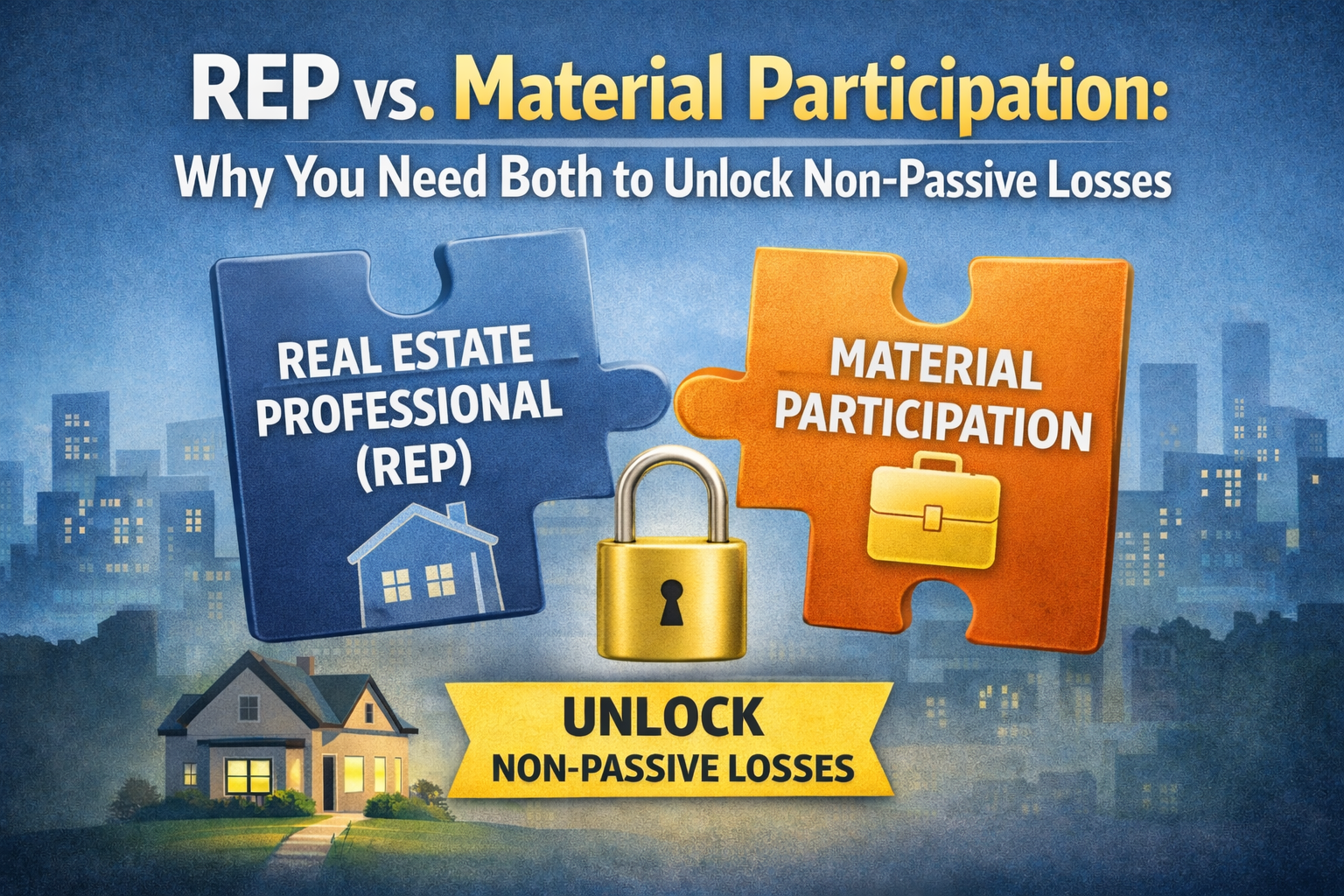
The Question, Answered Precisely
"Does Real Estate Professional status waive the passive activity loss rules?" is one of the most common questions in real-estate tax, and it is almost always answered too loosely. The short, technically correct answer is: no, REP status does not waive the passive activity loss (PAL) rules. It changes one specific input into those rules. That distinction is not pedantic; it is the difference between a deduction the IRS allows and a deduction an examiner disallows.
Section 469 of the Internal Revenue Code disallows losses from "passive activities" against non-passive income such as wages or business profits. By default, §469(c)(2) says every rental activity is passive, period, no matter how hard the owner works. That default is the per-se rule. Qualifying as a Real Estate Professional under §469(c)(7) switches that single default off for your rentals. What it does not do is declare your losses non-passive. After REP turns off the per-se rule, your rentals are tested for material participation just like any other business activity, and only material participation makes a loss non-passive.
Plain-English version: REP status moves your rentals out of the "automatically passive" bucket and into the "prove you materially participated" bucket. It does not put them in the "automatically deductible" bucket. There is no such bucket.
This article stays strictly in the mechanics of §469: what REP status legally removes, what it leaves fully intact, and where the two are routinely confused. If you are looking for the beginner-friendly story of how PALs trap losses, that ground is covered elsewhere. Here we are doing the technical anatomy.
How §469 Decides a Loss Is Passive
To see what REP changes, you have to see the logic §469 runs in order. The statute defines a passive activity as any trade or business in which the taxpayer does not materially participate, plus, separately, any rental activity. The word "rental" carries a special burden here.
Section 469(c)(2) states that the term passive activity "includes any rental activity," and §469(c)(4) adds that this applies "without regard to whether or not the taxpayer materially participates in the activity." Read those together and the per-se rule is explicit: a rental is passive even if you materially participate. For a typical landlord, no amount of hours can overcome that presumption. That is the trap REP status was written to address.
- Step 1 — Is it a rental activity? If yes, §469(c)(2) presumes it is passive automatically (the per-se rule).
- Step 2 — Does any exception turn off that presumption? REP status under §469(c)(7) is the main one for rentals.
- Step 3 — If the per-se rule is off, apply the normal test: did the taxpayer materially participate?
- Step 4 — Material participation makes the activity non-passive, so its loss can offset wages and other active income.
- Step 5 — No material participation means the activity is still passive, and the loss is suspended and carried forward.
Notice where REP status lives: only at Step 2. It is an off-switch for the per-se presumption at the rental gate. Steps 3 through 5, the material participation analysis, run exactly the same for a Real Estate Professional as for anyone else operating a non-rental business. REP status never reaches into those steps.
What REP Status Actually Waives
Here is the precise statutory mechanism. Section 469(c)(7)(A) provides that if a taxpayer qualifies as a real estate professional for the year, then §469(c)(2), the rule that makes rentals automatically passive, "shall not apply to any rental real estate activity of such taxpayer." In other words, the only thing REP status does is suspend the per-se passive treatment of rentals.
The qualification itself is demanding. To be a Real Estate Professional for the year you must meet both quantitative thresholds in the same tax year, determined per individual: more than 750 hours of service in real property trades or businesses in which you materially participate, and more than half of all your personal-service (working) hours performed in real property trades or businesses. Meeting these tests is what unlocks the off-switch; it is not, by itself, a deduction.
What REP status removes
- The §469(c)(2) per-se rule that rentals are automatically passive
- The inability to ever treat rental losses as non-passive no matter how many hours you log
- The dependence on the $25,000 special allowance (which phases out at $100k-$150k MAGI) as your only relief
What REP status leaves untouched
- The requirement to materially participate before a loss is non-passive
- The seven material participation tests of Treas. Reg. §1.469-5T
- Per-activity testing unless you make the grouping election
- The suspension and carryforward of any losses you still cannot use
Said another way: REP status converts your rentals from "passive no matter what" to "passive unless you materially participate." The word "unless" is doing all the work, and it is your job to satisfy it.
What REP Status Does NOT Waive: Material Participation
This is the heart of the confusion. Many owners believe that once they clear the 750-hour and 50% bars, their rental losses automatically become deductible against W-2 or business income. They do not. REP and material participation are two separate gates, and you must pass both. The hours you counted to qualify as a Real Estate Professional are not the same hours, and not the same test, as the hours that prove material participation in a specific rental.
Material participation is defined by Treas. Reg. §1.469-5T, which lists seven tests. You satisfy material participation in an activity if you meet any one of them. The most commonly used is the 500-hour test: more than 500 hours of participation in that activity during the year. Others include performing substantially all of the participation, or participating more than 100 hours and not less than any other individual. REP status does nothing to lower or remove these tests; it simply makes them relevant to your rentals, which they were not while the per-se rule applied.
- REP qualification is measured across all your real property trades or businesses combined (the 750-hour and 50% tests).
- Material participation is measured per activity (per property, unless you group), under the §1.469-5T tests.
- It is entirely possible to be a valid Real Estate Professional and still fail material participation on one or more individual properties.
- When that happens, the loss on that property remains passive and is suspended, even though you hold REP status for the year.
The trap looks like this: an owner with several scattered rentals clears 800 total hours and qualifies as a REP. But spread across six properties, no single property gets 500 hours, and the owner never made the grouping election. Result: REP status achieved, material participation failed property-by-property, losses still suspended. The off-switch worked; the deduction did not arrive because the second gate was never opened.
The Grouping Election: Where the Two Gates Meet
If material participation is tested per property, owners of multiple rentals face a real arithmetic problem. Hours that comfortably clear the REP thresholds in aggregate can fall short on every individual property. The intended solution is the grouping election under IRC §469(c)(7)(A) and Treas. Reg. §1.469-9(g).
The election lets a qualifying Real Estate Professional treat all interests in rental real estate as a single activity. Once grouped, material participation is tested against the combined activity, so your total hours across the portfolio count toward one 500-hour bar rather than several. For the owner with six properties and 800 combined hours, grouping can turn six near-misses into one clear pass.
- Confirm you actually qualify as a Real Estate Professional for the year first; the election is only available to REPs.
- Make the election by attaching a written statement to your timely filed original return declaring the grouping under §1.469-9(g).
- Understand the election is generally binding and irrevocable for future years absent a material change in facts.
- Recognize the trade-off: grouping can affect how suspended losses are freed when you later sell a single property.
- Keep aggregate-and-per-property hour records so you can support material participation under either approach.
The grouping election is not automatic and is easy to miss. There is no box to check on the form; it is a statement you attach. Owners who assume REP status alone aggregates their rentals are mistaken, and a forgotten election is one of the most common reasons a legitimately qualified REP still cannot deduct portfolio-wide losses.
A Different Path: Short-Term Rentals and the 7-Day Rule
There is a separate corner of §469 worth flagging because it is constantly conflated with REP status. Under Treas. Reg. §1.469-1T(e)(3), an activity is not a "rental activity" at all if the average period of customer use is seven days or less. This is a definitional carve-out, not an exception you elect.
Because a qualifying short-term rental is not a rental activity, the per-se passive rule of §469(c)(2) never applied to it in the first place. That means REP status is not required to escape the per-se rule for an STR. But, and this is the same lesson restated, you still must materially participate to make the loss non-passive. The 7-day rule and REP status are two different ways to get past the rental gate; neither one waives material participation.
REP path (long-term rentals)
- Activity IS a rental, so per-se passive applies by default
- Need REP status to switch off the per-se rule
- Then need material participation per property or per group
- Grouping election available to aggregate hours
STR path (average stay 7 days or less)
- Activity is NOT a rental, so per-se passive never applied
- REP status not required
- Still need material participation under §1.469-5T
- Average-stay calculation must be documented to support the carve-out
The common thread across both paths is unmistakable: getting out of the per-se rule, by whichever route, only buys you the right to be tested for material participation. It never substitutes for it.
Common Misreadings That Lose Deductions
Because the REP-versus-material-participation distinction is subtle, the same handful of mistakes recur. Each one stems from treating REP status as a deduction rather than as a single off-switch within a longer test.
- "I qualified as a REP, so my losses are deductible." No. REP status only removes the per-se rule; you still must materially participate in the activity.
- "My 800 REP hours prove material participation." Not directly. REP hours are aggregate; material participation is usually tested per property unless you grouped.
- "Grouping happens automatically once I'm a REP." No. The §1.469-9(g) election is a written statement you attach; nothing aggregates by default.
- "My short-term rental needs REP status." Usually not, if average stay is 7 days or less; but it still needs material participation.
- "If I can't use the loss this year it's gone." No. Disallowed passive losses are suspended and carried forward to future passive income or disposition.
Every one of these errors is survivable on paper and fatal on audit. The IRS does not have to argue that you failed to work hard; it only has to point out that REP status and material participation are different tests and that you documented one but not the other.
Documenting Both Gates, Not Just One
Because two distinct tests must each be satisfied, your records have to prove two distinct things. The first is REP qualification: that your real-property hours exceeded 750 and topped half of all your working hours for the year. The second is material participation: that for each property, or for the grouped portfolio, your participation cleared one of the §1.469-5T tests. A log that supports only the first leaves the second undefended, and that is exactly the gap examiners probe.
Contemporaneous records carry far more weight than a spreadsheet reconstructed the week before an audit. The regulations contemplate reasonable means of proof, but reconstructed estimates are routinely discounted. The practical answer is to capture the work as it happens and to tag each entry with enough detail to map it to the right test.
This is where contemporaneous tracking earns its keep. REP Helper is built to log activity by phone, voice, or web as the work happens, and it tracks both the 750-hour and 50% progress at once, counting your outside W-2 hours too so the ratio updates live rather than being guessed at year-end. That directly addresses the first gate, REP qualification, which the §469 logic runs before material participation is even reached.
For the second gate, the tool keeps separate per-property and grouped material-participation tracking, tags each activity by who performed it and by which test it counts toward, and computes average stay for short-term rentals so the 7-day carve-out is supportable. When the two gates require two bodies of evidence, having them maintained side by side, with CPA-ready exports, is the difference between a clean answer and a scramble.
Putting It Together: The Decision Path
If you walk the §469 logic in order, the role of REP status stops being mysterious. It is one node in a chain, not the whole chain. Run your situation through the same sequence the statute does.
- Is the activity a rental? If average stay is 7 days or less, it is not a rental activity and the per-se rule never applied; skip to material participation.
- If it is a rental, did you qualify as a Real Estate Professional this year (750+ hours and more than 50% of working hours)? If not, it stays per-se passive.
- If you are a REP, the per-se rule is now off for your rentals. You have cleared the gate REP status governs, and nothing more.
- Did you materially participate in the activity, per property or per the grouped portfolio, under one of the seven §1.469-5T tests?
- If yes, the loss is non-passive and can offset active income. If no, the loss stays passive, suspends, and carries forward.
- If you own several properties, confirm whether the §1.469-9(g) grouping election was made; without it, you are tested property-by-property.
Every disallowed-loss surprise involving a Real Estate Professional traces back to skipping or assuming one of these steps. REP status answers exactly one of them. The rest are still yours to prove. Given how fact-specific grouping and material participation can be, this is a good area to confirm your approach with a tax advisor who can look at your full picture.
Frequently Asked Questions
Q: Does Real Estate Professional status make my rental losses automatically deductible?
A: No. REP status only removes the §469(c)(2) per-se rule that treats rentals as automatically passive. After that rule is off, your rentals are tested for material participation under Treas. Reg. §1.469-5T just like any other business. Only material participation makes the loss non-passive and deductible against active income.
Q: I logged over 750 hours and qualified as a REP. Doesn't that prove material participation?
A: Not directly. REP qualification is measured in the aggregate across all your real property trades or businesses, while material participation is generally measured per property. You can be a valid REP and still fail material participation on an individual rental if that property did not meet one of the seven tests, such as the 500-hour test, on its own.
Q: How do I combine my hours across several rentals so they count together?
A: You make the grouping election under IRC §469(c)(7)(A) and Treas. Reg. §1.469-9(g), which lets a qualifying REP treat all rentals as a single activity for material participation. It is done by attaching a written statement to your timely filed return; it does not happen automatically, and it is generally irrevocable, so weigh it carefully or with your advisor.
Q: Do short-term rentals need REP status to be deductible?
A: Usually not. If the average guest stay is seven days or less, the activity is not a rental activity under Treas. Reg. §1.469-1T(e)(3), so the per-se passive rule never applied and REP status is not required. You must still materially participate, however, for the loss to be non-passive.
Q: What happens to a rental loss I can't use because I failed material participation?
A: It is not lost. A disallowed passive loss is suspended and carried forward indefinitely. You can use it against future passive income from that activity, or it is generally freed when you dispose of the entire interest in a fully taxable transaction.
About the author

Real Estate Investor · Founder, REP Helper
Carlos Lourenço is a real estate investor and the founder of REP Helper. Over 10+ years he's built a portfolio of long- and short-term rentals across several states, personally qualifying for Real Estate Professional Status (REPS) and running the short-term-rental strategy on his own properties. A product manager by trade, he built REP Helper after years of tracking his own hours and IRS tests by hand.
Connect on LinkedInDisclaimer: Carlos Lourenço is a real estate investor, not a CPA, enrolled agent, or tax attorney. This article is for educational purposes only and is not tax, legal, or financial advice. Tax outcomes depend on your specific facts and on current law, which changes. Always consult a qualified CPA or tax attorney before implementing any tax strategy.