
One Number Decides Everything
The short-term rental loophole rests on a single, fragile number. Under Treasury Regulation Section 1.469-1T(e)(3), a property is only a "rental activity" if the average period of customer use is more than seven days. If your average guest stay comes in at seven days or fewer, the property is not a rental activity for passive-loss purposes, the automatic-passive label never attaches, and as long as you materially participate, your losses can offset W-2 wages and other active income without Real Estate Professional status. That is the whole loophole, and it lives or dies on that average.
Most articles about the seven-day rule teach you how to calculate the average. This one is about how people get it wrong. Because the test is an average and not a ceiling, it fails quietly. There is no alarm when a single mid-term booking lands. There is no warning when your bookkeeper records nights instead of stays. You can run a property all year believing you are comfortably inside the loophole, file your return, and only discover during an audit, or during a careful CPA review, that your true average was 8.4 days and the whole deduction was never available.
The painful part is timing. The average is fully knowable on December 1, while you can still adjust pricing, minimum-stay settings, and bookings. It is far too late to fix on April 1, when the year is closed. Failing the seven-day test is almost always a monitoring failure, not a strategy failure.
Below we walk through the specific failure modes, the booking patterns and arithmetic mistakes that push owners over the line, then how to monitor the number through the year and how to course-correct if you see it slipping. Rules here are technical and fact-specific, so treat this as a way to ask sharper questions, not as a substitute for advice from a qualified tax advisor on your actual return.
How the Average Is Actually Computed
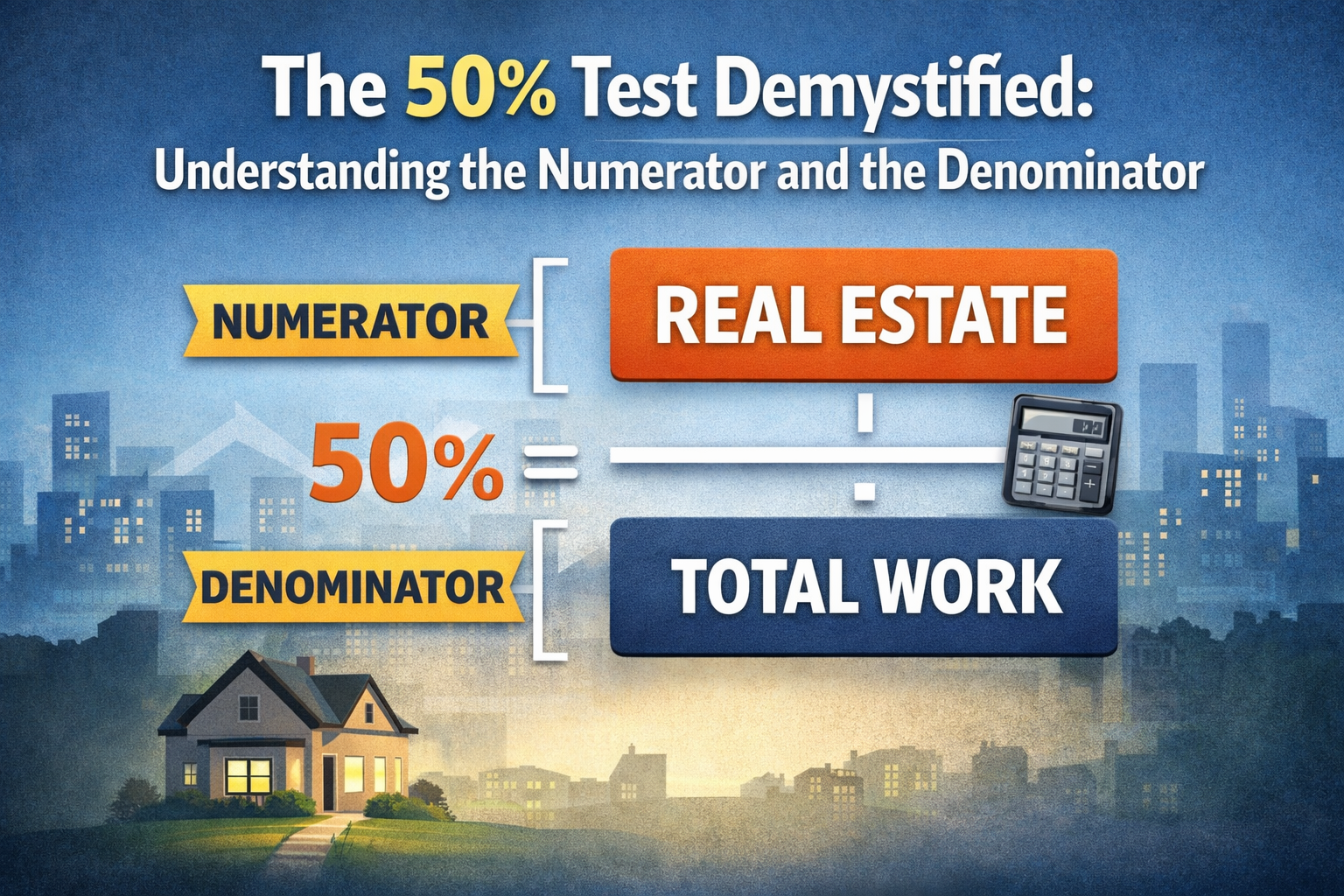
You cannot spot a failure mode until you know the exact formula, because most failures come from using the wrong one. The average period of customer use is computed per property, per tax year, as total rental days divided by the number of separate guest stays (reservations). Each distinct booking counts as one stay, regardless of how many nights it spans.
What goes in the numerator
- Total nights actually rented across the whole year
- Every paid reservation's nights, counted once
- Both peak-season and shoulder-season bookings
What goes in the denominator
- The count of separate reservations, not nights
- Each guest's single booking, however long
- A back-to-back guest as a new, separate stay
Walk through a clean example. Over the year a cabin has 40 reservations totaling 250 rented nights. The average is 250 divided by 40, which is 6.25 days. Comfortably under seven. Now change one fact: one of those guests stayed for 45 nights instead of 3, so total nights jump to 292 and reservations stay at 40. The average becomes 292 divided by 40, which is 7.3 days. The same property, with the same number of bookings, just failed the test because of one long stay. Nothing else changed.
That single-booking sensitivity is the heart of every failure mode in this article. The seven-day test is an average, so a handful of outliers carry enormous weight. The fewer total reservations you have, the more each long stay hurts.
Failure Mode 1: A Few Long Bookings
The most common way owners blow the seven-day test is by accepting a small number of unusually long stays without doing the math. A property booked mostly for weekend getaways and weeklong vacations sits at an average of four or five days for ten months. Then a relocating family books six weeks, or a traveling nurse takes the place for a season, and the owner thinks: it is just one booking, it cannot matter much.
It matters enormously, because of leverage. A 42-night booking does not add 42 to your average; it adds 42 nights to the numerator while adding only 1 to the denominator. On a property with 30 short reservations, that single long stay can swing the average by more than a full day. Two of them can be fatal.
- Low-volume properties are most exposed: a lake house with 18 bookings has far less cushion than a downtown condo with 90.
- Off-season is the danger zone: owners often relax minimum-stay rules in slow months and accept whoever shows up, which is exactly when long bookings sneak in.
- The damage is cumulative: each long stay you accept raises the bar that the rest of your short bookings must drag the average back under.
The fix is not to refuse all long stays, it is to know your cushion before you accept one. If your running average is 5.1 days with 30 bookings, you can absorb a long reservation. If it is 6.6 days with 20 bookings, the next 30-night booking ends your loophole for the year. REP Helper calculates your running average stay per property from your booking data, so you can see that cushion shrink in real time instead of discovering it in April.
Failure Mode 2: The Quiet 30-Day Mid-Term Stay
Mid-term rentals, often 30 to 90 days for traveling professionals, students, or insurance-displaced tenants, are a booming niche and a silent killer of the seven-day test. They are attractive because they are stable, low-turnover, and easy to manage. That is exactly why owners drift into them without realizing they are sabotaging their tax strategy.
There is a second, separate rule worth knowing here. Even if your average lands between eight and 30 days, there is a fallback under the regulations: the property can still escape rental-activity treatment if the average stay is 30 days or fewer AND you provide significant personal services, or if it is part of a larger trade or business meeting certain conditions. But the clean, services-light version of the loophole, the one most STR owners are actually relying on, requires the seven-day-or-fewer average. Mixing in a few mid-term stays usually pushes you out of the easy lane and into a harder one with extra requirements.
Why mid-term stays creep in
- Platforms actively promote 28-plus-night discounts
- Fewer turnovers means less cleaning and coordination
- A long booking feels like guaranteed income in a slow month
Why they break the test
- A single 30-night stay adds 30 nights but only 1 reservation
- Two or three a year can lift the average past seven on most properties
- They quietly move you from the seven-day rule to the harder 30-day-with-services path
If your business model is genuinely mid-term, that is a legitimate strategy, but it is a different one with different rules. The mistake is running a short-term strategy on paper while accepting mid-term bookings in practice, and never reconciling the two until the return is due.
Failure Mode 3: Miscounting Stays Versus Nights
Some failures are arithmetic, not booking behavior. The single most common calculation error is confusing the denominator. The average is total nights divided by the number of separate reservations, not nights divided by nights, and not some platform-reported "average length of stay" that may be calculated differently than the regulation requires.
- Counting nights as stays: dividing 250 nights by 250 "nights" gives a meaningless answer of 1.0. The denominator must be the count of bookings.
- Trusting a platform metric blindly: dashboards report their own average-stay numbers, which may exclude canceled bookings, blend properties, or use a different window than your tax year.
- Ignoring back-to-back bookings: two consecutive guests are two separate stays even with no gap between them, and each adds 1 to the denominator.
- Forgetting partial-year placed-in-service timing: only count nights and reservations for the period the property was actually available and rented.
These errors cut both ways. Some owners think they pass when they fail, having used too generous a denominator. Others think they fail when they pass, having miscounted and given up on a strategy that was actually available. Either way, the only cure is computing the regulation's exact ratio, per property, from clean booking records.
When an examiner reconstructs your average, they will pull every reservation and every night and do the division themselves. If your number does not match theirs, the loophole is gone. Keeping the underlying booking-by-booking record, not just a summary figure, is what lets you defend the calculation. REP Helper keeps that booking-level detail and derives the average the way the regulation defines it, per property.
Failure Mode 4: Mixing Properties Together
The seven-day average is computed per property, by default, unless you have made a valid election to group activities under the Section 469 grouping rules. Owners with two or three rentals routinely make one of two opposite mistakes, and both can be costly.
Mistake: blending when you shouldn't
- Averaging all properties into one figure to make a borderline property look like it passes
- Assuming a portfolio-wide average satisfies the test for each property
- Letting one heavy short-stay condo "cover" a failing mid-term house
Mistake: ignoring valid grouping
- Treating closely linked properties as separate when a grouping election would help
- Not documenting a grouping election and then relying on it
- Changing groupings year to year without consistency
The default rule is the safe mental model: each property must pass the seven-day test on its own. If you are relying on grouping to change that result, that election has formal requirements and real consequences for material participation and disposition, so it is exactly the kind of decision to make deliberately with your CPA rather than to back into on the spreadsheet. Calculating each property's average separately first tells you which ones actually need help.
Monitoring the Number All Year
Every failure mode above is preventable with one habit: watch the average as a live number, not a year-end calculation. The investors who fail are almost never the ones who looked. They are the ones who assumed. Here is a monitoring rhythm that keeps the surprise out of April.
- Recompute your running average stay per property at least monthly, and again before accepting any booking longer than your usual range.
- Track your cushion explicitly: how many extra long nights could you absorb right now before crossing seven days?
- Flag every reservation of eight nights or more for a deliberate look, since those are the only ones that pull the average up.
- Reconcile platform dashboards against your own per-property, per-tax-year calculation; never rely on the platform's number alone.
- Set minimum-stay and maximum-stay rules intentionally for slow months, when long bookings are most tempting.
- Keep the booking-by-booking record current so the year-end figure is just confirmation, not discovery.
Contemporaneous tracking is the throughline of this entire strategy. The same discipline that proves your material-participation hours also proves your average stay. REP Helper calculates the average per property from your bookings and logs your participation hours as you go, tagging who did each task, so both halves of the loophole are documented before you ever need them.
How to Course-Correct Mid-Year
Suppose it is October and your running average for a property has crept to 7.4 days. You are over the line, but the year is not closed. You still have levers, and the more reservations you have left to come, the more they can move the number.
- Add more short bookings: each additional short stay lowers the average, because it adds nights modestly while adding a full count to the denominator. A burst of weekend bookings in Q4 can pull a borderline property back under.
- Cap stay length: tighten the maximum-stay setting so no further long reservations land and worsen the average.
- Decline or restructure pending long requests: a 30-night inquiry you have not yet accepted is still optional.
- Reprice for turnover: lower nightly rates with strict minimums can drive volume of short stays in the remaining weeks.
If the math simply cannot recover, do not pretend it can. Accept that this property will not qualify under the seven-day rule this year and pivot the analysis. Two honest alternatives exist: lean into the longer-stay path with its services requirement if that fits, or evaluate whether Real Estate Professional status is achievable for you or your spouse this year so the losses become non-passive a different way. Both decisions need to be made before December 31, which is precisely why the monitoring matters.
Knowing your number in October is the difference between a strategy choice and a tax-time accident. The owner who learns the average is too high in April has no options left. The owner who learns it in October has four of them.
Passing the Test Is Necessary, Not Sufficient
One last failure mode deserves naming, because it is the cruelest. Some owners obsess over the seven-day average, nail it perfectly, and then lose the deduction anyway, because clearing the seven-day rule only takes the property out of automatic-passive treatment. It does not make your losses non-passive on its own. For that, you must also materially participate in the activity under one of the seven tests of Treasury Regulation Section 1.469-5T.
For most STR owners the realistic tests are: more than 500 hours on the activity; or more than 100 hours where no other single person, including your cleaner, co-host, or property manager, did more than you; or doing substantially all of the work. The 100-hour test is where people fall, because a property manager or cleaning company can easily out-hour the owner, which defeats it. Contractor, employee, and property-manager hours never count as your hours.
So the seven-day average and material participation are two locks on the same door, and you have to open both. REP Helper tags each logged activity by who performed it, owner, spouse, cleaner, co-host, or property manager, so you can prove you out-participated everyone else for the 100-hour test, and it tracks your progress toward whichever test you have chosen. Cost segregation, which front-loads the depreciation that creates these losses, is handled by a specialist firm; REP Helper's job is to prove the average stay and the participation that let you actually use that depreciation.
Frequently Asked Questions
Q: Is the seven-day test a maximum stay or an average?
A: It is an average, which is what makes it so easy to fail by accident. Individual guests can stay longer than seven days. What matters is that total rented nights divided by the number of separate reservations, computed per property for the year, comes out to seven days or fewer. Because it is an average, a few long bookings carry far more weight than their count suggests and can pull an otherwise-short-stay property over the line.
Q: One guest booked my place for 40 nights. Did I automatically fail?
A: Not automatically, but it raised your average significantly. That stay added 40 nights to your numerator while adding only 1 to your denominator. Whether you still pass depends on how many other short reservations you have. With many short bookings you may absorb it; with few, that single stay can push you over seven days. Run the actual per-property division for the year to know where you stand, ideally before year-end while you can still add short bookings to recover.
Q: Can I average all my properties together to pass the test?
A: Generally no. The average period of customer use is computed per property by default. You cannot let a heavy short-stay condo "rescue" a mid-term house by blending them. There are formal Section 469 grouping elections that can, in specific circumstances, treat activities as one, but those carry real requirements and consequences and should be made deliberately with your CPA, not assumed on a spreadsheet.
Q: My booking platform shows an average length of stay. Can I just use that?
A: Treat it as a hint, not as your tax number. Platform metrics may exclude canceled bookings, blend multiple listings, or use a different date window than your tax year, and they may not define the average the way the regulation does. Recompute it yourself per property and per tax year from the underlying booking records, and keep that booking-level detail so you can defend the figure if it is ever questioned.
Q: I realized in November my average is over seven days. Is the strategy dead for the year?
A: Not necessarily, and November is much better than April. You can add short bookings, cap maximum stay length, and decline pending long requests to pull the average back under. If the math truly cannot recover, you still have time before December 31 to pivot to the longer-stay path with services or to evaluate Real Estate Professional status for you or your spouse. The point is that options exist mid-year and vanish once the year closes, which is the whole case for monitoring the number continuously.
About the author

Real Estate Investor · Founder, REP Helper
Carlos Lourenço is a real estate investor and the founder of REP Helper. Over 10+ years he's built a portfolio of long- and short-term rentals across several states, personally qualifying for Real Estate Professional Status (REPS) and running the short-term-rental strategy on his own properties. A product manager by trade, he built REP Helper after years of tracking his own hours and IRS tests by hand.
Connect on LinkedInDisclaimer: Carlos Lourenço is a real estate investor, not a CPA, enrolled agent, or tax attorney. This article is for educational purposes only and is not tax, legal, or financial advice. Tax outcomes depend on your specific facts and on current law, which changes. Always consult a qualified CPA or tax attorney before implementing any tax strategy.