
The Numbers That Actually Decide REP Status
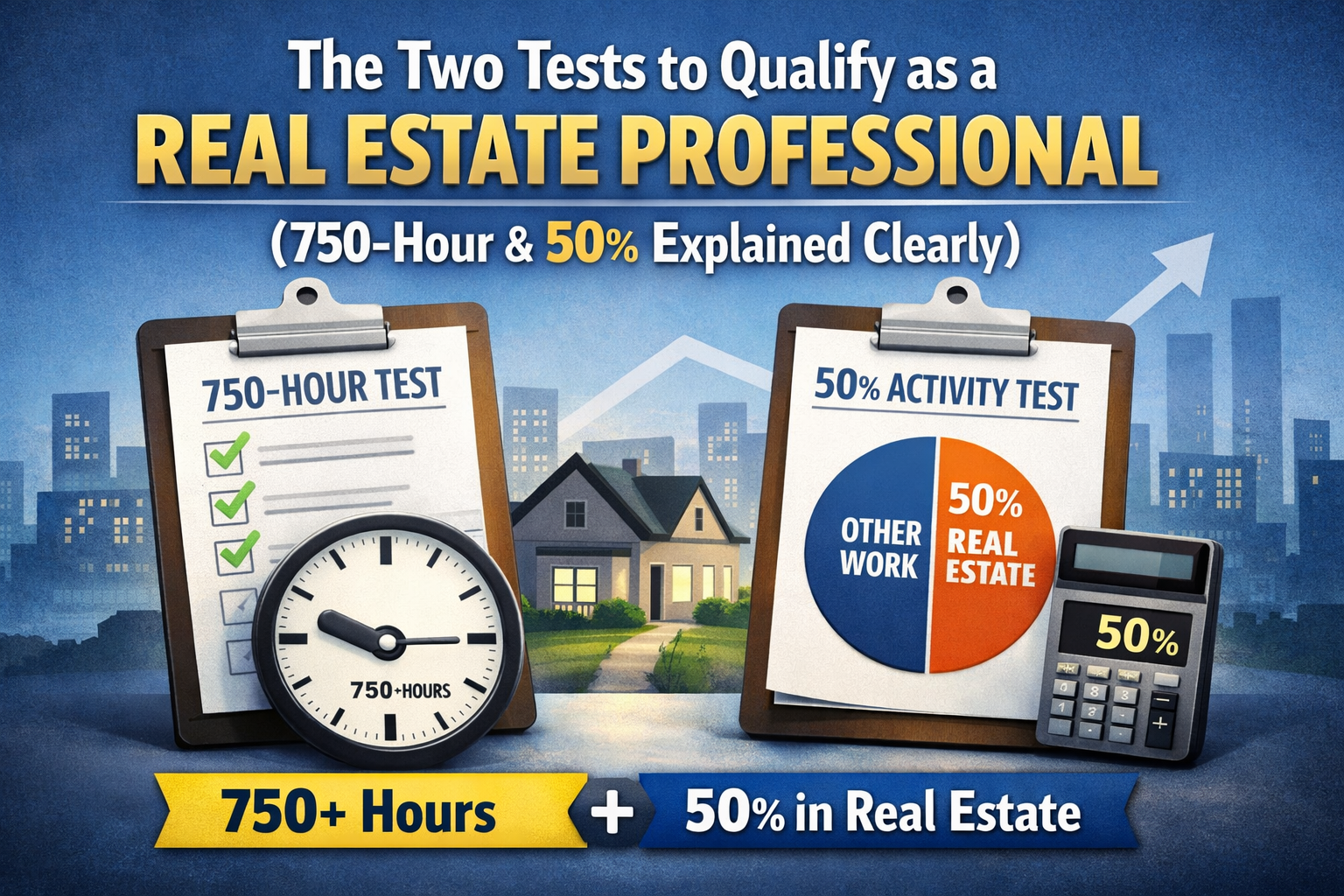
Real Estate Professional status and the material-participation rules behind it come down to a small set of very specific numbers: 750, 50%, 500, and 100. Each is a hard line. There is no "close enough," no rounding up, and no banking unused hours for next year. Yet most people who chase REPS misunderstand which number applies to which test, whether the numbers add together, and what the IRS will actually accept as an hour.
This article is a precise reference to those thresholds and the fine print that governs them. We will pin down what each number measures, in what unit, over what period, and for which person. Then we will walk through how the numbers interact, because clearing one threshold does almost nothing for you unless you understand how it connects to the others. If you only read one section, read the one on how the thresholds stack.
Quick map: 750 hours and the 50% ratio decide whether you are a Real Estate Professional. The 500-hour and 100-hour figures are material-participation tests that decide whether your rental losses are passive. Different tests, different jobs, same calendar year.
The 750-Hour Line, To the Hour
The first REP requirement is straightforward to state: you must perform more than 750 hours of services during the tax year in real property trades or businesses in which you materially participate. "More than" is literal. The statute uses 750 as a floor, so 750.0 hours flat does not clear it; you need 751 or more. There is no proration for a short year and no credit for hours your spouse worked when you are the one trying to qualify, because the test is applied to each individual.
- Unit: clock hours of personal service that you actually performed.
- Period: the single tax year, January 1 to December 31 for most filers. Hours do not roll forward or back.
- Counted activities: development, redevelopment, construction, reconstruction, acquisition, conversion, rental, operation, management, leasing, and brokerage of real property.
- A critical limiter: only hours in real property trades or businesses in which you materially participate count toward the 750. A property you own but barely touch contributes nothing here.
That last point trips people up. The 750-hour test is not "any real estate hours." It is hours in real property businesses where you also meet a material-participation standard. So the 750 test and the 500-hour material-participation test are not separate worlds; the activities feeding your 750 must themselves be ones you materially participate in.
The 50% Test: A Ratio, Not an Hour Count
The second REP requirement is the one people quietly fail. More than half of all the personal services you perform in all trades or businesses during the year must be in real property trades or businesses in which you materially participate. This is a ratio, not a fixed number of hours, which is exactly why it is harder than it looks.
Numerator (must be larger)
- Your real property trade-or-business hours where you materially participate
- The same hours that feed your 750-hour count
- Brokerage, management, leasing, construction, and so on
Denominator (everything)
- All your real property hours, plus
- Every hour at your W-2 job or other business
- Side gigs, consulting, any personal-service work
- The ratio must exceed 50%, not merely reach it
Here is the math that defeats most full-time employees. A standard full-time job runs roughly 2,000 hours a year. To put more than 50% of your working time into real estate, your real estate hours would have to exceed your job hours, which means you would need 2,001+ real estate hours on top of, or instead of, that job. The 750-hour floor is easy by comparison; the 50% ratio is the real wall. Tracking the denominator live, not reconstructing it in April, is the only way to know where you stand. REP Helper logs your real estate work as it happens and also captures your outside and W-2 hours, so the ratio updates continuously instead of becoming a year-end guess.
Where 500 and 100 Come In
Clearing 750 hours and the 50% ratio makes you a Real Estate Professional, but that alone does not make a single dollar of rental loss deductible against your salary. REP status only removes the automatic "all rentals are passive" presumption. You then have to materially participate in the rental activity itself, measured by the seven tests of Treasury Regulation §1.469-5T. The 500-hour and 100-hour figures live here, in material participation, not in the REP definition.
- 500-hour test: you participate in the activity for more than 500 hours during the year. This is the cleanest and most commonly used test.
- 100-hour alternative test: you participate for more than 100 hours AND no other individual (including any employee, property manager, or contractor) participates more than you do.
- Significant participation: an activity counts as significant if you do more than 100 hours but it is not your principal activity; if your total across all such significant-participation activities exceeds 500 hours, you can qualify on that combined basis.
- There are seven tests in total; 500 and 100 are simply the two with concrete hour thresholds you will rely on most.
The 100-hour test is conditional, not just numeric. Beating 100 hours is meaningless if your property manager logged more hours than you did. Tracking who performed each task is what makes or breaks this test.
Because the 100-hour test hinges on out-participating everyone else, you have to know not just your hours but theirs. REP Helper lets you tag each logged activity by who performed it, owner, spouse, or contractor, and by which test it counts toward, so you can see in real time whether you are still ahead of your manager on a given property.
How the Thresholds Stack (Read This Twice)
The numbers do not live in isolation; they chain together in a specific order, and skipping a link breaks the whole result. Think of it as a two-stage gate that must close in the same tax year.
Stage 1: Become a REP
- More than 750 hours in qualifying real property businesses
- More than 50% of all working hours in those businesses
- Applied to you as an individual, this tax year
Stage 2: Beat passivity per activity
- Materially participate in each rental (e.g., 500 hours)
- Or elect to group rentals and clear 500 once
- Only then are losses non-passive and usable
A subtle interaction: the same hours can count in more than one place when they belong to the same qualifying activity. Hours managing a rental you materially participate in can count toward your 750-hour REP floor, toward the numerator of your 50% ratio, and toward that property's 500-hour material-participation test simultaneously. They are not double-counted in a forbidden way; they are simply one set of hours satisfying multiple tests that each ask about them. What you cannot do is borrow hours from an activity you do not materially participate in to pad your 750, or borrow a future year's hours to rescue this year.
The order also matters for failure analysis. If you fail Stage 1, the 500-hour question never arises; your rentals stay passive regardless of how hard you worked any single property. If you pass Stage 1 but fail Stage 2 on a property, that property's loss is still passive even though you are a bona fide Real Estate Professional. People lose deductions at both gates for different reasons.
Grouping Changes the Math
By default, material participation is tested property by property. Own eight rentals and you face eight separate 500-hour bars, which is usually impossible. The aggregation election under IRC §469(c)(7)(A) and Treasury Regulation §1.469-9(g) changes that by letting you treat all of your rental real estate as a single activity. After grouping, you apply the 500-hour test once to the combined activity.
- What it does: collapses many separate 500-hour tests into one, so 80 hours on each of seven properties (560 total) can clear a single 500-hour bar.
- How it is made: by a written statement attached to your timely filed original return declaring the election under §469(c)(7)(A).
- Durability: the election is generally binding for all future years and is only revocable in limited circumstances, such as a material change in facts.
- What it does not do: grouping helps with the 500-hour material-participation step; it does not lower the 750-hour or 50% REP thresholds, which remain individual.
Grouping is the single most powerful lever for an owner whose hours are spread thin across a portfolio. It is also a place where documentation must match the election: if you grouped, your records should aggregate hours across the portfolio, and if you did not, they should stand up property by property. REP Helper supports both per-property and grouped material-participation tracking, so your logs line up with whichever election you actually filed.
Rounding, Fractions, and the Fine Print
Because every threshold is a bright line, the details of how you count matter more than people expect. There is no official rounding convention that inflates your hours, and the Tax Court has been unsympathetic to estimates that look reverse-engineered to land just above 750 or 500.
- Count actual time worked, not the calendar window the work spanned. Driving an hour each way to a property is travel time, not an eight-hour "property day."
- Do not round generously. Logging every task as a tidy 1.0 or 2.0 hours invites scrutiny; record real durations.
- Investor-type hours (studying financials, reviewing operations in a non-managerial capacity) generally do not count toward material participation.
- Each year stands alone. Unused hours above a threshold confer no benefit and never carry forward.
- The tests are per individual, so on a joint return one spouse must personally clear 750 and the 50% ratio; you cannot average the couple together for the REP tests.
A practical safety margin matters because there is no rounding in your favor. Aiming for the bare minimum, say 751 reconstructed hours, is fragile. Contemporaneous records and a comfortable cushion above each line are what survive review.
Contemporaneous logging is the recurring theme in every Tax Court loss on this issue. Records built as the work happens, by phone, voice, or web, carry far more weight than a spreadsheet assembled the week before an audit. That is exactly the gap REP Helper is built to close, with CPA-ready exports that show the hour-by-hour detail behind each threshold.
Short-Term Rentals: Different Numbers Entirely
Short-term rentals introduce another number, 7, that interacts with the others in a way worth isolating. If the average guest stay for a property is 7 days or fewer, that activity is not a "rental activity" under Treasury Regulation §1.469-1T(e)(3). The consequence is large: it is not automatically passive, so you do not need REP status at all for it.
- The 7-day figure is an average across the year, not a per-stay cap. One long booking can pull your average above 7 and change your classification.
- If you are under the 7-day average, REP status (the 750 and 50% tests) is not required for that activity.
- You still must materially participate, so the 500-hour and 100-hour tests still apply to make losses non-passive.
- A second threshold exists at an average stay of 30 days or less with substantial services, which is treated similarly as a non-rental activity.
This is why the STR path is so attractive to people who cannot win the 50% test: it sidesteps the REP thresholds entirely and leaves only material participation to satisfy. The catch is that the average-stay calculation has to be right, because crossing back over 7 days quietly puts you back under the rental rules. REP Helper computes average stay automatically as bookings change, so you know which side of the line each property sits on before year-end, not after.
Putting the Numbers Together
If you hold the whole framework in view, the sequence is clear. First confirm you can realistically beat 750 hours and the 50% ratio as an individual this year. If you can, you are a Real Estate Professional. Then, activity by activity, or across a grouped portfolio, confirm you clear a material-participation test, usually 500 hours, or the conditional 100-hour test where you out-work everyone else. Only when both gates close in the same tax year do your rental losses become non-passive and available against active income.
- More than 750 hours in qualifying real property businesses this year
- More than 50% of all your working hours in those businesses
- A material-participation test met per property, or per grouped activity
- If using the 100-hour test, confirmed you exceeded every other participant
- If STRs are involved, average stay verified at 7 days or fewer where intended
- Contemporaneous records with a cushion above each threshold
None of these numbers are negotiable, but all of them are trackable. The difference between a clean qualification and a disallowed loss is almost never the law itself; it is whether your records prove, hour by hour, that you actually cleared each line. As always, run your specific facts past your own tax advisor before relying on any threshold for a filing position.
Frequently Asked Questions
Q: Is it 750 hours total or 750 hours per property?
A: The 750-hour requirement is a single annual total across all your real property trades or businesses in which you materially participate, not a per-property figure. Per-property thresholds appear later, in the material-participation step, where the 500-hour test is typically applied activity by activity unless you have made the grouping election.
Q: If I work more than 750 hours, am I automatically a Real Estate Professional?
A: No. You must also pass the 50% test, meaning more than half of all your personal-service hours for the year are in real property businesses where you materially participate. Many full-time employees clear 750 hours but fail the ratio because their job hours dominate the denominator. Both conditions must be met in the same year.
Q: Can my hours and my spouse's hours be added together to reach 750?
A: Not for the REP tests. The 750-hour and 50% thresholds are applied to each individual, so one spouse must personally satisfy both. Spousal hours can, however, count toward the separate material-participation tests for an activity, which is a different step from establishing REP status.
Q: Does the 100-hour test mean I only need 100 hours on a property?
A: Only if you also out-participate everyone else. The 100-hour test requires more than 100 hours AND that no other individual, including a paid property manager or contractor, participates more than you do. If your manager logged 300 hours and you logged 150, you fail this test even though you cleared 100.
Q: Do hours round up, and can leftover hours carry to next year?
A: No to both. Thresholds use "more than," so you need to exceed them with actual recorded time, and there is no favorable rounding. Each tax year stands on its own; hours above a threshold in one year give you no benefit and never carry forward. This is why a documented cushion above each line is far safer than aiming for the exact minimum.
About the author

Real Estate Investor · Founder, REP Helper
Carlos Lourenço is a real estate investor and the founder of REP Helper. Over 10+ years he's built a portfolio of long- and short-term rentals across several states, personally qualifying for Real Estate Professional Status (REPS) and running the short-term-rental strategy on his own properties. A product manager by trade, he built REP Helper after years of tracking his own hours and IRS tests by hand.
Connect on LinkedInDisclaimer: Carlos Lourenço is a real estate investor, not a CPA, enrolled agent, or tax attorney. This article is for educational purposes only and is not tax, legal, or financial advice. Tax outcomes depend on your specific facts and on current law, which changes. Always consult a qualified CPA or tax attorney before implementing any tax strategy.