
The Cheat-Code That Isn't
I’ve watched investors — and nearly did this myself — lose REP status not because they didn’t do the work, but because they couldn’t prove it. These are the Tax Court lessons I keep taped to my own process.
Scroll through any real estate forum and you'll find the same promise repeated like gospel: clear 750 hours, claim Real Estate Professional status, and watch your rental losses wipe out the tax on your W-2 paycheck.
What those threads conveniently leave out is the part that actually decides your case.
REP status sits in one of the most heavily litigated corners of the federal tax code. The IRS has a well-rehearsed routine for challenging it, and a long trail of Tax Court decisions shows precisely where taxpayers come undone.
We worked through a stack of those cases — real audits, real people, real bills — and the failures repeat with almost boring consistency. Below is the anatomy of how investors lose, and how to position yourself to win instead.
Failure #1: Records Invented After the Fact
By a wide margin, this is the single most common way REP claims fall apart.
The pattern barely changes from case to case. An investor genuinely works on their properties all year. They write none of it down as it happens. An audit notice lands, and they scramble to rebuild twelve months of activity from memory, old emails, and bank statements.
In Sezonov v. Commissioner, the taxpayer didn't lose because the work was missing — they lost because they couldn't prove it. There were simply no contemporaneous records to stand behind the hours.
The Manalo case went further. The taxpayer produced “revised” logs assembled after the audit began, supposedly built from emails and documents that were never actually entered into evidence. The court applied a long-standing rule: if you held proof that would have helped your case and chose not to bring it, the assumption runs against you.
Courts even have a label for memory-based figures submitted after the fact — a “postevent ballpark guesstimate” — and they routinely toss them out wholesale.
What the IRS actually expects is a log built while the work happens, capturing:
- The date of each task
- A specific description — not “property management” but “screened three tenant applications for Unit 2B”
- How long it took
- Which property it relates to
- Entries created at or near the time of the work, not reconstructed two years later
This is exactly the gap REP Helper is built to close. Because you log each activity the moment you finish it — by phone, by voice, or on the web — your records are contemporaneous by design. Every entry already carries its date, description, duration, and property, so there is nothing to reconstruct when a notice arrives.
Failure #2: The Full-Time W-2 Arithmetic
In Drocella v. Commissioner, a married couple both held full-time W-2 jobs while owning and self-managing six rentals. They handed the court handwritten logs totaling 1,501 hours, and the husband's share alone cleared 750. They lost anyway.
Clearing 750 hours counts for nothing if you can't also win the second test.
The 50% test requires your real estate hours to exceed all of your other working hours combined. The couple stipulated that they worked “full-time” elsewhere but never put an exact figure on those jobs. Without that number, the court had no way to confirm that more than half their working time went to real estate — so the claim failed.
The math is unforgiving. If your day job runs 2,000 hours a year, you need at least 2,001 real estate hours to pass — roughly 38.5 hours of property work every week, on top of the job.
- A 1,500-hour job means 1,501+ real estate hours — about 29 hours a week
- A 2,000-hour job means 2,001+ real estate hours — about 38.5 hours a week
- A 2,500-hour job means 2,501+ real estate hours — about 48 hours a week
For most people holding a full-time W-2, REP simply isn't reachable on their own — the status was built for those whose primary occupation is real estate.
The honest version most online “gurus” skip: if you work full-time, your realistic route is usually a spouse who qualifies, or the short-term rental strategy covered later in this article.
Notice what the Drocella couple couldn't produce — their non-real-estate hours. REP Helper tracks both sides of that ratio, not just your rental time. You record your outside working hours alongside your property work, and the 50% test updates live, so you learn months ahead whether the denominator has already sunk your claim.
Failure #3: Forgetting Material Participation Is Its Own Test
In Gragg v. United States, the taxpayer crossed the 750-hour line as a real estate professional — and still lost, because they never demonstrated material participation in the actual rental activity.
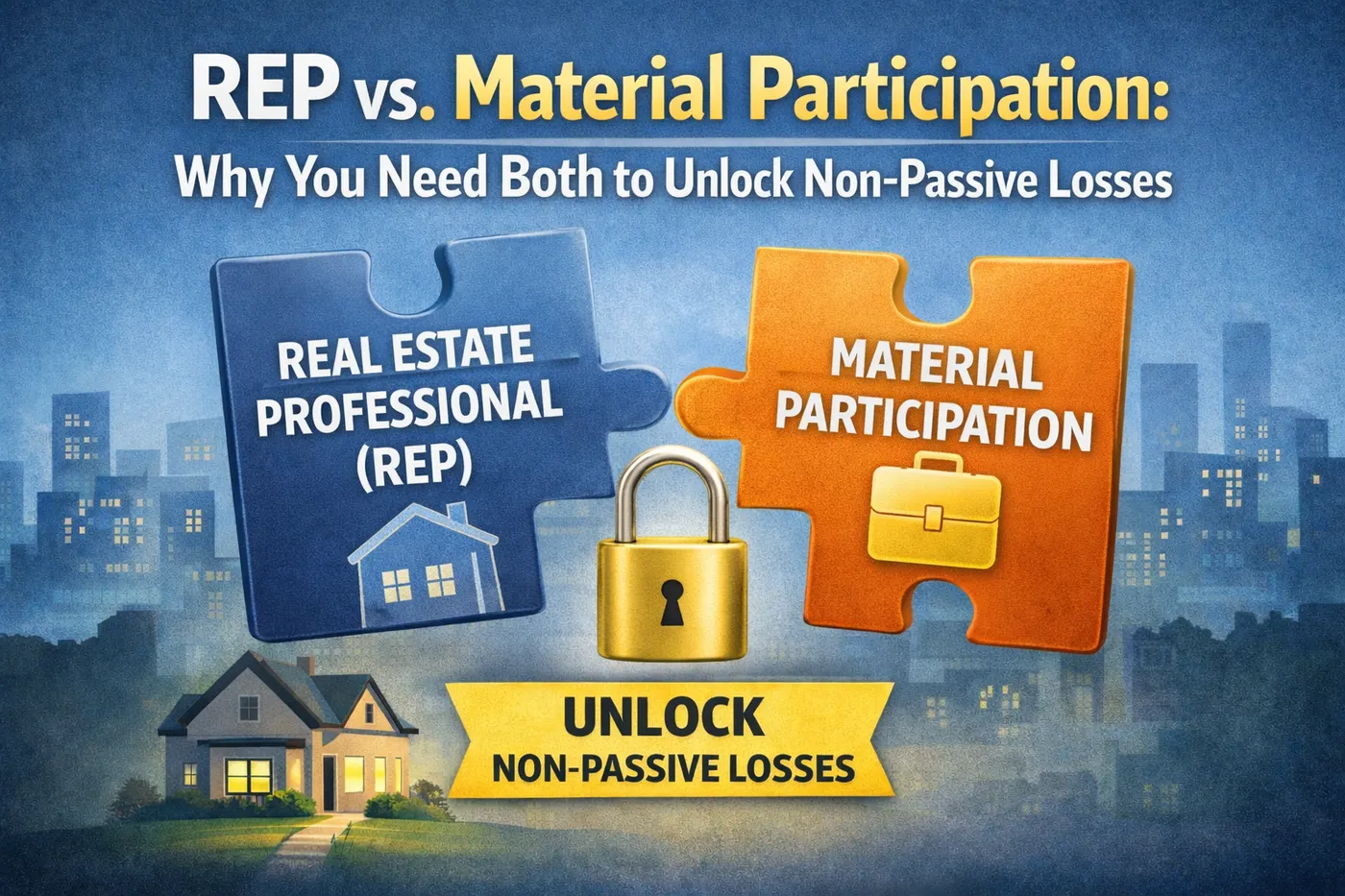
REP status and material participation are two separate gates. Passing the first does not carry you through the second.
Qualifying as a real estate professional only strips the automatic “per se passive” label off your rentals. You still have to prove you materially participated in each rental activity — or group them by election and prove it for the group as a whole.
Gate 1 — REP Status
- 750+ hours in real property trades or businesses
- More than 50% of all your working hours
- Measured at the taxpayer level
Gate 2 — Material Participation
- Usually 500+ hours in the specific rental activity
- Or one of the other six IRS tests
- Measured per activity (or per group)
Plenty of investors clear the first gate and never realize the second one exists. REP Helper keeps the two measurements apart — a portfolio-wide total for your REP tests and a per-property (or grouped) total for material participation — so you watch both bars climb instead of discovering the gap after you've filed.
The Cautionary Tales Nobody Mentions
Beyond the headline failures, the case files are full of warnings most advisors never bring up.
The CPA cascade. One auditor reviewed a single client's REP claim, rejected it, then pulled three more clients from the same preparer. The CPA had been padding hours with education, research, and travel to reach 750. If your accountant insists study time and webinars sail straight onto your hour count, treat it as a red flag — the IRS Passive Activity Loss audit guide specifically calls out that behavior, and the courts have been shaky on it at best.
Windshield-time roulette. A taxpayer tried to count driving to and from rentals toward both the 750-hour test and material participation. The IRS and the appeals officer both refused, treating it as ordinary commuting absent a dedicated home office for the rental business. Leaning on drive time to reach 750 is a bet you don't want to make.
The property-manager paradox. The IRS's stance here is aggressive: hire a manager, and they will argue you aren't the one materially participating. They've even run targeted sweeps, compiling investor client lists straight from property management firms. You can use a manager and still qualify — but only if you're demonstrably making the decisions, not rubber-stamping theirs.
Notice the thread running through all three: it isn't about effort. It's about whether your records can prove the right hours, in the right category, performed by the right person.
REP Helper tags every activity by who performed it and which test it counts toward, so education, travel, and contractor hours can't quietly inflate a total you'll later have to defend.
The Grouping Election Almost Everyone Botches
Here's a mistake nearly everyone with more than one property makes. By default, the IRS measures material participation property by property — which means 500+ hours on each one, separately.
The fix is an election under IRC §469(c)(7)(A) that treats all your rentals as a single activity, letting you pool hours across the whole portfolio for the material participation test.
The catch: you make this election by attaching a statement to your return for the first year it applies. Miss it, and you're stuck proving participation one property at a time.
The bigger catch: it's generally irrevocable. Once you group, you can't simply ungroup later because the math turned against you. And yet a large share of investors claiming REP either never make the election or forget it entirely.
Because REP Helper supports portfolio-level grouping, your hours aggregate across properties automatically once the election is in place — and your participation total reflects the structure you actually chose.
What Actually Survives an Audit
Read enough of these decisions and the winning pattern becomes obvious. The investors who survive audits all do the same handful of things.
- Log in real time. Not weekly, not at tax time — within a day or two of the work. A contemporaneous log is the gold standard, and it's exactly what REP Helper produces by default.
- Be specific. “Property management — 3 hours” loses in court. “Handled four maintenance requests for 123 Oak St, scheduled the plumber for the Unit 2 leak, logged the repair cost — 3 hours” wins.
- Track your W-2 hours too. You need both numbers to prove the 50% test. REP Helper records your outside hours alongside your real estate work so the ratio is always defensible.
- Keep REP hours and material-participation hours in separate buckets. They're different tests with different qualifying activities.
- Make the grouping election unless you have a clear reason not to — it makes material participation dramatically easier.
- Hold onto the supporting proof. Emails, invoices, photos, receipts, contracts, leases. Your log is the skeleton; attachments are what make it credible. REP Helper lets you attach them to each entry as you go.
The log is the spine of the entire claim. Everything else hangs off it.
The STR Alternative for W-2 Earners
If a full-time W-2 puts REP out of reach — which, realistically, it does for most people — the short-term rental strategy is often the smarter road.
The short version: when the average guest stay is seven days or fewer and you materially participate, the activity isn't automatically passive — no REP status required at all.
The participation bar is lower too. The most accessible test is usually 100+ hours of personal work, with nobody else putting in more time on the property than you.
This is how a lot of high-income W-2 earners offset $50K–$100K or more of rental depreciation against active income. Pair a cost segregation study (to front-load that depreciation) with STR material participation, and the effect is substantial.
REP Helper handles this path too — it calculates your average stay per property and tracks owner-versus-everyone-else hours, the exact figures the STR material participation tests turn on.
The Bottom Line
REP is real, legal, and genuinely valuable when it's done properly. The danger lives in the gap between “I think I qualify” and “I can prove I qualify under audit.” That gap is where most investors get wiped out.
The people who win these cases share one trait: relentless, real-time documentation. The people who lose all assumed they'd sort out the paperwork later.
That single habit — logging as you go instead of reconstructing after the fact — is the whole ballgame. It's the difference between confidence and a guess, and it's the reason REP Helper exists.
Frequently Asked Questions
Q: What's the most common reason investors lose REP status in Tax Court?
A: Missing contemporaneous documentation. In most cases, taxpayers aren't denied because they fell short on hours — they're denied because they couldn't prove the hours with records kept at the time. Numbers reconstructed after an audit opens are routinely rejected. Logging in real time with a tool like REP Helper removes that risk.
Q: Can I qualify for REP with a full-time W-2 job?
A: It's very hard. The 50% test requires your real estate hours to beat all your other working hours combined — a 2,000-hour job means you need 2,001+ real estate hours, about 38.5 a week on top of the job. For most W-2 earners the realistic path is a qualifying spouse or the short-term rental strategy.
Q: What's the difference between REP qualification and material participation?
A: They're two separate tests. REP qualification (750+ hours and more than 50% of total working time) removes the automatic passive label. Material participation (typically 500+ hours in the rental activity) proves you were genuinely involved. You must clear both to deduct rental losses against active income.
Q: Does travel time count toward REP hours?
A: Usually not. Courts generally treat driving to and from rentals as commuting. Travel between properties during a working day may count, but typically only if you maintain a dedicated home office for the rental business. Don't build your 750 hours on drive time.
Q: What is the grouping election and why does it matter?
A: The election under IRC §469(c)(7)(A) lets you treat all your rentals as one activity for material participation. Without it you need 500+ hours on each property; with it you need 500+ across the whole portfolio. You file it by attaching a statement to your return, and it's generally irrevocable.
About the author

Real Estate Investor · Founder, REP Helper
Carlos Lourenço is a real estate investor and the founder of REP Helper. Over 10+ years he's built a portfolio of long- and short-term rentals across several states, personally qualifying for Real Estate Professional Status (REPS) and running the short-term-rental strategy on his own properties. A product manager by trade, he built REP Helper after years of tracking his own hours and IRS tests by hand.
Connect on LinkedInDisclaimer: Carlos Lourenço is a real estate investor, not a CPA, enrolled agent, or tax attorney. This article is for educational purposes only and is not tax, legal, or financial advice. Tax outcomes depend on your specific facts and on current law, which changes. Always consult a qualified CPA or tax attorney before implementing any tax strategy.