
Introduction
Ask most real estate investors what it takes to deduct rental losses against their salary and they will recite the two famous numbers: 750 hours and 50%. Those are the Real Estate Professional (REP) tests, and they get nearly all of the attention in blog posts, webinars, and CPA conversations.
Here is the uncomfortable opinion this article is built around: the REP tests are not where most investors fail. Material participation is. You can pass both REP tests cleanly, log every hour, and still end up with suspended passive losses because you never cleared the second, separate gate that almost nobody talks about with the same urgency.
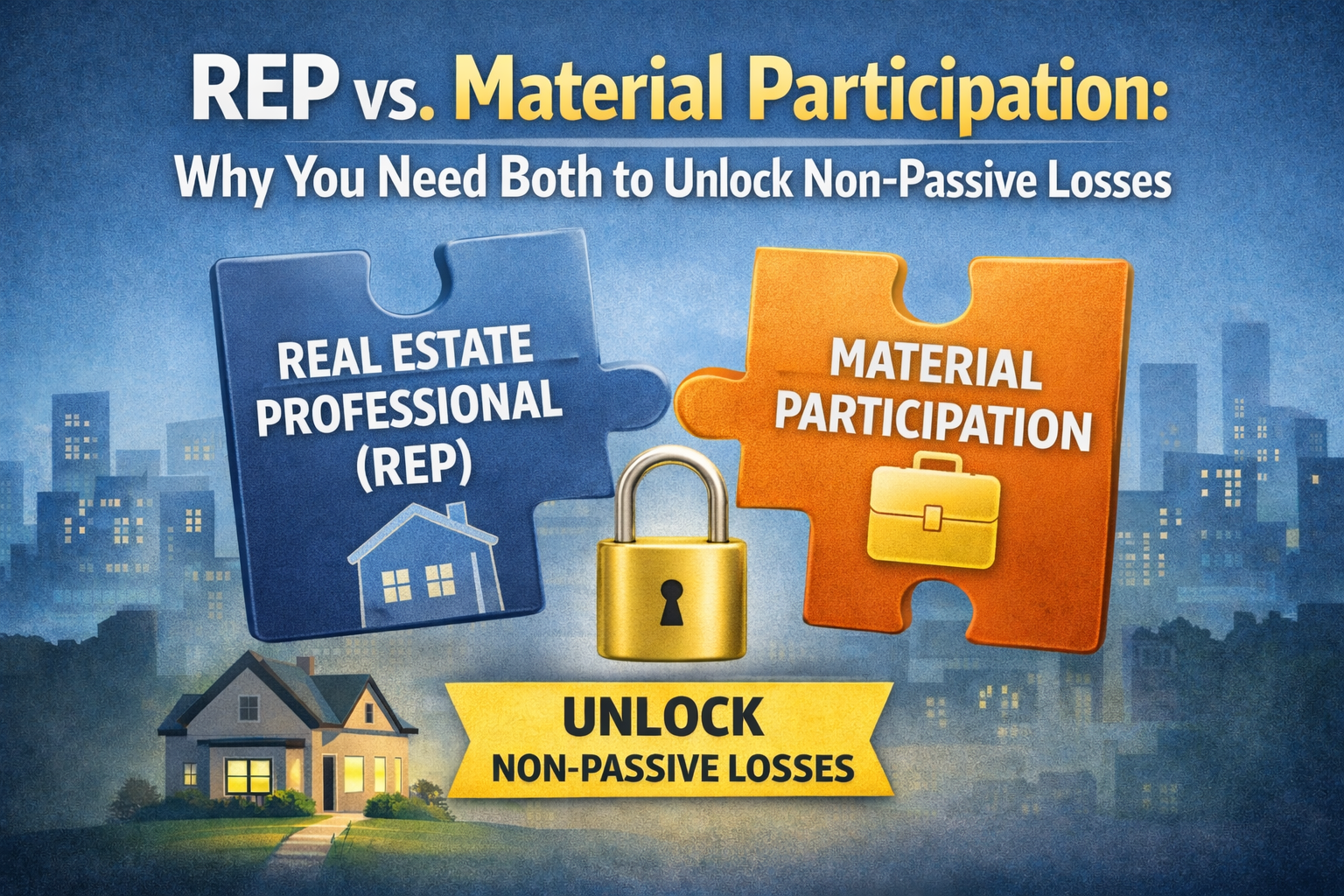
REP status removes the assumption that your rentals are passive. Material participation is what actually makes the losses non-passive. They are two different gates, and the second one is the harder one.
This is especially true for the two groups most likely to think they are safe: investors with several properties who never made a grouping election, and investors who use a property manager. Both can sail through the 750/50% math and then quietly fail the test that matters. Let's walk through why.
Two Gates, Not One
Under IRC §469, rental activities are presumed passive, and passive losses generally cannot offset active income like wages or business profit. REP status, defined in §469(c)(7), removes that automatic presumption for someone in a real property trade or business.
To be a Real Estate Professional you must meet both REP tests in the same tax year, evaluated per individual:
- More than 750 hours of services in real property trades or businesses in which you materially participate.
- More than 50% of all your personal-service (working) hours across every trade or business spent in real property trades or businesses.
But notice the language buried inside the first test: real property trades or businesses in which you materially participate. REP status by itself only strips away the per-se passive label. It does not make your losses deductible. For that, each rental activity still has to clear material participation under Treasury Regulation §1.469-5T.
Think of it as a two-door system. REP unlocks the building. Material participation unlocks the room where the deduction actually lives. People celebrate at the first door and never check whether the second one opens.
The reason this matters so much is that the two gates have completely different shapes. The REP tests are about your total annual hours and your ratio of real estate work to everything else. Material participation is about a specific activity and how your hours stack up inside that one activity. Passing one tells you almost nothing about the other.
Why Material Participation Is Harder Than People Expect
On paper, material participation looks easy. There are seven tests in §1.469-5T, and you only need to pass one. The most common is the 500-hour test: participate for more than 500 hours in the activity during the year. Five hundred is less than 750, so investors assume that if they cleared the bigger REP number, the smaller one is automatic.
It isn't, and here is the structural reason why. The 750 hours can be spread across all of your real estate activities combined. The 500 hours for material participation must be met inside a single activity, unless you have grouped your rentals into one. So a landlord with five properties might log 800 total hours, comfortably passing the REP test, while putting only about 160 hours into each property, failing the 500-hour material participation test on every single one.
The REP Tests Measure
- Your total annual hours across all real estate work
- Your real estate hours versus all other work
- Whether you belong in the real property trade or business
- One number, summed across everything you do
Material Participation Measures
- Your involvement in one specific activity
- Sometimes your hours versus everyone else's hours
- Whether you are truly running that activity
- Per property, unless you have grouped them
There is a second trap. Several of the seven tests are comparative, not absolute. The 100-hour test, for example, requires that you participate more than 100 hours AND not less than any other individual, including paid help. The significant-participation test counts only activities where you exceed 100 hours and then aggregates them above 500. These comparative tests can be lost not because you did too little, but because someone else did more. That is a failure mode the headline REP numbers cannot warn you about.
The 750-hour test asks how much you worked. Material participation often asks whether you worked more than everyone else combined or at least more than any single other person. Those are very different questions.
The Multi-Property Trap (and the Grouping Fix)
This is the single biggest reason material participation quietly defeats serious investors. By default, the IRS treats each rental as its own activity. You must materially participate in each one, on its own, every year. The more properties you own, the more your time is diluted, and the harder each individual 500-hour bar becomes.
Consider an investor with four long-term rentals who logs 1,000 hours across the portfolio. The REP tests are easily satisfied. But split evenly, that is 250 hours per property, and not one of them clears 500. Without intervention, every property fails material participation and the losses stay passive, no matter how many total hours the spreadsheet shows.
More properties usually means more total hours but fewer hours per property. Past a certain point, scaling your portfolio makes material participation harder, not easier, unless you change how the activities are defined.
The fix is the grouping election under IRC §469(c)(7)(A) and Treasury Regulation §1.469-9(g). It lets a qualifying real estate professional treat ALL rental real estate interests as a single activity for material participation purposes. Once grouped, you test the 500 hours against the combined activity. Our four-property investor with 1,000 hours now clears 500 with room to spare.
A few things to understand about the election before you rely on it:
- It is made by a written statement attached to your original return declaring you are a qualifying taxpayer making the §1.469-9(g) election.
- It is generally binding for all future years and is treated as irrevocable absent a material change in facts, so it is not a casual decision.
- It groups rentals for material participation, but it does not, by itself, change other elections like the at-risk rules.
- It only helps if you are already a qualifying real estate professional for the year; grouping is not a substitute for the REP tests.
The cruelty of this trap is that it is silent. Nothing on the return announces that you needed an election. Many multi-property investors deduct losses for years, fully passing the REP tests, with no idea that an examiner could disallow them for failing per-property material participation that a grouping statement would have solved.
The Property Manager Problem
The second group that gets blindsided is investors who use a property manager. The instinct to hire one is completely rational. The tax consequence is that you have introduced another person whose hours can directly compete with yours inside the activity.
Using a manager does not automatically disqualify you. But it changes the math in two ways. First, it removes hours from your column; the leasing calls, the showings, the maintenance coordination are now done by someone else, so your own count shrinks. Second, and more dangerous, it can hand the comparative tests to that manager.
The 100-hour test requires you to participate more than 100 hours and not less than any other individual. A full-time property manager can easily exceed your hours, which means you lose that test even if you stayed personally involved.
So a manager-using investor is often pushed toward the 500-hour test as the only realistic path, because it is absolute rather than comparative. But a manager exists precisely to reduce your hours, which makes hitting 500 in that activity harder. The very tool that makes a portfolio manageable is the tool that erodes material participation.
If you use a manager, the practical implications are:
- Lean on the 500-hour test, since the comparative tests likely favor the manager.
- Keep performing genuinely substantive owner work: approving expenditures, making leasing and pricing decisions, handling major repairs and capital decisions, and selecting and overseeing vendors.
- Track the manager's hours too, because you may need to show you out-participated them or simply demonstrate that the 500-hour absolute test was met regardless.
- Tag who performed each task, because at audit the question is rarely whether work was done; it is who did it.
This is exactly the kind of pain REP Helper is built to surface. By tagging each logged activity to the person who performed it, owner versus spouse versus contractor or manager, it shows you in real time whether your hours still clear the bar, or whether your manager has quietly out-participated you on a property you assumed was safe.
Reading the Seven Tests Through the Failure Lens
Rather than re-explain all seven §1.469-5T tests, it is more useful to look at each one through the question that actually matters: how do investors lose it?
- 500-hour test: Lost when hours are spread across ungrouped properties so no single activity reaches 500. The grouping election is the fix.
- Substantially-all test: Lost when you bring in a manager or contractors, because then you are no longer doing substantially all of the work in the activity.
- 100-hour-and-not-less-than-anyone test: Lost when a manager, contractor, or co-owner logs more hours than you in that activity.
- Significant-participation test: Lost when your involvement in any activity stays under 100 hours, since only 100-plus-hour activities count toward the 500 aggregate.
- Any-five-of-ten-years test: Mostly relevant after you have already materially participated for years, so it rarely rescues a newer investor.
- Personal-service-activity test: Generally not applicable to rental real estate, so do not count on it.
- Facts-and-circumstances test: The weakest and most contested; it requires more than 100 hours and is unavailable if anyone is paid to manage or if another person spends more time, which knocks out most managed portfolios.
Notice the pattern: nearly every failure mode traces back to two things, hours spread too thin across separate properties, or another person doing more of the work. Grouping addresses the first. Disciplined owner involvement addresses the second.
Short-term rentals deserve a footnote here because they change which gate applies. If the average guest stay is seven days or less, the activity is not a rental activity under Reg. §1.469-1T(e)(3), so it is not automatically passive and REP status is not even required. But material participation still applies, and the comparative tests can be punishing for STRs with cleaning crews and co-hosts. The hurdle moves; it does not disappear.
Why Documentation Decides the Argument
Here is the part that ties everything together. Material participation is not just harder to meet; it is harder to prove. The REP tests can often be supported with broad summaries of your year. Material participation is a per-activity, sometimes person-by-person comparison, and reconstructed estimates rarely survive scrutiny.
Tax Court cases have repeatedly rejected ballpark logs and after-the-fact calendars. What holds up is a contemporaneous record showing what was done, when, how long it took, which property it belonged to, and who performed it. That last field, who performed it, is the one most logs omit and the one the comparative tests turn on.
- Records were made as the work happened, not reconstructed at year-end.
- Each entry is tied to a specific property or to the grouped activity.
- Each entry names who did the work: owner, spouse, contractor, or manager.
- Each entry notes which material participation test the hours support.
- Other workers' hours are tracked so comparative tests can be evaluated honestly.
- If multiple rentals exist, a grouping statement is on file or a clear per-property case is documented.
This is precisely the gap REP Helper is designed to close. It captures contemporaneous entries by phone, voice, or web as the work happens, tracks material participation separately for each property and for a grouped portfolio, and tags every activity by who performed it and which test it counts toward. The same records also feed your 750-hour and 50% progress, so both gates are visible at once. When it is time to file, the CPA-ready export shows not just that you worked, but that you out-worked everyone else where the rules require it.
What This Means For Your Strategy
If the argument of this article is right, then the way most investors prioritize is backwards. They spend their energy on the 750/50% tests, which are usually the easier part for someone genuinely in real estate, and treat material participation as an afterthought. Flip it.
- Decide your material participation path first: 500 hours in a single grouped activity is the cleanest target for most multi-property owners.
- If you own more than one rental and want losses to flow, evaluate the §469(c)(7)(A) grouping election early, ideally before you file, with your advisor.
- If you use a property manager, plan around the 500-hour absolute test and keep performing substantive owner work.
- Track every hour contemporaneously, per property and per person, not just in total.
- Re-check both gates every year; REP and material participation are annual determinations, not one-time achievements.
The investors who lose at audit are rarely the ones who did too little real estate work overall. They are the ones who did plenty of work but in a structure that never cleared material participation, and could not prove it per activity.
None of this is a substitute for advice tailored to your facts. The grouping election in particular is generally irrevocable and interacts with other parts of your return, so it is worth a real conversation with your tax advisor. The goal here is simpler: to move material participation from the footnote it usually occupies to the center of your planning, where it belongs.
Frequently Asked Questions
Q: If I already pass the 750-hour and 50% REP tests, why would I still fail material participation?
A: Because they measure different things. The 750 hours are summed across all your real estate work, while material participation is usually tested per property. If you own several rentals and never grouped them, your hours can be spread too thin to clear 500 in any single one, so the losses stay passive even though you are clearly a real estate professional.
Q: Does the grouping election guarantee I materially participate?
A: No. Grouping lets you combine all your rentals into one activity so your hours are pooled toward a single 500-hour bar, which makes the test much easier to reach. But you still have to actually meet one of the seven tests for that combined activity, and you must be a qualifying real estate professional for the election to apply. It is a powerful tool, not an automatic pass.
Q: Can I still materially participate if I use a property manager?
A: Often yes, but you usually have to rely on the 500-hour test rather than the comparative tests. A manager can easily log more hours than you, which loses the 100-hour test and the facts-and-circumstances test. Keep doing substantive owner work, document it contemporaneously, and track the manager's hours so you can show where you stand.
Q: Do short-term rentals change the material participation analysis?
A: They change which gate applies. If the average guest stay is seven days or less, the activity is not a rental activity under the regulations, so REP status is not required. But material participation still applies, and with cleaners and co-hosts in the picture the comparative tests can be hard to win. The hurdle moves rather than disappears.
Q: How do I prove material participation if I am audited?
A: With contemporaneous records that show what was done, when, on which property, and by whom. Reconstructed year-end logs are routinely rejected in Tax Court. Because several tests compare your hours to other people's, the strongest files also track contractor and manager hours, which is exactly the kind of per-activity, per-person record a tool like REP Helper is built to produce.
About the author

Real Estate Investor · Founder, REP Helper
Carlos Lourenço is a real estate investor and the founder of REP Helper. Over 10+ years he's built a portfolio of long- and short-term rentals across several states, personally qualifying for Real Estate Professional Status (REPS) and running the short-term-rental strategy on his own properties. A product manager by trade, he built REP Helper after years of tracking his own hours and IRS tests by hand.
Connect on LinkedInDisclaimer: Carlos Lourenço is a real estate investor, not a CPA, enrolled agent, or tax attorney. This article is for educational purposes only and is not tax, legal, or financial advice. Tax outcomes depend on your specific facts and on current law, which changes. Always consult a qualified CPA or tax attorney before implementing any tax strategy.