
It All Comes Down to Participation
On my own short-term rentals, escaping the rental label was only half the job — I still had to materially participate to use the losses. These are the tests I track against every year, and the ones that are easiest to fail by accident.
If you own short-term rentals and want to use your losses to offset other income, there's one word that matters: Participation.
Not ownership. Not revenue. Not how many properties you have. Your involvement.
If your STR qualifies as a non-rental under the 7-day rule, the next question becomes: Did you materially participate in the activity?
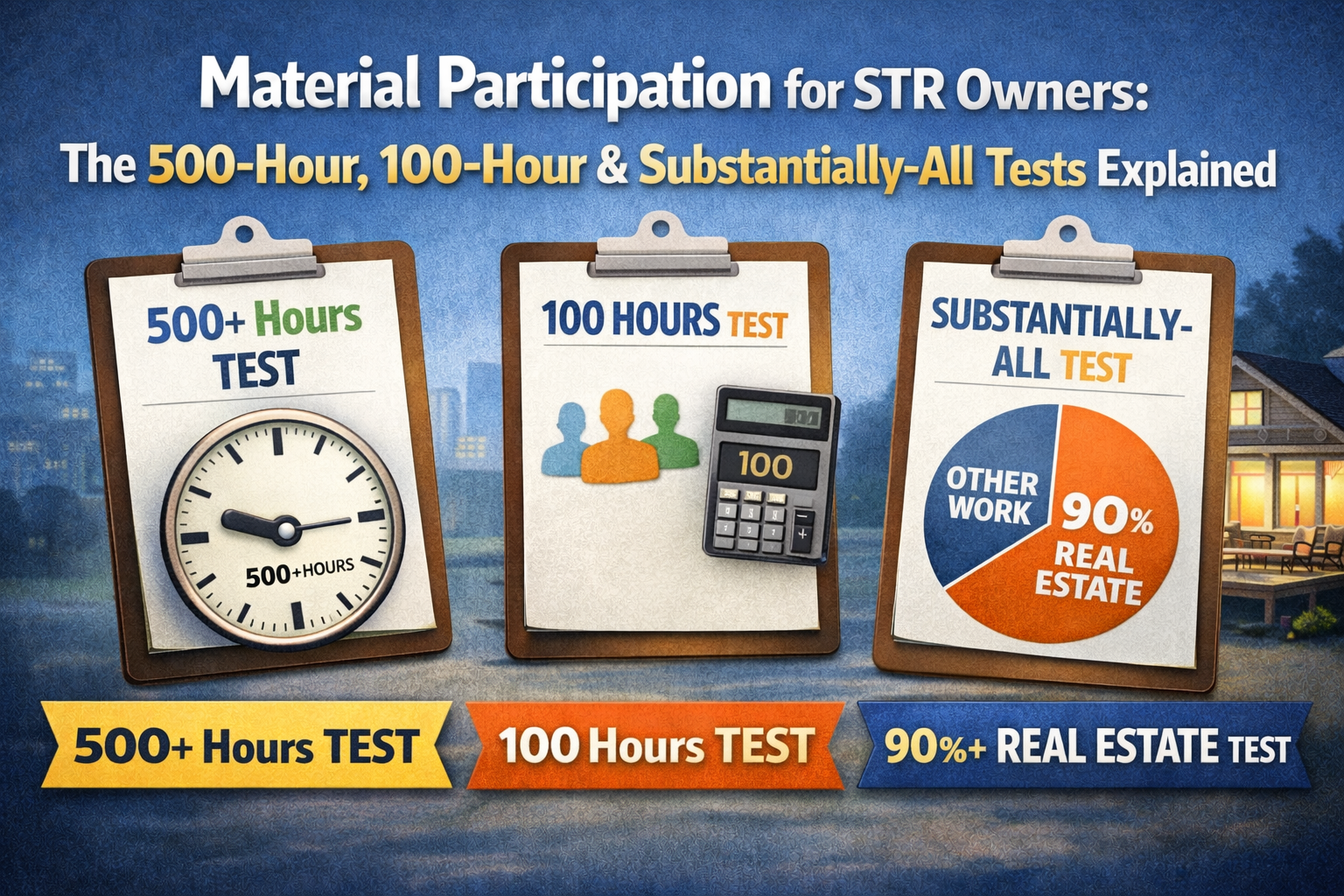
For most STR owners, there are three practical ways to qualify. This is the participation half of the short term rental loophole — short stays open the door, material participation walks you through it.
The 500-Hour Test
This is the cleanest one. If you personally spend 500 hours or more during the year operating your STR activity, you qualify.
That's about 42 hours per month, or roughly 10 hours per week. For hands-on operators, this is achievable.
What Counts
- Guest communication
- Pricing updates
- Scheduling cleaners
- Supervising maintenance
- Reviewing bookings
- On-site visits
- Managing supplies
- Bookkeeping and marketing
What Doesn't Count
- Cleaner hours
- Contractor hours
- Property manager hours
Only your time matters.
One owner who self-managed two cabins handled every guest message, all scheduling, vendor coordination, and minor repairs. By year-end, she logged 620 hours. She passed the 500-hour test clearly. The key was documentation — she didn't estimate, she tracked consistently.
The 100-Hour + More-Than-Anyone-Else Test
This one is often overlooked. You qualify if you spend at least 100 hours during the year and no one else spends more time than you on the activity.
This is powerful for semi-active owners. Let's say:
- You spent 180 hours managing your STR
- Your cleaner spent 120 hours
- Your handyman spent 60 hours
- No property manager
You qualify.
But here's the catch: if you hire a property manager who spends 300 hours, you likely fail this test — even if you hit 150 hours. It's a comparison rule.
That's why separating owner hours from team hours is critical. REP Helper tracks who performed each activity so you can clearly see whether you exceed everyone else's involvement.
The Substantially-All Test
This one is less about total hours and more about control. You qualify if you perform substantially all of the work in the activity.
In practical terms, that means you're doing almost everything yourself. You own one beach condo. You handle bookings, coordinate cleaning, restock supplies, oversee repairs, and visit regularly.
You might only log 350 hours for the year. But if you performed nearly all the operational work yourself, you may qualify under this test.
This works best for small, self-managed portfolios. The moment you delegate heavily, this test becomes harder to defend.
Which Test Do Most STR Owners Use?
In practice, most STR operators rely on the 500-hour test because it's clear and defensible. It's simple math.
The 100-hour test works well for hybrid operators — involved, but with some help.
The substantially-all test tends to apply to smaller, owner-run operations.
The right test depends on your structure.
Grouping Multiple STR Properties
If you own multiple short-term rentals, you can often treat them as one combined activity for material participation purposes. That makes it easier to reach 500 hours across the portfolio.
Instead of 220 hours on Property A and 180 hours on Property B separately, you can combine them: 400 total hours. And continue building toward 500.
REP Helper tracks hours per property and allows portfolio-level visibility, so you can see both individual and combined totals.
The Most Common Mistakes
- Counting contractor hours — Your cleaner working 300 hours doesn't help you reach 500.
- Not tracking consistently — Trying to recreate a year's worth of work in December rarely works.
- Ignoring the comparison element — For the 100-hour test, you must exceed everyone else's time.
- Mixing real estate hours together — If you also pursue long-term rentals or brokerage work, those hours are separate from STR material participation.
Clear separation matters.
Why Tracking in Real Time Changes Everything
Most STR owners are active. They're busy every week. But if you don't log your activity:
- You underestimate your hours
- You can't prove your involvement
- You can't compare against team members
REP Helper allows quick activity entry, voice logging on the go, attaching receipts or documentation, and tagging who performed the work.
You see your progress toward 500 hours. You see whether you exceed everyone else's involvement. It removes the guesswork.
The Bigger Picture
Material participation is about control and involvement. If your STR is structured properly and you're hands-on, the rules are often favorable. But they require proof.
You don't need all three tests. You need one solid path that fits your operating style.
Know which one you're targeting. Track your time intentionally. Because when losses are large — and STR depreciation often is — the difference between qualifying and not qualifying can be substantial. And that difference usually comes down to hours.
About the author

Real Estate Investor · Founder, REP Helper
Carlos Lourenço is a real estate investor and the founder of REP Helper. Over 10+ years he's built a portfolio of long- and short-term rentals across several states, personally qualifying for Real Estate Professional Status (REPS) and running the short-term-rental strategy on his own properties. A product manager by trade, he built REP Helper after years of tracking his own hours and IRS tests by hand.
Connect on LinkedInDisclaimer: Carlos Lourenço is a real estate investor, not a CPA, enrolled agent, or tax attorney. This article is for educational purposes only and is not tax, legal, or financial advice. Tax outcomes depend on your specific facts and on current law, which changes. Always consult a qualified CPA or tax attorney before implementing any tax strategy.