
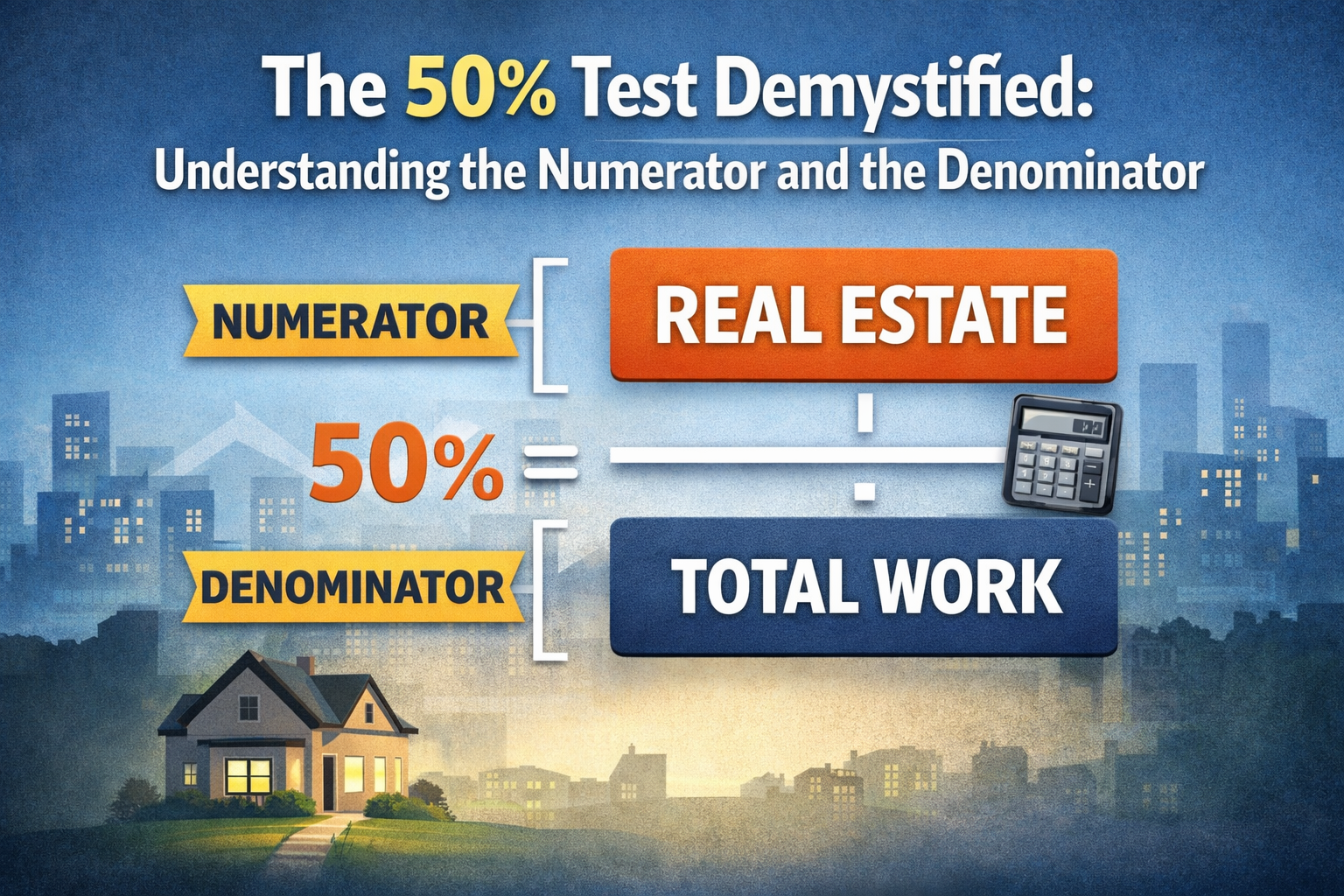
The One-Property Question
There is a persistent myth that cost segregation is only for institutional landlords, apartment syndicators, or investors sitting on a dozen doors. New short-term rental owners hear about the strategy, get excited about accelerated depreciation, and then talk themselves out of it with a single assumption: "I only have one property, so it is not worth it." That assumption is usually wrong, and it costs people real money.
Cost segregation does not care how many properties you own. It cares about how much depreciable basis sits inside the one you do own. A cost segregation study is an engineering-based analysis that breaks a building into its components and reclassifies the shorter-lived ones, such as appliances, flooring, cabinetry, specialty plumbing and electrical, and land improvements, into 5-, 7-, and 15-year recovery periods instead of the default 27.5 years for residential property. Those shorter-life components then become eligible for bonus depreciation, which means a large chunk of them can be written off in year one.
The real question is not "do I have enough properties?" It is "does this one property have enough building basis to make a study pay for itself?" For a surprising number of mid-priced STRs, the answer is yes.
This article stays narrowly focused on the single-property threshold question. We will walk through the economics of one study, the rough value level where it starts to make sense, what a first-year deduction looks like on a realistic mid-priced STR, and the specific situations where the honest answer is to skip it or wait. Figures here are illustrative ranges, not promises, and your own numbers should come from a qualified cost-segregation firm and CPA who have seen your actual purchase.
Why One Property Is Often Plenty
Cost segregation is fundamentally a per-property calculation. The engineer studies one building, allocates its cost across asset classes, and produces a report for that building. Owning ten properties just means running the same exercise ten times. There is no portfolio synergy required and no minimum number of doors hiding in the tax code. A study on your one STR is mechanically identical to a study on one building owned by a fund.
What actually drives whether a single study is worthwhile is the interaction of three numbers: your building (non-land) basis, the percentage of that basis an engineer can reclassify into short-life assets, and your marginal tax rate. A furnished short-term rental is, perversely, an ideal candidate. Compared with a bare long-term rental, an STR is loaded with the very components that get reclassified: appliances, furniture-grade built-ins, decorative lighting, window treatments, flooring, and often outdoor improvements like decks, fire pits, hot tub pads, fencing, and landscaping.
On many residential properties an engineered study reclassifies somewhere in the range of 20 to 35 percent of the building basis into 5-, 7-, and 15-year property, and furnished STRs frequently land at the higher end of that band because of all the contents and site work. Every dollar that moves into a 20-year-or-shorter class becomes eligible for bonus depreciation and can be deducted in the first year the property is placed in service.
What pulls a single study UP in value
- Higher building (non-land) basis
- A furnished, amenity-rich STR with lots of 5- and 15-year components
- Significant land improvements (deck, pool, fencing, landscaping)
- A high marginal tax rate on the income the loss will offset
- You can meet material participation, so the loss is non-passive
What pulls it DOWN
- Low building basis after backing out land
- A bare, minimally improved property
- A low current marginal rate, or losses you cannot use this year
- Plans to sell within a few years (recapture)
- You cannot clear the material-participation hurdle
The Economics of a Single Study
Every study has a cost. An engineered study on a single residential STR typically runs somewhere in the low-to-mid four figures, broadly the $2,000 to $5,000 range depending on the property's size, complexity, and the firm. That fee is the hurdle. The study is worth doing when the present value of the tax it saves clearly exceeds that fee, and ideally by a wide margin so the effort and any audit-readiness work are also justified.
Here is the logic in plain terms. The study moves a slice of your basis from a 27.5-year life into the first year. That accelerated deduction does not create new total deductions over the life of the property; you would have eventually depreciated all of it anyway. What it creates is timing value: you get the deduction now instead of spread over decades. The benefit is the tax saved on the accelerated amount, adjusted for the time value of money and for the fact that some of it will be recaptured on sale.
A simple sanity check: multiply the basis you expect to accelerate by your marginal tax rate. If that first-year tax saving is several multiples of the study fee, the study almost certainly pays. If it is barely above the fee, the timing benefit may be too thin to bother with.
Suppose an engineer can accelerate $150,000 of basis into year one on your STR and your combined federal-and-state marginal rate on the income that loss will offset is 35 percent. That is roughly $52,500 of first-year tax deferred, against a study fee of a few thousand dollars. Even after discounting for time value and eventual recapture, the math is not close. This is exactly why one property is so often enough: the fee is fixed and modest, while the benefit scales with your basis and your rate.
The Rough Value Threshold
Investors want a number, so here is an honest one, framed as a rule of thumb rather than a bright line. Engineered cost segregation tends to start clearly paying for itself once the building (non-land) basis is roughly in the $150,000 to $200,000 range and up, assuming you have a meaningful marginal tax rate and can actually use the loss this year. Many studies make sense below that, and a few above it do not, but that band is where the answer flips from "maybe" to "almost certainly yes" for most owners.
The crucial subtlety, and the one that trips up first-time owners, is that the threshold is about building basis, not purchase price. Land is not depreciable, so you must subtract the land value from the price before you have anything to work with. In land-expensive markets, a property that sold for $600,000 might carry only $400,000 of building basis; in a land-cheap rural cabin market, that same $600,000 price might leave $500,000 of building. Two STRs at identical prices can have very different cost-seg potential purely because of the land allocation.
- Start with your total tax basis (generally purchase price plus capitalized closing costs and improvements).
- Subtract a reasonable land allocation (tax assessor ratios, an appraisal, or the engineer's allocation).
- What remains is your building basis, the pool a study works from.
- Estimate the reclassifiable share (often 20 to 35 percent for residential, higher for furnished STRs).
- Multiply that accelerated amount by your marginal rate to gauge the first-year benefit against the fee.
Below roughly $100,000 of building basis the arithmetic gets tight. The reclassified slice may be only $20,000 to $35,000, the first-year tax saving might be in the four figures, and once you net out a four-figure study fee the timing benefit can be modest. That is the zone where many owners reasonably choose a free or low-cost desktop estimate, or skip a formal study entirely. The threshold is not a wall; it is the point where the benefit becomes large enough that the decision stops being a close call.
What Year One Looks Like on a Mid-Priced STR
Let us make this concrete with an illustrative mid-priced STR. Imagine you buy a furnished cabin for $500,000. After backing out a $100,000 land allocation, you have $400,000 of building basis. Without cost segregation, your first-year residential depreciation is roughly $400,000 divided by 27.5 years, which is about $14,500, and even less in the first year after the mid-month convention. Useful, but modest.
Now run an engineered study. Say it reclassifies 30 percent of the building basis, or $120,000, into 5-, 7-, and 15-year property. Because all of those classes have a recovery period of 20 years or less, that $120,000 is eligible for 100 percent bonus depreciation under current law. Add the normal first-year 27.5-year depreciation on the remaining $280,000 of structure, and your first-year deduction jumps from roughly $14,500 to somewhere on the order of $130,000. On one property.
Under the 2025 One Big Beautiful Bill Act, 100 percent bonus depreciation was permanently restored for qualified property acquired and placed in service after January 19, 2025. That is what lets the entire reclassified slice land in year one rather than being spread out. These are illustrative figures; your reclassification percentage and allocations come from the actual study.
At a 35 percent marginal rate, that incremental deduction, the difference between $130,000 and the $14,500 you would have gotten anyway, is worth tens of thousands of dollars of first-year tax deferral. Against a study fee of a few thousand dollars, the single-property case sells itself. Notice, too, that the deduction often outruns the cash you put down: a leveraged purchase can generate a paper loss far larger than your out-of-pocket equity, which is the heart of the appeal.
One realistic caveat: a giant year-one paper loss is only valuable if you have income for it to offset and if the loss is non-passive. That is not a cost-segregation question; it is a material-participation and 7-day-rule question, and it is where most single-property plans either succeed or quietly fail.
The Catch: You Must Be Able to Use the Loss
A cost segregation study manufactures a large deduction. It does nothing to tell you whether that deduction can offset your W-2 salary, your business income, or your capital gains. That depends entirely on the passive activity loss rules of Section 469, and this is where a beautiful first-year number can turn into a suspended loss that just sits there until you sell.
For a short-term rental, the well-known path to a non-passive loss is the so-called STR loophole. If the average guest stay across the year is seven days or fewer, the property is not a rental activity under Treasury Regulation Section 1.469-1T(e)(3), so it is not automatically passive. But that is only half the test. You must also materially participate in the activity, meaning you meet one of the seven tests of Treasury Regulation Section 1.469-5T. For most single-property owners the realistic ones are: more than 500 hours; or more than 100 hours with no one else (cleaner, co-host, property manager) participating more; or substantially all the participation in the activity.
This is the failure point that wastes cost-seg dollars on a single property. Owners pay for a study, generate a $130,000 loss, and then learn it is passive because their average stay crept over seven days, or because their property manager logged more hours than they did and blew the 100-hour test. Contractor, employee, and PM hours do not count as your hours and can actively defeat that test.
This is exactly the gap REP Helper is built to close. It calculates your average guest stay per property from your bookings so you know in real time whether you are under the seven-day line before year-end, and it logs your material-participation hours contemporaneously by phone, voice, or web. Because it tags every activity by who performed it, owner versus spouse versus cleaner versus co-host versus property manager, you can prove you out-participated everyone else for the 100-hour test rather than discovering at tax time that you did not. The cost segregation study is done by a specialist firm; REP Helper is what proves you can actually use the depreciation it produces.
When to Skip a Study on One Property
A single property does not always warrant a study, and a good advisor will tell you when to pass. Cost segregation is a timing strategy, so the cases where it does not help all share a theme: either there is too little basis to accelerate, the acceleration is worth too little to you right now, or the future cost (recapture, complexity) outweighs the present benefit.
- Building basis is small. With well under $100,000 of building basis, the reclassified slice and resulting tax saving may not clearly beat the study fee.
- You plan to sell soon. Acceleration is borrowed from the future; an early sale brings depreciation recapture forward, with personal-property gain taxed as ordinary income and real-property depreciation recapture taxed up to 25 percent, eroding much of the timing benefit.
- Your current tax rate is low. If you are in a very low bracket this year, the deduction is worth little now; deferring the study to a higher-income year may be smarter.
- You cannot meet material participation. If the loss will be passive, a giant deduction just sits suspended; fix the participation and average-stay problem first, then study.
- You bought the property years ago and already sold it, or basis is mostly depreciated. The remaining pool to accelerate may be too small to justify the effort.
- Personal use makes it a residence. If you personally use the dwelling more than the greater of 14 days or 10 percent of rental days, Section 280A can limit loss deductions, undercutting the strategy.
None of these are permanent disqualifications. A property that is not worth a study today may be worth one after you furnish it, raise its basis through improvements, fix your participation tracking, or land in a higher-income year. The single-property decision is best revisited, not made once and forgotten.
A Single-Property Go / No-Go Checklist
Before commissioning a study on your one property, walk through this short go/no-go list. If you can check most of the left column, a study is very likely worth it. If you are stuck on the right, fix those items first.
Green lights (lean toward a study)
- Building basis comfortably above ~$150,000 after removing land
- Furnished, amenity-rich STR with lots of 5- and 15-year components
- Meaningful marginal tax rate on income you want to shelter
- Average guest stay reliably seven days or fewer
- You can document material participation and out-participate any helpers
- You intend to hold the property for several years
Yellow / red flags (pause first)
- Low building basis or property mostly already depreciated
- Plans to sell within a couple of years
- Currently in a low tax bracket with little income to offset
- Property manager or contractors out-log your hours
- Personal use heavy enough to trigger Section 280A
- No contemporaneous records of hours or guest stays
The recurring theme is that the study itself is the easy part. The decision turns on basis, rate, holding period, and your ability to prove you can use the loss. Get an estimate from a cost-segregation firm (most provide a free preliminary feasibility analysis) and confirm with your CPA that the loss will be non-passive in your situation before you commit.
Frequently Asked Questions
Q: Is it really worth doing cost segregation on just one rental property?
A: Frequently, yes. Cost segregation is a per-property calculation, so there is no minimum number of doors. What matters is the building basis, your tax rate, and whether you can use the loss. Once the non-land basis is roughly in the low-to-mid six figures and you can meet material participation, a single study on one furnished STR commonly produces a first-year benefit that dwarfs its few-thousand-dollar fee.
Q: What is the rough value threshold where a study starts to pay off?
A: As a rule of thumb, the decision becomes a clear yes once building (non-land) basis is around $150,000 to $200,000 and up, assuming a meaningful marginal rate and a loss you can use this year. Below roughly $100,000 of building basis the math gets tight and a free desktop estimate may make more sense than a formal engineered study. Remember the threshold is about building basis, not purchase price, because land is not depreciable.
Q: How big can the first-year deduction be on one mid-priced STR?
A: On an illustrative $500,000 furnished cabin with $400,000 of building basis, a study that reclassifies about 30 percent of basis can lift the first-year deduction from roughly $14,500 to around $130,000, because the reclassified slice qualifies for 100 percent bonus depreciation under current post-January-19-2025 rules. The exact figure depends on your land allocation and the engineer's reclassification percentage, so treat this as illustrative.
Q: Does the study by itself let me offset my W-2 income?
A: No. The study only creates the deduction. To offset active income, the loss must be non-passive, which for an STR means an average guest stay of seven days or fewer plus genuine material participation under Section 469. If you cannot clear those, the loss is passive and suspended until you sell. Tracking your average stay and tagging who performed each task, which is what REP Helper does, is how you confirm the loss is usable before you pay for a study.
Q: What if I sell the property in a few years?
A: A near-term sale weakens the case. Cost segregation accelerates deductions you would have taken anyway, and selling triggers depreciation recapture, with personal-property gain taxed as ordinary income and real-property depreciation recapture taxed at up to 25 percent. The strategy works best when you hold long enough for the time value of the early deduction to outweigh the recapture brought forward. Discuss your expected holding period with a qualified tax advisor before committing.
About the author

Real Estate Investor · Founder, REP Helper
Carlos Lourenço is a real estate investor and the founder of REP Helper. Over 10+ years he's built a portfolio of long- and short-term rentals across several states, personally qualifying for Real Estate Professional Status (REPS) and running the short-term-rental strategy on his own properties. A product manager by trade, he built REP Helper after years of tracking his own hours and IRS tests by hand.
Connect on LinkedInDisclaimer: Carlos Lourenço is a real estate investor, not a CPA, enrolled agent, or tax attorney. This article is for educational purposes only and is not tax, legal, or financial advice. Tax outcomes depend on your specific facts and on current law, which changes. Always consult a qualified CPA or tax attorney before implementing any tax strategy.