
The Losses That Never Seem to Help You
You bought a rental property, did everything right, and at tax time your accountant tells you the property ran a $20,000 loss on paper, mostly from depreciation. Naturally you expect that loss to shrink your tax bill. Then comes the surprise: the loss does not touch your salary, your consulting income, or your business profit. It just sits there, parked, doing nothing. If that has happened to you, you have run straight into the passive activity loss rules, and you are far from alone.
These rules trip up new investors constantly because they are counterintuitive. A real economic loss that you genuinely incurred can be legally blocked from offsetting your other income. This article is the beginner-friendly map of how that happens, where the losses go, and how Real Estate Professional status (often shortened to REP or REPS) combined with material participation can finally set those losses free. We will keep the jargon to a minimum and explain every term the first time it appears.
The short version: rental losses are usually 'passive,' passive losses can only offset passive income, and most people do not have enough passive income to use them. REP status plus material participation is the most powerful way to break that logjam.
What a Passive Activity Loss Actually Is
Back in 1986, Congress decided that taxpayers should not be able to use losses from investments they were not really running to wipe out income from their day jobs. The mechanism it created lives in Internal Revenue Code section 469, and it sorts your income and losses into buckets. The two buckets that matter here are 'active' income (your wages, your salary, profit from a business you run) and 'passive' income or loss (income or loss from a trade or business in which you do not materially participate).
The core rule is simple to state: passive losses can only offset passive income. They cannot offset your active income, and they cannot offset portfolio income such as interest, dividends, or capital gains from stocks. So if you have a passive loss but no passive income to absorb it, the loss is disallowed for the year. It does not reduce your taxes at all in that year.
Now the part that surprises almost every new landlord: section 469 says rental activity is passive by default, no matter how many hours you put in. This is sometimes called the 'per se passive' rule. Even if you personally screen every tenant, handle every repair call, and manage the whole property yourself, the law presumes your rental is passive simply because it is a rental. That single presumption is the source of most trapped real estate losses.
Active income (cannot be reduced by passive losses)
- W-2 wages and salary
- Self-employment income from a business you run
- Bonuses and commissions
Passive income (can be reduced by passive losses)
- Net income from rentals you do not materially participate in
- Income from a business you are a silent partner in
- Income from most limited partnership interests
The Trap: Suspended Losses Pile Up Unused
Here is the good news hidden inside the bad news: a disallowed passive loss is not destroyed. It is 'suspended' and carried forward to the next year. Each year the loss you could not use gets added to a running pile attached to that activity. The bad news is that the pile can keep growing for years while never lowering your current tax bill, which is exactly the trap that frustrates so many investors.
Picture a property that throws off a $15,000 passive loss every year, mostly from depreciation, while you have no passive income to absorb it. After year one you have $15,000 suspended. After year three, $45,000. After year five, $75,000 of perfectly real losses sitting on the shelf, doing nothing for you while you keep paying full tax on your salary. (These figures are illustrative.)
Suspended losses generally come back to life in only two situations. First, if the activity ever produces passive income, the suspended losses offset it. Second, when you sell the entire activity in a fully taxable disposition to an unrelated party, the suspended losses are finally released and can offset other income. Until one of those things happens, the losses just wait, and many investors hold for a decade or more before a sale, leaving real tax savings frozen the entire time.
Suspended losses are an asset on a shelf you cannot reach. The whole point of the strategies in this article is to bring the ladder, not to manufacture new losses.
The $25,000 Special Allowance and Its Phase-Out
Congress did carve out one relief valve for ordinary middle-income landlords who are not real estate professionals. It is called the $25,000 special allowance. If you 'actively participate' in your rental, you may be able to deduct up to $25,000 of rental losses against your other (non-passive) income each year. Active participation is a low bar: it generally means you are involved in management decisions such as approving tenants, setting rents, or authorizing repairs, and you own at least 10% of the property.
But there is a catch that quietly excludes most of the high earners who would benefit most. The $25,000 allowance phases out based on your modified adjusted gross income, or MAGI. For every $2 of MAGI above $100,000, you lose $1 of the allowance. By the time your MAGI reaches $150,000, the entire $25,000 allowance is gone.
- MAGI of $100,000 or less: full $25,000 allowance available (subject to active participation).
- MAGI of $125,000: allowance reduced by half of the $25,000 over the threshold, leaving roughly $12,500.
- MAGI of $150,000 or more: allowance fully phased out at $0.
- Any losses you cannot use under the allowance remain suspended and carry forward as described earlier.
This is why the allowance often does not solve the problem for the people reading this article. A married couple with two professional incomes, or a single high earner, frequently sits well above $150,000 of MAGI, which means their special allowance is zero and every dollar of rental loss is suspended. For them, the $25,000 valve is shut. The path that remains is to stop being passive altogether, which is where Real Estate Professional status enters the story.
How REP Status Removes the Passive Label
Real Estate Professional status is the exception built into section 469 itself. If you qualify as a real estate professional for the year, your rental activities are no longer automatically passive. The 'per se passive' presumption is lifted. That is a big deal, because it reopens the door for your rental losses to offset your active income, including W-2 wages and business profit, with no $25,000 cap and no MAGI phase-out.
Qualifying as a real estate professional is demanding and rests on two hour-based tests that you must both satisfy in the same tax year, measured per individual:
- The 750-hour test: you spend more than 750 hours during the year in real property trades or businesses in which you materially participate.
- The more-than-50% test: more than half of all the personal-service (working) hours you put in across everything you do for a living are in real property trades or businesses. If you work 2,000 hours total across all jobs, more than 1,000 must be in real estate.
That second test is what makes REP status genuinely hard for someone with a busy non-real-estate career. A full-time W-2 job can easily consume 2,000 hours a year, and beating that with real estate hours is a tall order for one person. For married couples there is an important wrinkle: REP status is tested per individual, so one spouse can qualify on their own hours while the other carries the W-2 job, and the qualifying spouse's status can then benefit the couple's jointly owned rentals on a joint return.
Because both REP tests live or die on documented hours, tracking time as the work happens is essential. REP Helper logs your real estate work by phone, voice, or web in the moment, and tracks both the 750-hour count and the 50% ratio live, including your outside W-2 hours, so you can see whether you are actually on pace rather than guessing in April.
REP Status Is Only the First Gate; Material Participation Is the Second
Here is the single most misunderstood point in this entire topic, and getting it wrong is how investors lose at audit. Qualifying as a real estate professional does not, by itself, make your rental losses non-passive. REP status only removes the automatic passive presumption. After that, you still have to clear a second, separate gate: you must materially participate in the rental activity for its losses to become non-passive and offset your active income.
Material participation is a different concept with its own rules, found in Treasury Regulation section 1.469-5T. It is satisfied if you meet any one of seven tests. The most commonly used is the 500-hour test: you participate in the activity for more than 500 hours during the year. Other tests include doing substantially all of the work in the activity, or participating more than 100 hours while no one else participates more. Material participation is generally tested activity by activity.
Gate 1: REP status (per person)
- More than 750 hours in real property trades or businesses
- More than 50% of all working hours in real estate
- Effect: removes the automatic passive label from rentals
Gate 2: Material participation (per activity)
- Meet one of the seven tests, commonly the 500-hour test
- Tested for each rental activity unless grouped
- Effect: makes that activity's losses non-passive
You need both gates. Pass the REP tests but fail to materially participate in a property, and that property's losses stay passive and stay suspended. This is precisely why so many DIY claims fall apart: the taxpayer proves they are a real estate professional but never proves material participation in each property, and the deduction is denied.
The Grouping Election: Treating All Rentals as One
If you own several rentals, the per-activity material participation requirement can be brutal. Clearing 500 hours on each of five separate properties would mean 2,500 hours, which is impractical for almost anyone. Congress anticipated this and provided a fix: the grouping election under IRC section 469(c)(7)(A) and Treasury Regulation section 1.469-9(g).
The election lets a qualifying real estate professional treat all of their rental real estate as a single combined activity for purposes of material participation. Instead of needing to materially participate in each property separately, you measure participation across the whole portfolio at once. Now 500 hours spread across five properties can satisfy material participation for the entire group, rather than falling short on each one individually.
- The grouping election is made by attaching a written statement to your timely filed original return.
- Once made, the election is generally binding and irrevocable for future years, so it is a decision to make deliberately with your advisor.
- Grouping helps with material participation, but it does not change the separate REP qualification tests you must still meet as an individual.
- Even when grouped, you should keep records of hours spent on each property so the total is defensible and properly attributed.
Tracking grouped participation by hand is error-prone. REP Helper keeps separate per-property logs and rolls them up into a portfolio total, so a grouped material-participation claim is supported by the underlying property-by-property detail an examiner would expect to see.
A Note on Short-Term Rentals: A Different Door
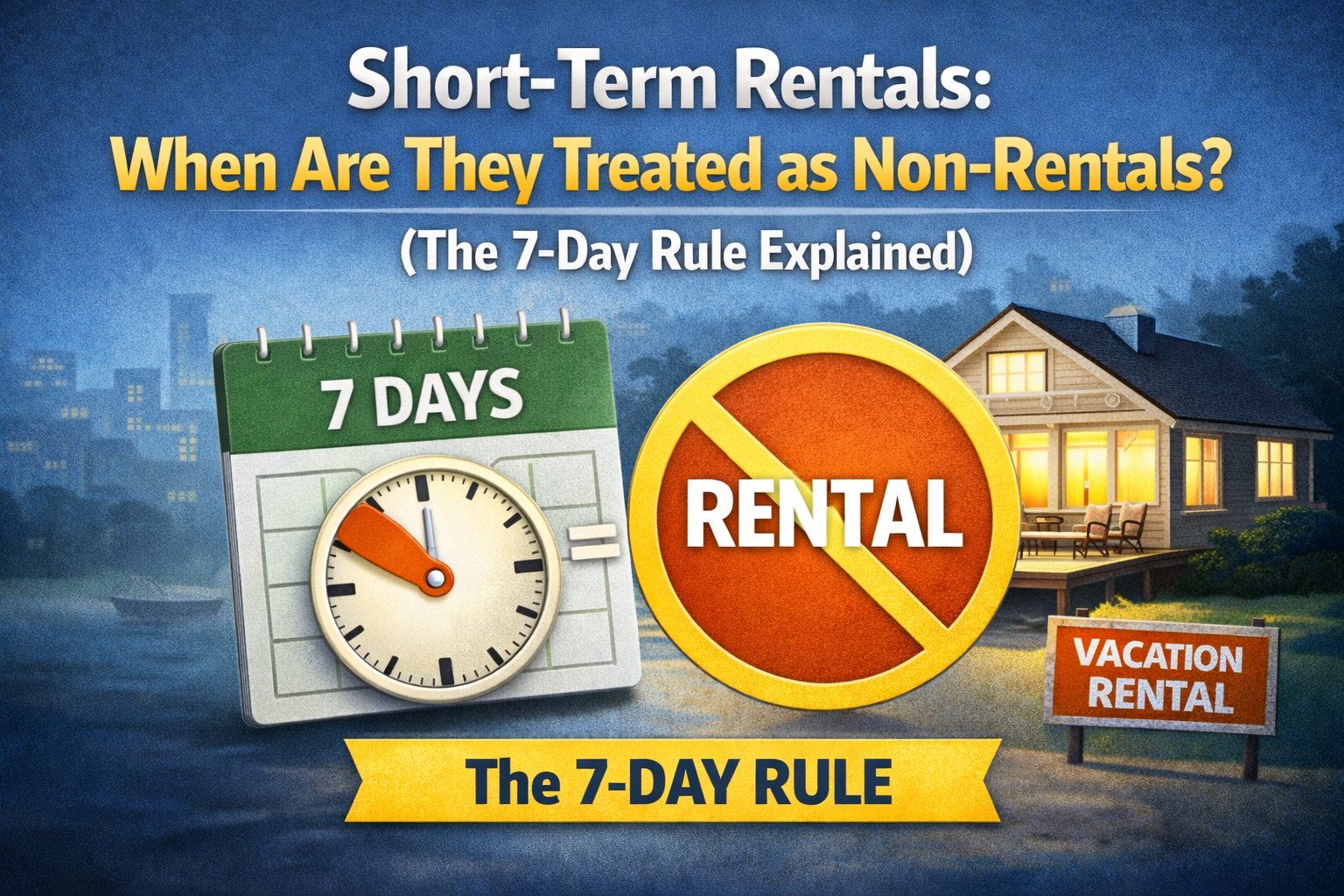
There is one more path worth knowing, because it sidesteps the REP tests entirely. The passive activity rules apply to 'rental activities,' but the regulations define that term narrowly. Under Treasury Regulation section 1.469-1T(e)(3), if the average period of customer use of your property is seven days or less, the activity is not treated as a rental activity at all.
Because a short-term rental with an average stay of seven days or fewer is not a 'rental activity,' it is not automatically passive, and you do not need to qualify as a real estate professional to make its losses non-passive. This is the well-known 'short-term rental loophole.' But do not miss the catch: you still must materially participate (the second gate from earlier) for the losses to offset your active income. The seven-day rule only removes the automatic passive label; it never removes the material participation requirement.
The seven-day rule turns on your average guest stay, a number you have to actually compute and document. REP Helper calculates average length of stay from your booking data and tracks your material participation hours on the same property, so both halves of the short-term rental position are supported.
Putting It All Together
Step back and the logic forms a clean chain. Rental losses are presumed passive. Passive losses only offset passive income, so without passive income they get suspended and pile up unused. The $25,000 allowance is the relief valve for modest earners, but it phases out between $100,000 and $150,000 of MAGI, leaving higher earners with no relief. To escape entirely, you remove the passive label with REP status and then make the losses non-passive by materially participating, optionally grouping your rentals to make that participation achievable.
- Confirm whether your rental losses are currently suspended and how large the carryforward has grown.
- Check your MAGI against the $100,000 to $150,000 phase-out to see if the $25,000 allowance is even available to you.
- Assess realistically whether you (or a spouse) can meet both the 750-hour and more-than-50% REP tests this year.
- Plan to materially participate in each property, or make the grouping election so portfolio-wide hours count.
- If you run short-term rentals, track average stay and material participation as a separate path.
- Keep contemporaneous, dated records of every hour, because both gates are proven with documented time.
Everything in this chain ultimately rests on hours: hours to qualify as a real estate professional, and hours to materially participate. That is the practical reason record-keeping matters so much here. REP Helper exists to capture those hours as the work happens, tag who performed each activity and which test it supports, and produce a CPA-ready export, so the deduction you claim is backed by evidence rather than a year-end reconstruction. None of this is a substitute for personalized advice, so confirm your specific situation with your own tax advisor.
Frequently Asked Questions
Q: If my rental loss is suspended this year, do I lose it permanently?
A: No. A disallowed passive loss is suspended and carried forward indefinitely. It can be used in a later year against passive income, or it is generally released in full when you sell the entire activity in a fully taxable disposition to an unrelated party. It is parked, not lost.
Q: I make over $150,000. Can I still use the $25,000 special allowance?
A: Generally no. The $25,000 allowance phases out as MAGI rises from $100,000 to $150,000, dropping $1 for every $2 of MAGI over $100,000, and reaches zero at $150,000. Above that level your route to using rental losses against active income is usually REP status plus material participation, not the special allowance.
Q: I qualified as a real estate professional. Are my rental losses automatically deductible now?
A: Not automatically. REP status only removes the rule that treats rentals as automatically passive. You still have to materially participate in the activity, under one of the seven tests in Treasury Regulation section 1.469-5T, before the losses become non-passive and can offset your active income. REP and material participation are two separate requirements.
Q: I own five rentals. Do I need 500 hours on each one?
A: Not if you make the grouping election under section 469(c)(7)(A). That election lets a real estate professional treat all rental properties as one activity for material participation, so your hours are measured across the whole portfolio rather than property by property. The election is filed by statement with your return and is generally irrevocable, so discuss it with your advisor first.
Q: Do short-term rentals need REP status to deduct losses against my salary?
A: Often not. If the average guest stay is seven days or fewer, the activity is not a 'rental activity' under the regulations, so it is not automatically passive and REP status is not required. However, you must still materially participate for the losses to be non-passive. The seven-day rule removes the passive presumption, not the participation requirement.
About the author

Real Estate Investor · Founder, REP Helper
Carlos Lourenço is a real estate investor and the founder of REP Helper. Over 10+ years he's built a portfolio of long- and short-term rentals across several states, personally qualifying for Real Estate Professional Status (REPS) and running the short-term-rental strategy on his own properties. A product manager by trade, he built REP Helper after years of tracking his own hours and IRS tests by hand.
Connect on LinkedInDisclaimer: Carlos Lourenço is a real estate investor, not a CPA, enrolled agent, or tax attorney. This article is for educational purposes only and is not tax, legal, or financial advice. Tax outcomes depend on your specific facts and on current law, which changes. Always consult a qualified CPA or tax attorney before implementing any tax strategy.