
The Mistake That Costs Investors
Early on I thought REP status alone unlocked my rental losses. It doesn’t — I learned (the slightly expensive way) that you also have to materially participate. This is the distinction that actually determines whether your losses go active.
An investor works hard all year. Tracks 800 hours. Confirms they passed the 50% test. Feels confident.
Then their CPA asks one question: "Did you materially participate in the rental activity?"
Silence.
Qualifying as a Real Estate Professional (REP) is only half of the equation.
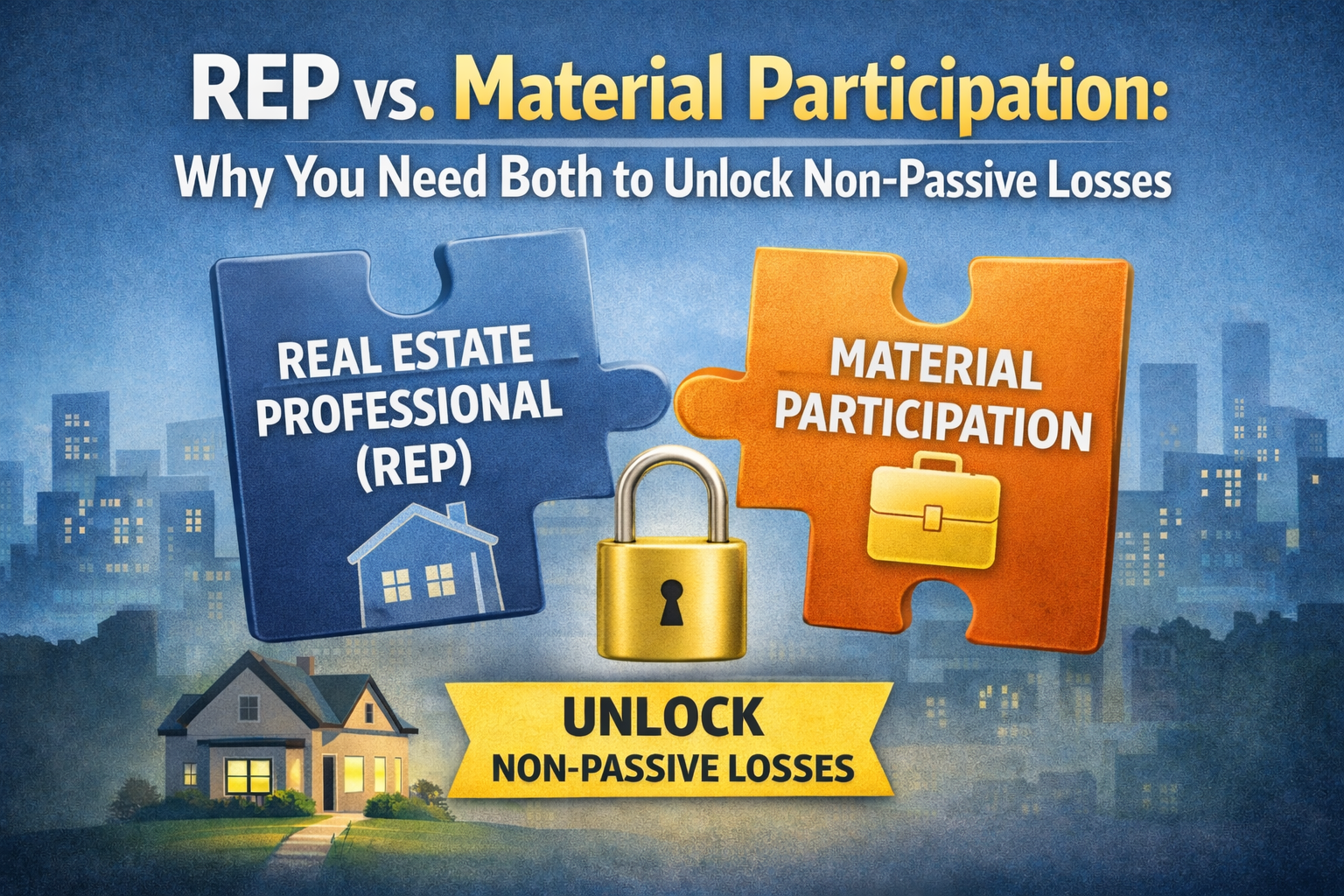
If you want to turn rental losses into non-passive losses — the kind that offset W-2 or business income — you need two things: REP status and material participation in your rentals. Miss either one, and the losses stay passive.
What REP Status Does (and Doesn't Do)
When you qualify as a Real Estate Professional, you remove one major barrier. Normally, rental activity is automatically treated as passive. That means losses can't offset active income.
REP status changes that rule. It allows your rentals to be treated as active — but only if you materially participate in them.
REP status alone doesn't unlock anything. It simply gives you the opportunity to move forward. Think of REP as opening the door. Material participation is what lets you walk through it.
What Material Participation Really Means
Material participation answers one question: Were you genuinely involved in running the rental activity?
It's about your level of hands-on involvement in your properties. You can't just own them. You can't just supervise from a distance. You must actively participate.
There are several ways to qualify, but most long-term rental investors rely on one of these:
- Spend 500 hours or more on the rental activity
- Spend 100 hours and more than anyone else involved
- Do substantially all of the work yourself
Again, your hours only. Contractor hours don't count.
Why You Need Both
Let's say you worked 900 hours in real estate this year and passed the 50% test. You qualify as REP.
But if those 900 hours were mostly spent researching deals, attending conferences, or managing other people's properties — and only 80 hours were spent on your own rentals — you may fail material participation. Result? Your rental losses stay passive.
Now flip it. You spent 600 hours working hands-on in your rental properties. You clearly materially participated. But you also worked 2,000 hours at your corporate job. You fail the 50% test. You're not REP. Result? Losses stay passive.
Both gates must open.
Think of it as two locks: Lock #1 is REP qualification (750 hours + 50% test). Lock #2 is material participation in the rental activity. You need both keys. One without the other doesn't work.
Where Investors Get Confused
The confusion usually comes from mixing the hours together. "I worked 850 hours in real estate, so I'm fine."
That number might qualify you as REP. But how many of those hours were spent directly on your rental properties?
If you're a broker, developer, or property manager, your real estate work may be spread across many activities. Only the hours tied to your rental activity count toward material participation.
This separation matters. And it's why tracking needs to be structured.
Real Example
A client once logged 1,200 real estate hours. Strong year. But when we broke it down:
- 700 hours were spent managing properties for other owners
- 300 hours were spent on education and networking
- 200 hours were spent on his own rentals
He passed REP easily. But 200 hours wasn't enough to meet material participation under the 500-hour test. And he didn't meet the "100 hours and more than anyone else" standard either because he had a property manager heavily involved.
The losses stayed passive. He had done the work. He just didn't separate it properly.
Why Documentation Matters More Than You Think
In an audit, the IRS won't just ask, "Did you work a lot?" They'll ask:
- What did you do?
- On which property?
- On what date?
- For how long?
When you mix all real estate hours together, you can't clearly show which hours qualify you as REP and which hours qualify you for material participation.
REP Helper was built to separate these two tracks clearly. It tracks total real estate hours (for REP tests) and hours per property or grouped rental activity (for material participation). You can see both progress bars independently. No guessing. No end-of-year scrambling.
What About Grouping Properties?
Many investors own multiple long-term rentals. In many cases, you can group them into one activity for material participation purposes. That makes the 500-hour test more realistic across a portfolio.
Material participation applies to the rental activity itself — whether grouped or separate. REP applies to your total real estate work across all qualifying real estate businesses. Different focus. Different measurement.
The Order Matters
You can think of it this way:
- First, ask: Did I qualify as REP this year?
- Second, ask: Did I materially participate in my rentals?
If the answer to either is no, the losses remain passive. There's no partial credit.
Why Real-Time Tracking Changes the Outcome
Most investors look at this once a year. That's too late.
If you see in August that you're short on rental-specific hours, you can increase your involvement. Take on more direct tasks. Reduce reliance on third parties.
REP Helper makes this visible throughout the year. You see REP progress, material participation progress, and per-property breakdown. You don't find out after filing.
The Big Picture
REP status allows rental losses to be treated as active. Material participation determines whether your specific rental activity qualifies as active. They work together.
If you're serious about using real estate to reduce taxable income, you have to manage both intentionally. Track them separately. Review them monthly. Adjust your involvement as needed.
Treat your hours like financial data. Because for tax purposes, they are.
About the author

Real Estate Investor · Founder, REP Helper
Carlos Lourenço is a real estate investor and the founder of REP Helper. Over 10+ years he's built a portfolio of long- and short-term rentals across several states, personally qualifying for Real Estate Professional Status (REPS) and running the short-term-rental strategy on his own properties. A product manager by trade, he built REP Helper after years of tracking his own hours and IRS tests by hand.
Connect on LinkedInDisclaimer: Carlos Lourenço is a real estate investor, not a CPA, enrolled agent, or tax attorney. This article is for educational purposes only and is not tax, legal, or financial advice. Tax outcomes depend on your specific facts and on current law, which changes. Always consult a qualified CPA or tax attorney before implementing any tax strategy.