
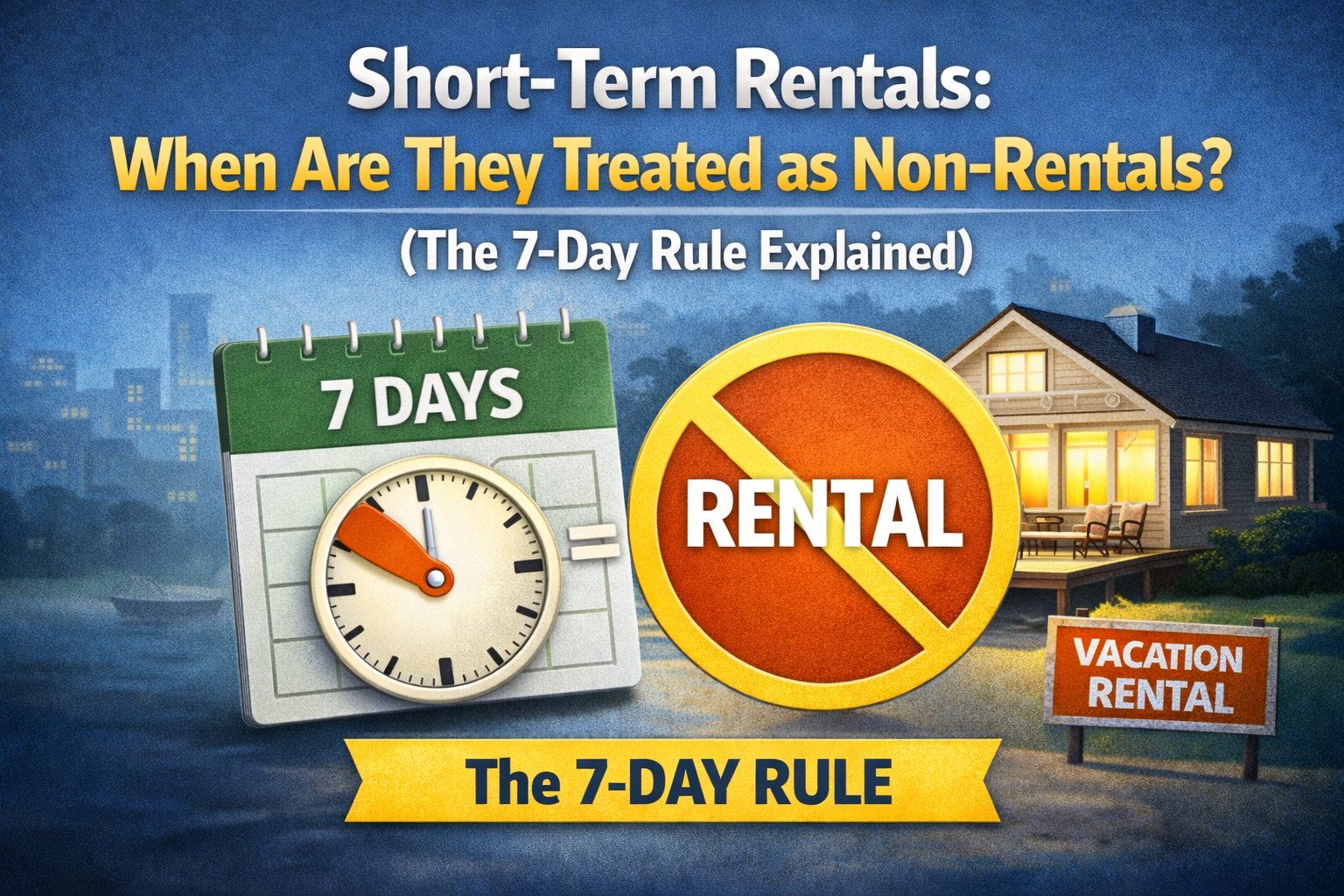
The Rule That Surprises Most STR Owners
I run short-term rentals where the average stay stays under seven days on purpose — because that single fact changes how the IRS treats the activity. Here’s the rule that makes the STR strategy work, explained the way I had to understand it for my own properties.
If you own short-term rentals, you've probably heard someone say: "If your average stay is seven days or less, it's not considered a rental."
That statement is mostly correct. But the details matter. And those details can completely change how your losses are treated. This 7-day test is the foundation of the short term rental loophole.
Some investors assumed they needed to qualify as a Real Estate Professional to use their STR losses — when in reality, they didn't. The 7-day rule is often the reason.
Why the "Rental" Label Matters
Long-term rentals are automatically treated as passive activities. That means losses usually can't offset your W-2 or business income unless you qualify as a Real Estate Professional and materially participate.
Short-term rentals are different. If your property meets certain criteria, it may not be treated as a rental activity at all for tax purposes.
And if it's not treated as a rental, the rules change. You may not need REP status. That's a big shift.
The 7-Day Rule in Plain English
If the average stay of your guests is 7 days or less, the property is generally not treated as a rental activity for tax purposes.
Average stay means: total days rented during the year divided by total number of guest stays.
A simple example: you had 120 bookings during the year, guests stayed a total of 600 days. 600 ÷ 120 = 5 days average stay. That's under 7 days. In most cases, that property would not be treated as a rental activity.
Why This Matters So Much
If your STR is not treated as a rental activity, then the usual passive rental rules don't automatically apply. Instead, the activity is treated more like an active business.
That means if you materially participate — meaning you're actively involved — your losses may be able to offset other income without needing REP status.
That surprises many investors. They assume REP is required. For STRs under the 7-day rule, that's often not the case.
What If the Average Stay Is Over 7 Days?
If your average stay is more than 7 days, the property is generally treated as a rental activity. At that point:
- The normal passive rental rules apply
- You may need REP status to use losses against active income
- Material participation alone won't remove the passive classification
So that average number carries serious weight.
Real-World Scenario
An investor assumed his lake house STR was automatically passive. He had strong losses due to depreciation and renovation costs.
When we ran the numbers, his average stay was 4.8 days. He had been actively managing guest messaging, cleaning coordination, maintenance, and pricing updates. He materially participated.
He didn't need REP status at all. But he almost missed that because he never calculated the average stay properly.
The 30-Day Rule (Briefly)
There's another threshold at 30 days, but for most STR operators focused on vacation markets, the 7-day rule is the key number.
If your average stay is between 7 and 30 days, the analysis becomes more detailed. For now, if you're operating typical Airbnb-style bookings of a few nights at a time, focus on the 7-day average.
Why Tracking Average Stay Is Harder Than It Sounds
Many investors guess. They say, "Most guests stay 3 or 4 nights." That's not enough. You need actual numbers.
- If you use multiple booking platforms, the math can get messy
- Manual spreadsheets are easy to miscalculate
- Mid-year changes can shift the average without you realizing it
REP Helper includes a Stay Ledger feature that connects to your booking calendar and automatically calculates average stay throughout the year. You don't have to estimate. You see the number clearly.
And if that number starts creeping above 7, you'll know early.
Material Participation Still Matters
Even if your STR is not treated as a rental, you still need to materially participate in the activity for losses to offset active income. That means real involvement:
- Managing guests
- Overseeing cleaning
- Handling repairs
- Managing pricing
- Coordinating vendors
Your time counts. Contractor time doesn't. You need solid records showing what you did and when.
REP Helper separates owner-performed activities from contractor activities and builds a timeline of your work. That structure matters if you ever need to defend your position.
Common Mistakes
- Never calculating the average stay — Assumptions aren't enough. The rule depends on math.
- Mixing long-term and short-term use — If you convert a property mid-year from long-term to short-term, the classification may change.
- Ignoring documentation — The IRS doesn't just take your word for it. You need records.
- Thinking REP is always required — For many STR owners under the 7-day rule, it isn't.
One Final Thought
The 7-day rule is simple on the surface. Under 7 days average stay often means your STR isn't treated as a rental activity. That can open the door to using losses without qualifying as a Real Estate Professional.
But it only works if:
- The math supports it
- You materially participate
- Your documentation holds up
Short-term rentals can create powerful tax outcomes. But only when the classification is clear. Know your numbers. Track your activity. Don't assume.
The difference between a passive loss and a usable loss often comes down to one average.
About the author

Real Estate Investor · Founder, REP Helper
Carlos Lourenço is a real estate investor and the founder of REP Helper. Over 10+ years he's built a portfolio of long- and short-term rentals across several states, personally qualifying for Real Estate Professional Status (REPS) and running the short-term-rental strategy on his own properties. A product manager by trade, he built REP Helper after years of tracking his own hours and IRS tests by hand.
Connect on LinkedInDisclaimer: Carlos Lourenço is a real estate investor, not a CPA, enrolled agent, or tax attorney. This article is for educational purposes only and is not tax, legal, or financial advice. Tax outcomes depend on your specific facts and on current law, which changes. Always consult a qualified CPA or tax attorney before implementing any tax strategy.