
The Quietest Tax Move in the House
Picture a familiar household. One spouse earns a high W-2 salary as a physician, engineer, or executive and is buried under a punishing schedule. The other spouse works part-time, runs the home, or has stepped away from full-time work entirely. Between them sits a small portfolio of rental properties that throws off paper losses every year from depreciation and operating expenses.
On most returns, those rental losses do nothing. They are passive, suspended, and parked on a carryforward schedule waiting for a sale that may be years away. The household pays full freight on the high salary while sitting on deductions it cannot touch.
Here is the move: the spouse with the lighter work calendar becomes the Real Estate Professional, and the whole household gets to use the losses.
This is not the dry mechanical version of the spouse rule. This article is the strategy and the story behind it: why the non-working or part-time spouse is so often the right person to carry Real Estate Professional status (REP), how the pieces fit on a joint return, and what a worked scenario actually looks like. We will use illustrative numbers throughout, and you should confirm the specifics with your own tax advisor.
Why the High Earner Is Usually Stuck
REP status requires two things in the same tax year, judged for one individual: more than 750 hours in real property trades or businesses in which that person materially participates, AND more than 50% of ALL of that person's personal-service hours spent in real property trades or businesses.
The second test is where the high earner runs aground. Consider a surgeon working 2,400 hours a year in the operating room. To put more than half of her working hours into real estate, she would need to log over 2,400 real estate hours on top of an already demanding career. That is roughly another full-time job. It is not impossible in theory, but for a genuinely busy professional it is a fantasy.
The 50% test is a ratio, and a big W-2 makes the denominator enormous.
This is the trap many investors fall into. They assume the person who earns the income that needs sheltering must be the one who qualifies. The tax code does not work that way on a joint return. Qualification and benefit are decoupled, and that gap is exactly what makes the spouse strategy work.
Only One Spouse Has to Qualify
On a married-filing-jointly return, the IRS lets you treat the REP tests as met for the couple if EITHER spouse passes them individually. The hours of the two spouses are not combined to clear the 750-hour or 50% thresholds; each person is measured on their own. But once one spouse clears both tests, the household's rental activities lose their automatic passive label.
That single rule flips the planning question. Instead of asking 'how does the breadwinner find 2,000 real estate hours,' you ask 'which spouse has the most room in their calendar to legitimately do real estate work?'
- REP status is determined per individual, never per household.
- On a joint return, only one spouse needs to qualify for the household to benefit.
- The qualifying spouse's status changes the character of the SHARED rental losses on the return.
- Those now-active losses then offset all income on the joint return, including the OTHER spouse's W-2 salary.
The spouse who qualifies and the income that gets sheltered do not have to belong to the same person.
Why the Non-Working or Part-Time Spouse Wins the Math
Go back to the 50% test as a fraction: real estate hours divided by total working hours. For the high earner the denominator is huge. For a spouse who is not working a W-2 job, the denominator is tiny, sometimes zero. That changes everything.
The High Earner
- 2,400+ W-2 hours already on the books
- Needs 2,400+ real estate hours just to tie the 50% test
- Schedule leaves little or no room
- Realistically cannot qualify
The Part-Time or At-Home Spouse
- Few or zero competing W-2 hours
- Just needs to clear 750 real estate hours
- 750 hours over a year is roughly 15 hours a week
- 50% test is easily satisfied
For a spouse with no other job, ANY positive number of real estate hours technically exceeds 50% of their working hours. The binding constraint becomes the 750-hour floor, not the ratio. That means the entire planning effort can focus on one concrete, trackable goal: getting one person genuinely past 750 hours of real, documented real estate work.
For a part-time spouse, the math is still friendly. Someone working 600 hours a year at a part-time job only needs to log more than 600 real estate hours to win the ratio, and at least 750 to clear the floor. Pushing slightly past 750 hours covers both tests at once.
When the denominator is small, the 750-hour floor is the whole ballgame.
REP Is the Door, Material Participation Is the Key
This is the single most common way the strategy is bungled. Earning REP status does NOT automatically make rental losses deductible against W-2 income. REP only removes the rule that says rentals are passive by default. After that, the qualifying spouse must ALSO materially participate in the rentals for the losses to be treated as non-passive.
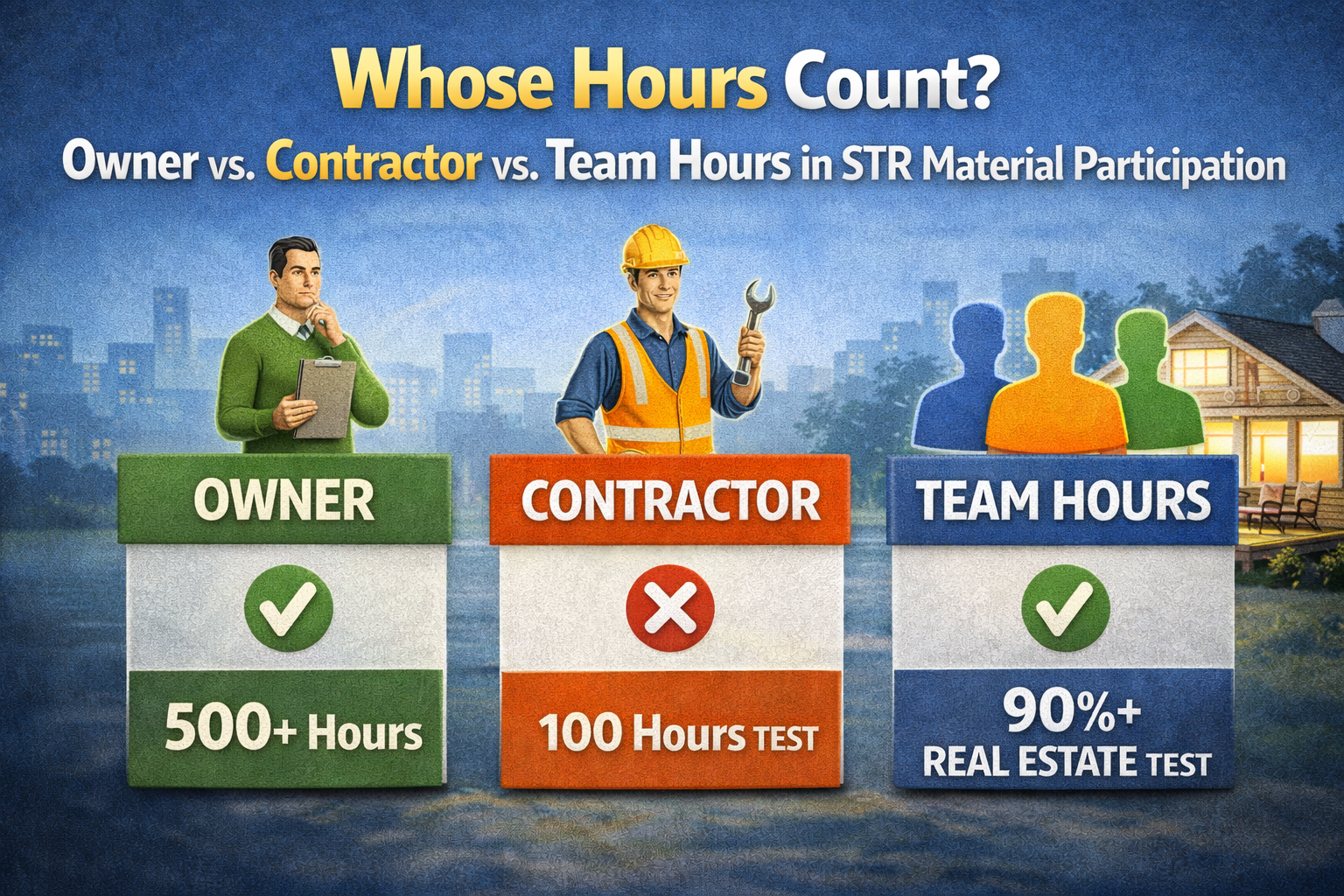
Material participation is its own separate test, governed by the seven tests in Treasury Regulation section 1.469-5T. The most common one for landlords is the 500-hour test: more than 500 hours in the activity during the year. There are other ways to qualify, including doing substantially all of the work, or doing more than 100 hours where no one else does more.
There is a sequencing nuance for portfolios with several properties. Material participation is generally tested activity by activity, so a small landlord could pass REP yet fail material participation on each individual property. The fix is the grouping election under IRC section 469(c)(7)(A) and Treasury Regulation section 1.469-9(g), which lets you treat all rental real estate as ONE activity. File it as a statement attached to the return, and understand it is generally irrevocable.
- Gate 1: The qualifying spouse clears 750 hours AND the 50% test (REP status).
- Gate 2: The qualifying spouse materially participates in the rentals, usually via the 500-hour test.
- Gate 3: If there are multiple properties, the grouping election ties them into one activity so material participation is easier to prove.
Pass REP but flunk material participation, and your losses stay passive. You need both gates.
A Worked Scenario: The Lopez Household
The following figures are illustrative and rounded for clarity. They are not a real client and not a promise of any result.
Daniel earns $360,000 a year as a hospital anesthesiologist and works about 2,300 clinical hours. His spouse Maria left a full-time marketing role two years ago and now does occasional freelance work, roughly 200 hours a year. Together they own four long-term rentals that generate $70,000 of combined tax losses this year, mostly from depreciation.
On their old return, that $70,000 was passive and suspended. With Daniel's MAGI well above $150,000, even the $25,000 special allowance was fully phased out, so the losses sheltered nothing.
The plan: make Maria the household's Real Estate Professional.
Maria's REP Test
- Real estate hours logged: about 820
- Freelance hours: about 200
- Real estate share: 820 / 1,020 = ~80%
- 50% test: PASSED
- 750-hour test: PASSED
Material Participation
- Grouping election filed: all 4 rentals = 1 activity
- Combined hours in the grouped activity: 820
- 500-hour test on the group: PASSED
- Losses become non-passive
Because Maria qualifies and materially participates in the grouped activity, the $70,000 of rental losses becomes active on the joint return. That $70,000 now offsets Daniel's W-2 income. At a combined marginal rate of roughly 35%, the household keeps about $24,500 it would otherwise have paid in tax, and it stops accumulating losses it could not use.
Same properties, same losses, same family. The only thing that changed was who logged the hours and how the return was structured.
Notice what made it work: Maria's small freelance footprint made the 50% test trivial, her real estate hours cleared both the 750-hour floor and the 500-hour material participation test, and the grouping election let four properties count as one.
What Those 820 Hours Actually Looked Like
Auditors do not accept a round number scribbled at year-end. The hours have to be real, performed by the qualifying spouse, and documented as they happen. Here is the kind of work that legitimately fills a year for a hands-on landlord.
- Screening tenants, showing units, and handling lease renewals.
- Coordinating and overseeing repairs and turnovers between tenants.
- Bookkeeping, rent collection, and vendor management for the portfolio.
- Property inspections, drive-bys, and maintenance walk-throughs.
- Researching and evaluating new acquisitions she actively pursues.
- Marketing vacancies and responding to tenant communications.
Two cautions that separate winning logs from losing ones. First, a contractor's hours are not Maria's hours. If a handyman spends six hours on a repair, Maria only counts the time she spent coordinating and supervising it. Second, pure investor activities like reading financial statements or passively monitoring markets generally do not count toward the tests.
This is precisely where REP Helper earns its place. As Maria does the work, she logs it by phone, voice, or web in the moment, so the record is contemporaneous rather than reconstructed. Each entry is tagged by who performed it, which keeps Maria's qualifying hours cleanly separated from Daniel's, from contractors, and from any team members.
The Pitfalls That Sink This Strategy
The spouse strategy is sound, but it fails in predictable ways. Most failures are not about the law; they are about proof and follow-through.
- Counting both spouses' hours together to reach 750. The thresholds are per individual; you cannot pool them.
- Treating REP as the finish line and forgetting material participation entirely.
- Skipping the grouping election with multiple properties, then failing the 500-hour test on each one separately.
- Letting the qualifying spouse quietly return to substantial W-2 work, which can blow the 50% test.
- Logging contractor hours as the spouse's own hours.
- Reconstructing a log at tax time, which is the weakest possible position in an audit.
There is also a planning rhythm to respect. Qualification is annual. A spouse who qualifies one year is not automatically qualified the next. If the part-time spouse picks up a bigger job, or the portfolio shrinks and the available work drops below 750 hours, the household can quietly fall out of status without realizing it until the return is prepared.
REP Helper is built to surface these problems early. It tracks progress toward the 750-hour AND 50% thresholds at the same time, updating the ratio live as outside or W-2 hours are entered, so the qualifying spouse can see in real time whether they are on pace or drifting. It also tracks per-property and grouped material participation separately, so a multi-property household knows whether the 500-hour bar is being met on the grouped activity.
Is This Strategy a Fit for Your Household?
The spouse strategy shines in a specific situation, and it is worth being honest about when it does and does not apply.
Strong Fit
- One spouse has a high W-2 income to shelter
- The other spouse works part-time or not at all
- The household owns rentals throwing off real losses
- The lighter-schedule spouse can genuinely do 750+ hours
- You can commit to contemporaneous logging
Weak Fit
- Both spouses work demanding full-time jobs
- No one has room for 750 real hours
- The rentals are fully managed by third parties
- Losses are small relative to the effort required
- You only want to back-fill hours after the fact
If you land in the strong-fit column, the next step is to map the year: assign the qualifying spouse, confirm the work that needs doing genuinely adds up to more than 750 hours, decide whether to file the grouping election, and start logging from January 1. Then bring the plan to your CPA to validate before you rely on it.
When it is time to file, REP Helper produces CPA-ready exports of the qualifying spouse's hours, the 50% ratio, and material participation by activity, so your advisor receives organized evidence rather than a shoebox of guesses.
Frequently Asked Questions
Q: Can my spouse and I combine our hours to reach 750?
A: No. The 750-hour test and the 50% test are applied to each individual separately, so hours cannot be pooled across spouses. The benefit on a joint return comes from the fact that only ONE spouse needs to clear both tests on their own; once they do, the rental activities lose their passive status for the whole return.
Q: Does the non-working spouse really qualify with so few hours?
A: The 50% test is a ratio of real estate hours to total working hours, so a spouse with little or no other work clears it easily. But they still must exceed the absolute 750-hour floor, and they must materially participate in the rentals, usually by passing the 500-hour test. The small denominator helps the ratio; it does not waive the 750-hour and material participation requirements.
Q: My spouse qualifies. Does that shelter my W-2 income too?
A: Yes. On a joint return, once one spouse qualifies and materially participates, the household's rental losses become non-passive and offset all income on the return, including the other spouse's salary. The person who qualifies and the income being sheltered do not have to be the same person.
Q: Do we need the grouping election?
A: Often, yes, if you own more than one rental. Without it, material participation is tested property by property, and a small landlord may fail the 500-hour bar on each one individually. The election under IRC section 469(c)(7)(A) treats all your rental real estate as a single activity, making the 500-hour test far easier to meet. It is attached to the return as a statement and is generally irrevocable, so discuss it with your advisor first.
Q: What happens if my part-time spouse takes a bigger job next year?
A: Qualification is annual, so a larger W-2 load raises the denominator on the 50% test and can knock the household out of REP status for that year. You would need the qualifying spouse to either keep real estate hours above half of total working hours or have the other spouse step in. Tracking the ratio live throughout the year is the only way to catch this drift before it costs you the deduction.
About the author

Real Estate Investor · Founder, REP Helper
Carlos Lourenço is a real estate investor and the founder of REP Helper. Over 10+ years he's built a portfolio of long- and short-term rentals across several states, personally qualifying for Real Estate Professional Status (REPS) and running the short-term-rental strategy on his own properties. A product manager by trade, he built REP Helper after years of tracking his own hours and IRS tests by hand.
Connect on LinkedInDisclaimer: Carlos Lourenço is a real estate investor, not a CPA, enrolled agent, or tax attorney. This article is for educational purposes only and is not tax, legal, or financial advice. Tax outcomes depend on your specific facts and on current law, which changes. Always consult a qualified CPA or tax attorney before implementing any tax strategy.