Why REP Status Matters
When I first worked through the two REP tests on my own return, I assumed the 750 hours were the bar. They aren’t — the 50% test is what trips up most investors I talk to, myself included early on. Here’s how both really work together.
If you own rental properties and want to use your losses to reduce your regular income (like W-2 salary or business income), you've probably heard about qualifying as a Real Estate Professional — often shortened to "REP."
The idea sounds simple: "If I spend enough time in real estate, I can unlock my rental losses." But in practice, many investors misunderstand what actually needs to happen.
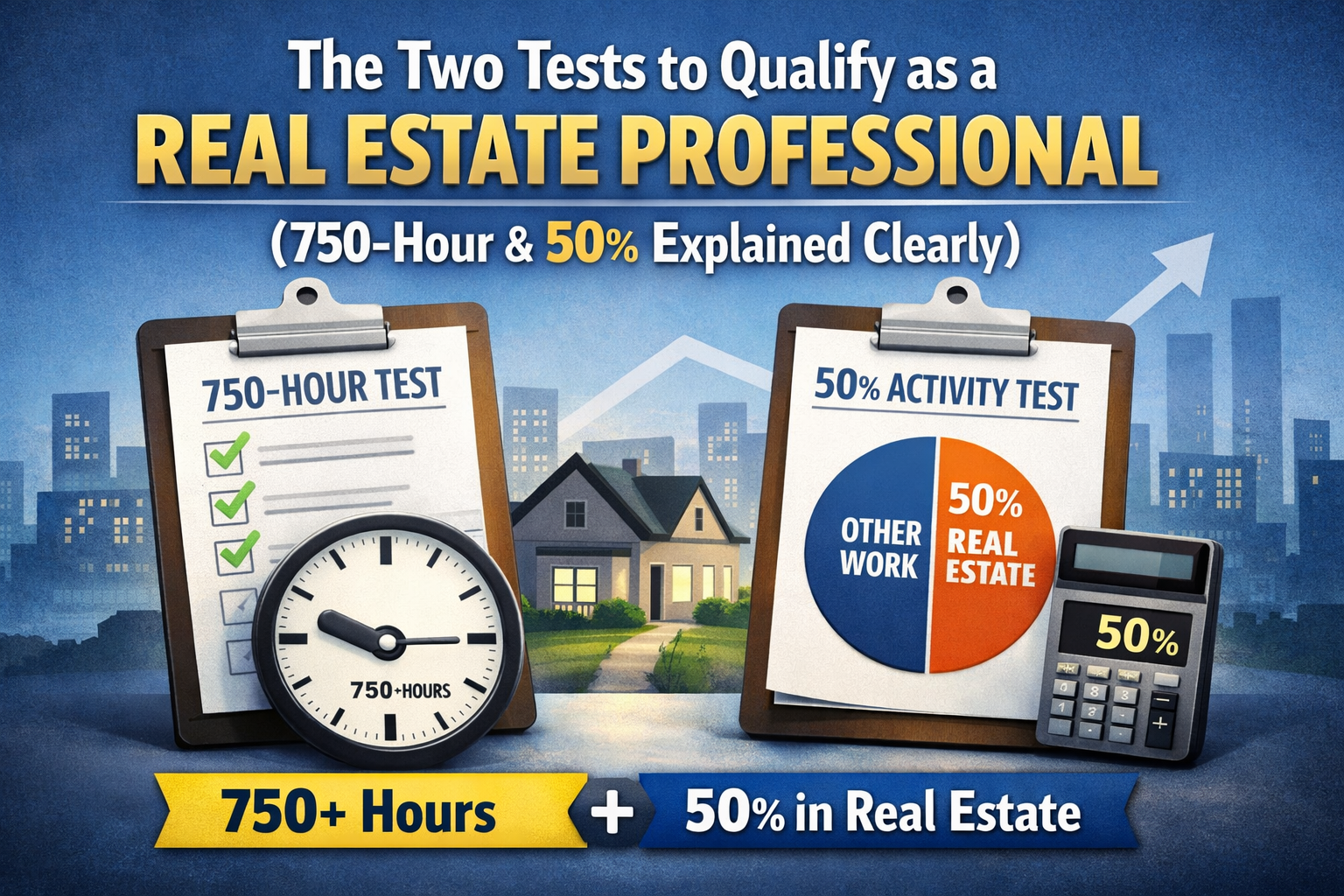
There are two tests. You must pass both in the same year.
Normally, rental losses are considered passive. That means they can only offset passive income. If you qualify as a Real Estate Professional and you materially participate in your rentals, your rental losses can become non-passive.
That means they can reduce:
- W-2 income
- Business income
- Investment income
For many investors, this is the difference between a large tax refund and being stuck carrying losses forward for years.
Test #1: The 750-Hour Test
This one is straightforward. You must spend at least 750 hours during the year working in real estate activities.
But here's what matters:
- These hours must be real estate work
- They must be work you personally perform
- They must be business-related activities
What Counts
- Managing tenants
- Advertising vacancies
- Reviewing applications
- Supervising repairs
- Visiting properties
- Coordinating contractors
- Bookkeeping for your rentals
- Researching new deals
- Property management work
What Does Not Count
- Time spent only reviewing financial statements casually
- Contractor time
- Passive ownership
- Education unrelated to your own real estate activities
If you didn't personally do the work, it doesn't count. If your handyman spent 10 hours repairing a fence, that does not help you reach 750 hours.
What 750 Hours Really Means
750 hours per year is:
- About 62.5 hours per month
- About 14–15 hours per week
That's very doable for active investors. But it's much harder if you work a full-time job outside of real estate.
And this is where the second test becomes critical.
Test #2: The 50% Test
This is the test that most people underestimate.
You must spend more time working in real estate than in all other jobs combined.
In other words: real estate must be more than half of your total working time for the year.
If you have a full-time W-2 job working 2,000 hours per year, then you would need more than 2,000 hours in real estate to pass this test. Not 750. More than 2,000.
That's why many high-income W-2 earners fail the 50% test — even if they easily hit 750 hours.
Important clarification: this test compares working time, not income. It does not matter how much money you make in each activity, which one is more profitable, or which one you prefer. Only the hours matter.
How the Two Tests Work Together
You must work at least 750 hours in real estate, and those hours must be more than half of your total work time. If either test fails, you do not qualify.
Both tests must be met.
Example 1: 1,000 hours in real estate, 1,200 hours at W-2 job. You pass 750 hours. You fail 50%. Result: you do not qualify.
Example 2: 800 hours in real estate, 600 hours at consulting job. You pass 750 hours. You pass 50%. Result: you qualify.
Example 3: 600 hours in real estate, 200 hours at W-2 job. You pass 50%. You fail 750 hours. Result: you do not qualify.
Why Most Investors Get This Wrong
There are three common mistakes:
- They only track the 750 hours — They celebrate hitting 750 but forget the 50% test.
- They underestimate their non-real-estate work — Side businesses, consulting, and W-2 jobs all count in the denominator.
- They don't track consistently — At the end of the year, they try to "reconstruct" hours from memory. That's risky.
If you ever get audited, you need:
- Dates
- Descriptions
- Duration
- Evidence
That's one of the reasons REP Helper was built — to eliminate the guessing and reconstruction. Instead of scrambling in December, you can see your total real estate hours, your progress toward 750, and whether you're ahead or behind on the 50% comparison. In real time.
What Counts as "Real Estate Work"?
To qualify, the work must be related to real estate businesses like:
- Rental activity
- Property development
- Brokerage
- Property management
- Construction
- Real estate acquisition
But again, it must be work you perform. If you own rental properties but a property manager does everything, your hours may be very low. Ownership alone is not enough.
What About Your Spouse?
If you're married and filing jointly, your spouse's real estate hours can count toward the 750-hour test.
However, the 50% test is applied individually.
This is where careful tracking becomes very important.
A Quick Note About Material Participation
Even if you pass both tests, you're not done yet. You must also materially participate in your rental properties for the losses to become non-passive. That's a separate requirement.
Many investors think passing REP automatically unlocks losses.
It doesn't. You need both: REP qualification and material participation in your rentals.
Inside REP Helper, both are tracked separately so you can see clearly where you stand.
Why Tracking Early in the Year Matters
Many investors realize in November that they're short. At that point, it may be too late.
If you track from January:
- You know if you're pacing correctly
- You know if your W-2 hours are making the 50% test impossible
- You can make strategic decisions earlier
For example: reducing outside work, increasing hands-on property involvement, or grouping activities properly.
Without visibility, you're guessing.
What Proper Tracking Looks Like
If you want to be audit-ready, you need:
- Date of activity
- Property involved
- Description of what you did
- Time spent
- Supporting evidence (emails, receipts, photos, call logs)
Not just a spreadsheet with totals. The IRS does not accept vague estimates like "Approximately 800 hours." They expect contemporaneous records.
REP Helper was designed around this principle: log activities as you perform them, use voice entry if you're on the go, attach documentation instantly, and see live progress toward both tests.
The goal is not just to qualify. It's to qualify confidently.
Final Takeaways
To qualify as a Real Estate Professional, you must:
- Work at least 750 hours in real estate
- Spend more time in real estate than in all other jobs combined
Both must happen in the same year.
Most investors fail not because they didn't work hard — but because they didn't track properly or misunderstood the 50% test.
If you're serious about unlocking non-passive losses, treat your hours like financial data. Track them. Measure them. Review them monthly.
That clarity alone changes how you operate. And if you want a system built specifically for this purpose — one that shows you exactly where you stand at any moment — that's precisely what REP Helper was created to do.
About the author

Real Estate Investor · Founder, REP Helper
Carlos Lourenço is a real estate investor and the founder of REP Helper. Over 10+ years he's built a portfolio of long- and short-term rentals across several states, personally qualifying for Real Estate Professional Status (REPS) and running the short-term-rental strategy on his own properties. A product manager by trade, he built REP Helper after years of tracking his own hours and IRS tests by hand.
Connect on LinkedInDisclaimer: Carlos Lourenço is a real estate investor, not a CPA, enrolled agent, or tax attorney. This article is for educational purposes only and is not tax, legal, or financial advice. Tax outcomes depend on your specific facts and on current law, which changes. Always consult a qualified CPA or tax attorney before implementing any tax strategy.