
The Question That Trips Everyone Up
When I started using a cleaner and a co-host on my STRs, I had to figure out whose hours actually count toward material participation. The answer surprised me, and getting it wrong is one of the most common ways owners quietly disqualify themselves.
If you own short-term rentals and want your losses to offset other income, you've probably heard: "You need to materially participate." It is the make-or-break half of the short term rental loophole.
That part's straightforward enough. But here's where things get murky: Whose hours actually count toward that participation?
Smart investors stumble on this one issue alone. They think their cleaner's time helps. Or they assume everything blends together. Then tax season hits and the picture gets a lot clearer — and not in a good way.
The One Rule That Matters
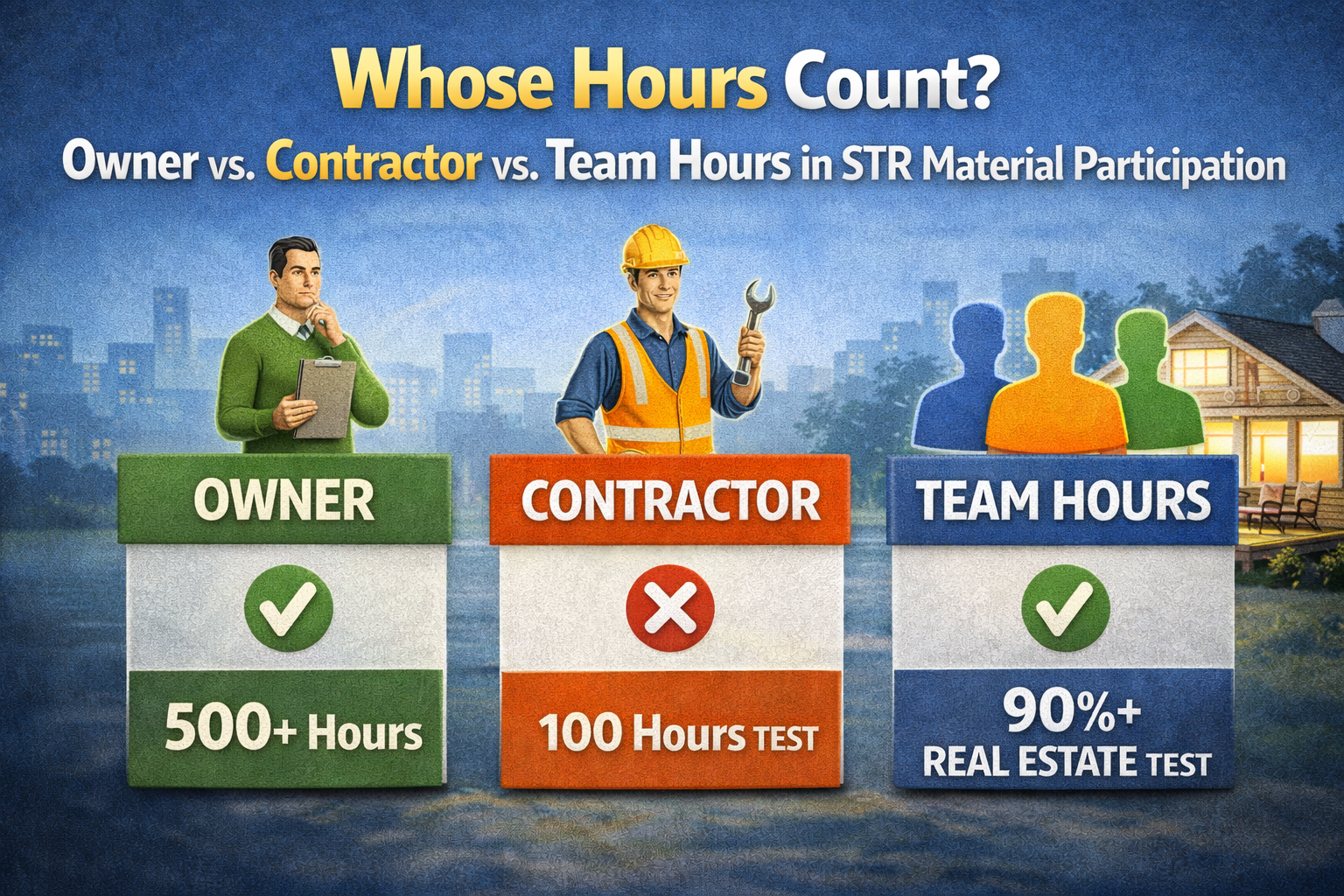
Only your personal work counts. That's it.
Not your cleaner's time. Not your handyman's. Not your property manager's. Just you.
And if you file taxes jointly, your spouse's hours count too.
Everything else? It doesn't add to your total.
What Your Hours Actually Cover
When you're working on your STR, here's what counts. The work doesn't need to be exciting or complicated. It just needs to be real.
- Handling guest messages
- Changing pricing
- Scheduling cleaners
- Checking the property condition
- Coordinating repairs
- Ordering supplies
- Reviewing booking calendars
- Managing your marketing
You're texting with guests at 9 p.m.? That counts. You're adjusting nightly rates at midnight? Counts. You spend Saturday morning inspecting the property, checking supplies, scheduling a repair person? All of it counts.
Contractor Time: The Hard Stop
Here's where the confusion usually starts. Your cleaner shows up twice a week and spends 400 hours a year. Your handyman fixes things for another 120 hours. Your landscaper maintains the grounds for 80 hours.
None of that counts toward your participation total. You can't add it up. You can't combine it. It doesn't help you reach any threshold.
One investor had carefully tracked 900 hours across his STR operation. He felt good about it. Then we separated owner work from contractor work. His actual personal involvement? 220 hours. That's a big difference. And it changed whether he could claim his losses.
Why Team Hours Still Matter (Even Though They Don't Count)
Your contractor hours don't get added to your total. But they can still affect whether you qualify.
Think about the "100 hours plus more than anyone else" test. To pass it, you need at least 100 of your own hours, and no one else can exceed your time.
So if you worked 150 hours but your property manager worked 300, you're out. The manager's hours don't count toward your total. But they can knock you out of that specific path to qualification.
That's why knowing who did what matters. A lot.
The Property Manager Problem
When you hire a full-service property manager, things shift significantly. If that person is handling guest messages, pricing, maintenance scheduling, and cleaning coordination, your hands-on hours drop. Fast.
You can still qualify under material participation. But you've got to be honest about what you're actually doing.
If your property manager is running the show, then you're not the one materially participating. That's just reality.
Your Spouse Counts (If You File Jointly)
If you and your spouse file taxes together, their hours count the same as yours.
If your spouse manages guest communication for 140 hours and you handle pricing and vendor coordination for 380 hours, you're working with 520 hours total. That works toward qualification.
But again, those hours have to be documented and real.
Real Numbers, Real Scenario
You own two beach properties. Over the year:
- You personally worked 420 hours
- Your spouse handled another 130 hours
- Your cleaner was there for 350 hours
- A handyman did work for 90 hours
Your qualifying participation is 550 hours. That's you and your spouse combined. The cleaner and handyman? They're not part of that calculation.
Now flip it: same properties, but you've hired a property manager who handles everything — bookings, cleaning coordination, maintenance. You worked 140 hours doing occasional check-ins and approving large repairs.
Under the "100 hours plus more than anyone else" test, you fail. Your manager's involvement exceeds yours. Same property. Different structure. Different result.
Where Documentation Gets Real
This is where most people fall short. You log something like: "Property work – 5 hours." That's not enough.
You need to know:
- Was that you or someone on your team?
- What specifically did you do?
- When did it happen?
- Can you point to something that shows it?
Without that separation, you're mixing owner work with contractor work. And if you ever get questioned, you can't prove which was which.
REP Helper allows you to tag each activity by who performed it — owner, spouse, contractor, or team member. You see clean totals of owner-performed hours. No mixing. No confusion.
Building Your Strategy
Think about how you want to qualify.
- If you're targeting the 500-hour test, you need to know you're hitting that mark. Track your weeks. Know your monthly target.
- If you're relying on the "100 hours plus more than anyone else" standard, you've got to stay ahead of your team. That's harder if you've delegated a lot of the work.
- If you plan to claim substantially all the work is yours, then you actually need to be doing almost everything.
Pick your path based on your real situation. Not on how you wish things worked.
The Practical Approach
Ask yourself honestly: Am I running this short-term rental, or am I overseeing someone else who runs it?
Those are two different things entirely. One gets you to material participation without much trouble. The other makes it harder.
Track your time consistently. When you log an activity, note whether you did it or a contractor did. Review your numbers monthly instead of trying to reconstruct everything in November.
When owner hours are clear and documented, qualification becomes straightforward. When everything's blended together, it becomes nearly impossible to defend. That's the difference between confidence and guessing.
About the author

Real Estate Investor · Founder, REP Helper
Carlos Lourenço is a real estate investor and the founder of REP Helper. Over 10+ years he's built a portfolio of long- and short-term rentals across several states, personally qualifying for Real Estate Professional Status (REPS) and running the short-term-rental strategy on his own properties. A product manager by trade, he built REP Helper after years of tracking his own hours and IRS tests by hand.
Connect on LinkedInDisclaimer: Carlos Lourenço is a real estate investor, not a CPA, enrolled agent, or tax attorney. This article is for educational purposes only and is not tax, legal, or financial advice. Tax outcomes depend on your specific facts and on current law, which changes. Always consult a qualified CPA or tax attorney before implementing any tax strategy.